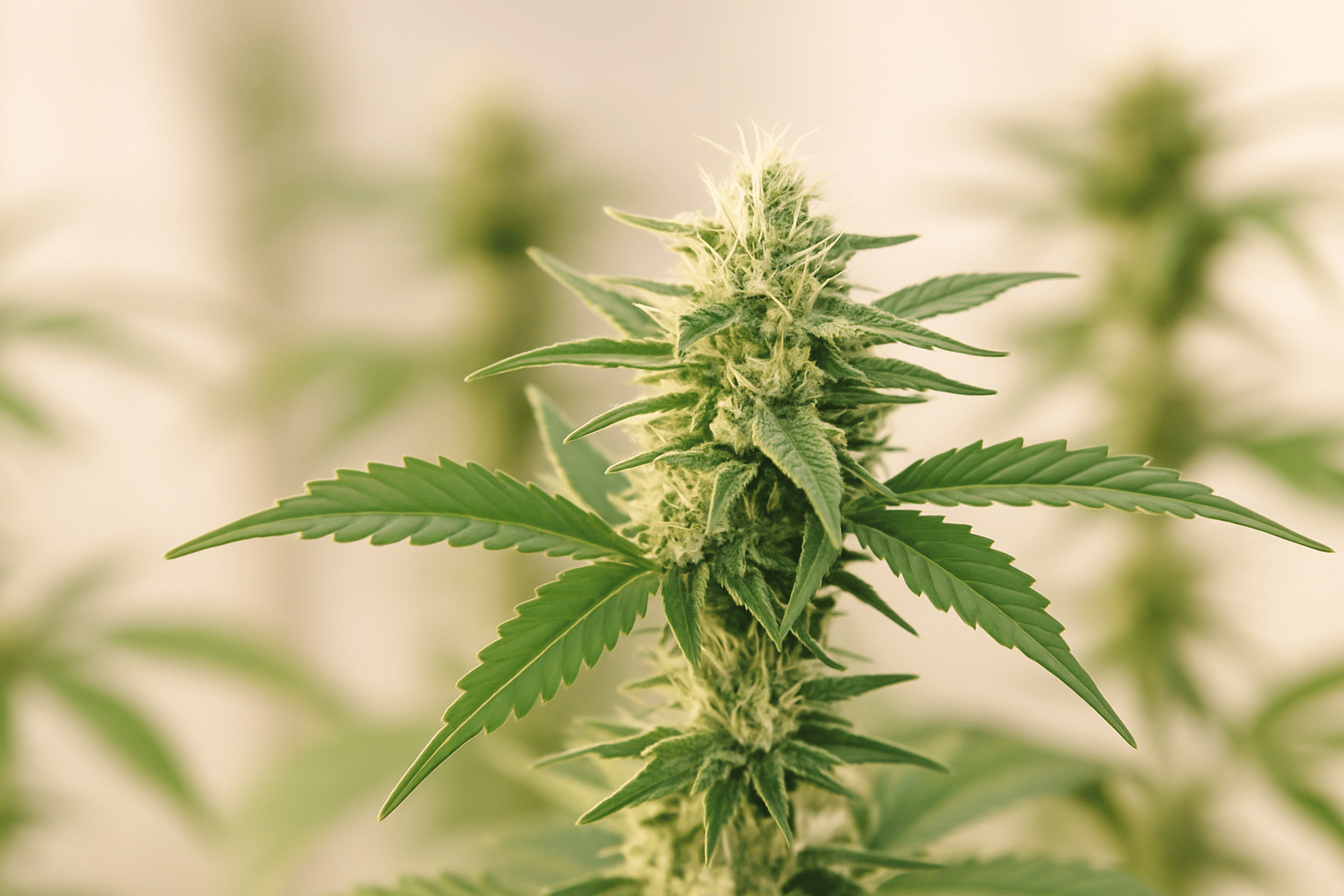
What Really Happens When You Top Cannabis
When topping, the plant’s shoot tip is deliberately removed, usually above a pair of nodes. This interrupts apical dominance—the natural priority of the main shoot. The plant responds by no longer sending energy almost exclusively into one central head bud, but distributing it more strongly to lateral shoots. In practice, this usually creates two new main shoots, often accompanied by stronger side growth below.
From our experience, this is exactly the key point: topping is not a “yield shortcut,” but a method for controlling plant architecture. Under good conditions, this leads to a more even canopy, better light use, and often more usable flowers at a similar height. Under poor conditions—such as weak light, stressed roots, or nutrient issues—topping can instead cost growth without delivering any real advantage.
Many growers confuse topping with general pruning. They are not the same. With topping, you are specifically intervening in the plant’s hormonal growth pattern. With normal pruning, you are more likely removing disruptive, weak, or unnecessary plant parts. If you clearly understand the differences, it becomes easier to decide whether topping is even the right technique for your grow. You can also find a broader overview of pruning measures in our article How to Prune Cannabis Properly: Timing & Instructions.
When Topping Makes Sense—and When It Doesn’t
Topping is especially worthwhile for photoperiod plants in the vegetative stage, when there is enough time for recovery and shaping. It is particularly useful for genetics that stretch heavily, for indoor grows with limited height, and anywhere you want to build a flat, even canopy. In our day-to-day grow work, we have found that topping often delivers the greatest benefit when the plant is going to be trained anyway—for example in combination with LST, mainlining, or a screen.
Topping is less useful for plants that are already visibly stressed. This includes specimens with overwatering, root problems, pest pressure, calcium deficiency, severe heat stress, or very slow development. If you cut in this condition, you force the plant into a repair response even though it is already dealing with underlying problems. One common mistake we see again and again: growers top out of routine even though the plant first needs stability. Especially after repotting, it is often worth waiting 3 to 5 days until active growth is visible again.
With autoflowering varieties, topping is only recommended to a very limited extent. The reason is simple: autos have a fixed, short vegetative window. Every growth pause directly costs potential flower mass because the plant cannot regenerate indefinitely. Very experienced growers top some vigorous autos early and successfully, but for most setups, gentle tie-down training is the safer method. Anyone working with clones or photoperiod plants has much more flexibility. You can find more on overall plant development in the article Cannabis Growth Stages: A Guide to Every Phase.
The Right Time to Top
The best time is generally between the 4th and 6th true node, when the plant is growing vigorously, is a rich green color, and is visibly gaining size every day. We have usually seen the best results in plants that have already built a well-developed root system and are no longer in the sensitive seedling stage. Topping too early slows small plants unnecessarily. Topping too late often means the main shoot is already too dominant and the plant has already stretched upward in an unfavorable way.
Indoors, timing is usually easier to control because temperature, light, and irrigation are more consistent. If conditions remain stable at around 24 to 28 °C during the day, 20 to 24 °C at night, and moderate humidity of about 60 to 70% in early vegetation, plants recover much faster. Light intensity also plays a role: under weak light, plants stretch more and react more sensitively to interventions. If you want to optimize your setup, our guide Cannabis Lighting: Which Grow Light Really Fits and How to Use Light Strategically for Higher Yields will help.
Outdoors and in the greenhouse, timing depends much more on the weather. We would not top before a cold, wet, or windy period. Fresh cut sites and slowed growth are simply riskier under unstable climate conditions. In protected environments, this can be controlled better, which is why topping often works more smoothly in sheltered cultivation. Our article Growing Cannabis in a Greenhouse: Climate, Protection, and Strong Harvests Under Controlled Conditions also fits well here.
How to Top Cannabis Cleanly and Safely
You do not need complicated equipment for a clean cut, but you do need precision. A sharp, disinfected pair of scissors or fine pruning shears works best. Some growers pinch off the tip with their fingers. That can work, but it more often leads to crushed tissue and uneven wounds. We clearly recommend using a clean tool that is disinfected before every use with isopropanol or another suitable disinfectant.
The cut is made above a healthy pair of nodes. Leave a small piece of stem above the node instead of cutting flush directly into the branching point. This small “stub” reduces the risk of the area splitting as it dries or damaging the node below. Especially with vigorous, juicy plants, this is a detail that makes a big difference in practice. If you cut too low, the branching may emerge asymmetrically or weakened.
- Check the plant: only top if it is vigorous, green, and actively growing.
- Disinfect the tool and let it dry.
- Select the 4th to 6th node.
- Cleanly remove the shoot tip just above the desired node.
- Then keep the plant as stress-free as possible for 24 to 72 hours: no major climate changes and no hard training immediately afterward.
After the cut, we usually observe a visible response within 2 to 5 days. The two upper side shoots then take over leadership. Depending on genetics, root space, and climate, the plant is often fully “recovered” after 5 to 10 days. In very vigorous systems, such as well-established coco with clean irrigation and stable nutrition, it can happen faster. In soil with heavy, wet pots, it usually takes longer.
Topping, FIM, LST, and Defoliation Compared
Topping is only one of several techniques used to influence shape and yield. Looking at it in isolation means wasting potential. In our experience, topping delivers especially good results when it is part of an overall strategy. A single topped main shoot does not create a perfect canopy on its own. Only through subsequent tie-down training, even shoot positioning, and, if necessary, selective removal of obstructive leaves does the plant become a truly productive structure.
FIM (“Fuck, I missed”) is a less precise variation in which the entire tip is not removed. This can produce three to four new shoots, but sometimes only deformed or uneven growth. We see FIM more as a technique for experimental growers. If you want reproducible results, classic topping is usually the better choice. LST, on the other hand, is much gentler because no tissue is removed. However, it requires more time and regular adjustment.
| Method | Goal | Stress Level | Suitable For | Typical Strength |
|---|---|---|---|---|
| Topping | Break apical dominance | Medium | Photoperiod plants | Even canopy, 2 main shoots |
| FIM | Create multiple new tops | Medium | Experienced growers | Potential for 3–4 shoots, but more variable |
| LST | Redirect shoots without cutting | Low | Almost all plants, including many autos | More light on side shoots |
| Defoliation | Improve light and airflow inside | Low to medium | Dense plant canopies | Better ventilation, less shade |
We often see misunderstandings especially with defoliation. Many growers remove too many leaves in a short time and then wonder why growth slows down. Leaves are not decoration—they are energy suppliers. If you also defoliate after topping, do it moderately and with a clear purpose. You can read more in Defoliating Cannabis: When It Makes Sense, How to Do It Properly, and Which Mistakes Cost Yield.
What Determines Success or Failure After Topping
The cut itself takes seconds. What matters are the days afterward. After topping, plants above all need stable conditions. During this phase, we like to keep the root zone evenly moist, but never wet. Overwatering is one of the most common mistakes after cutting measures. The plant often takes up slightly less water in the short term because above-ground growth is being reorganized. If you keep watering according to the old pattern, you risk oxygen deficiency in the root zone. If you want to review your watering habits, our article How to Water Cannabis Properly: Mastering Water, Rhythm, and Common Mistakes will help.
Nutrition should also not be increased reflexively. A fresh cut is not a signal for an extra dose of fertilizer. On the contrary, EC values that are too high directly after topping tend to intensify stress rather than help. In soil, many plants do well continuing with an unchanged, moderate feeding level. In coco or hydro, we pay particular attention to stable pH and EC values instead of giving “boosts.” As a rough guideline, many veg setups in coco run at pH 5.8 to 6.0, while in soil it is more around 6.2 to 6.6. If you want to go deeper into this, you will find background information in Fertilizing Cannabis: Nutrients, Dosage, and Common Mistakes Under Control.
Air movement after topping should be gentle, but present. Fresh cut sites do not like stagnant, humid air. At the same time, you do not want a strong fan pointed directly at the plant, because that causes additional drying and mechanical stress. Light air exchange, stable temperatures, and clean hygiene do far more here than any miracle product from a bottle.
Common Mistakes When Topping Cannabis
The most common mistake is poor timing. Topping plants that are too small just because they have four nodes is not automatically sensible. Node count alone is not enough as a criterion. What matters is whether the plant is truly growing strongly. A compact, dark green young plant with an active root zone handles the intervention well. A pale, stretched plant with slow development usually does not. In our experience, you save more yield by skipping topping once than by cutting a weak plant “by the book.”
Another mistake is using unclean tools. Especially in rooms with many plants, mother plants, and clones, a non-disinfected cut can mechanically spread pathogens or viruses. Anyone who regularly cuts plants should treat hygiene discipline as a fixed workflow—not as an optional precaution. This is especially true when working with clones or when plants from different sources are kept in the same room.
Overtraining is just as problematic. Some growers top, tie down heavily at the same time, defoliate aggressively, and repot on the same day. Each individual measure can make sense—but the full combination at once is often too much. We prefer to stagger interventions. A practical example: first top, then allow 3 to 5 days of recovery, then apply gentle LST, and later, if needed, selective defoliation. This keeps the plant moving forward instead of repeatedly falling into repair phases.
How Often Can You Top Cannabis?
Photoperiod plants can be topped multiple times as long as they are healthy and have enough vegetative time. Topping once usually creates two strong main shoots. If you top those again later, you can build four dominant tops. In longer veg phases, eight or more main shoots are also possible if pot size, light output, and climate support it. However, we often see that more is not automatically better. Too many tops on too small a plant tend to create competition, shade, and smaller individual flowers.
Whether multiple topping makes sense depends heavily on the setup. In a small tent with limited floor space, four to eight even tops are often ideal. In a Sea of Green approach with many small plants, multiple topping usually offers little benefit because the focus there is more on short veg time and fast canopy filling. In a Screen of Green, on the other hand, repeated topping is often very effective because you can deliberately fill the area with shoots of equal height.
Our rule of thumb: only top again once the plant has visibly regained momentum after the last cut and the new shoots are strong enough. If you cut again too quickly out of impatience, you are more likely to create delay than structure. In many setups, around 7 to 14 days between topping events makes sense, depending on growth speed.
Special Considerations for Clones, Mother Plants, and Outdoor Grows
Clones often react somewhat differently than plants grown from seed. Since they no longer go through a juvenile seedling phase, they can be trained earlier if rooting is good. Even so, the same rule applies here: only top once the clone is actively growing and the root system has colonized the pot. We generally do not cut freshly arrived or newly repotted clones immediately. Only when new leaf mass is visibly coming in is the right moment there. Anyone working with clones can find additional basics in our article Growing Cannabis Clones Successfully: The Guide from Arrival to Harvest.
For mother plants, topping is a central tool for maintaining a bushy structure that is easy to cut from. Here, the goal is less flower yield and more many healthy, even side shoots for future clones. In practice, mother plants are topped regularly and kept in shape so they do not become woody or develop only a few dominant tops. Very clean hygiene is important here because mother plants remain in the crop for long periods.
Outdoors, the benefit depends heavily on season length, genetics, and location. In long summers with vigorous photoperiod plants, topping can work very well and make the plant more wind-stable and broader. In short seasons or harsh locations, however, the lost time can weigh more heavily. Especially in rainy regions, we make sure topped plants do not become too dense later on. Otherwise, the risk of poor airflow and mold during flowering increases.
How to Tell That Topping Was Successful
A successful topping cut is not shown only by the fact that “two new tops” appear. More important is how evenly the plant grows afterward. Good signs are symmetrical new growth, short internodes, healthy leaf color, and a visibly broader canopy. If the two upper side shoots take over leadership within a few days and the branches below also become more active, the plant has successfully shifted its energy distribution.
Warning signs, on the other hand, include twisted new growth, very slow recovery, limp leaf posture over several days, or a clear slowdown of the entire crop compared with untopped plants under the same conditions. In that case, it is worth not fixating on the cut itself, but checking the basics: root health, VPD, light distance, watering rhythm, EC, pH, and possible pests. Topping often exposes weaknesses in the setup mercilessly—and that is exactly why it is also a good learning technique for growers who really want to understand their system.
If you work cleanly, choose the right timing, and then give the plant stable conditions, topping is one of the most effective methods for bringing cannabis into shape in a controlled way. Not every plant needs to be topped. But when the genetics, vegetative time, and setup are right, the difference in structure and light distribution is often clearly visible—and that is exactly where the later value in flowering is created.
Sources
- Cervantes, Jorge – “Marijuana Horticulture: The Indoor/Outdoor Medical Grower’s Bible”, 2015
- Rosenthal, Ed – “Marijuana Grower’s Handbook”, 2021
- Caplan, David – “Cannabis cultivation science and management”, 2018
- Bugbee, Bruce – “Cannabis Physiology and Production Practices”, 2021

About the Author – Hannah
Hannah focuses on researching, contextualizing, and observing current developments in plant care and modern cultivation techniques. Her focus lies on new methods, optimizing growth conditions, and making complex topics accessible. Her content complements practical experience with analysis, updates, and a keen eye on emerging trends.
Content is regularly reviewed and updated.
This article was created with AI support and editorially reviewed.
More about the team behind LeafConnect