What Cannabis Sugar Leaves Actually Are
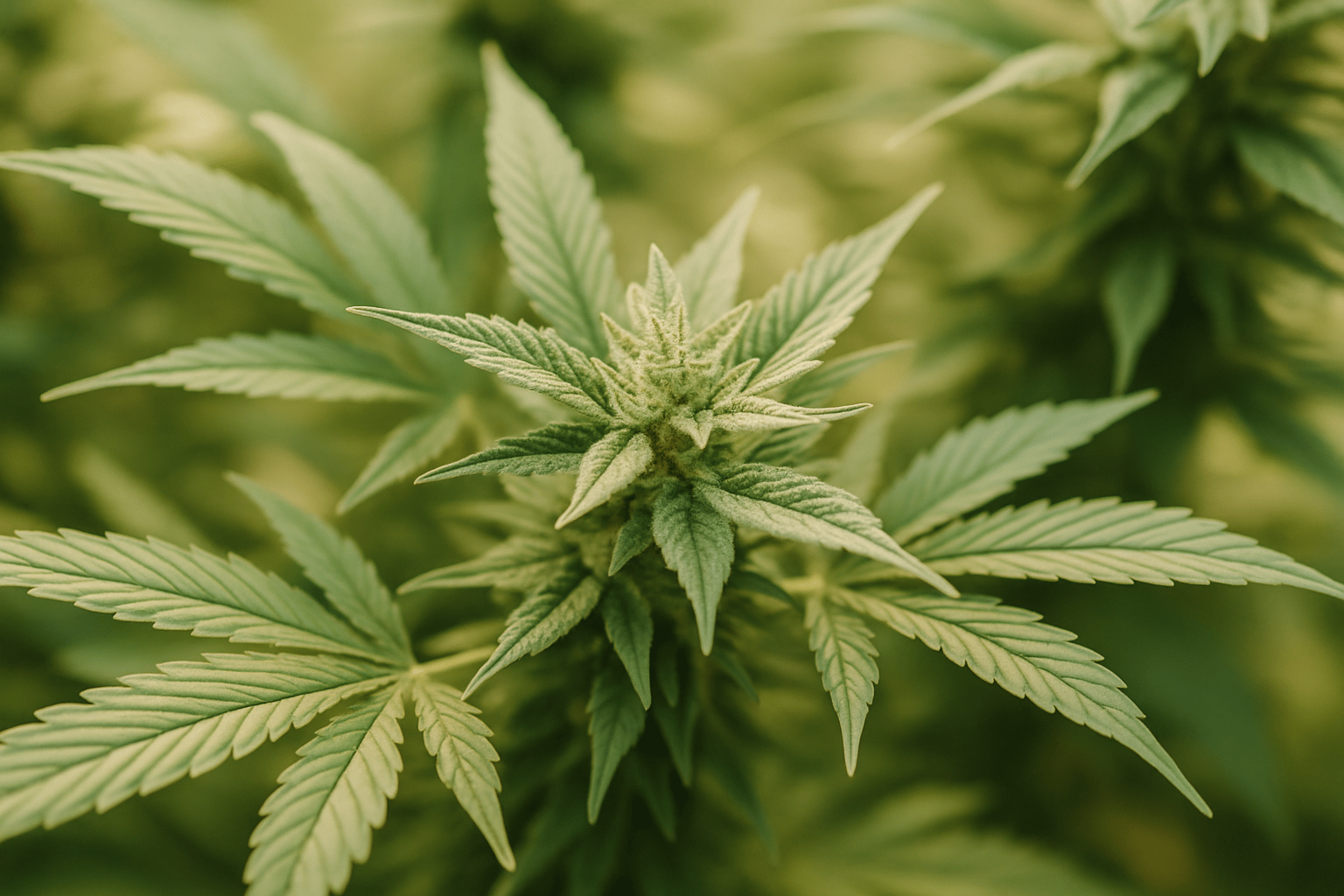
Sugar leaves are the small, resin-covered leaves that grow directly out of the flower sites. Unlike the large fan leaves, they sit tightly against the bud sites, protrude between the calyxes, and are often recognizable even to the naked eye by their glittering surface. This very “sugary” look is what gave them their name. In practice, sugar leaves are a transitional zone between leaf and floral tissue: they still perform classic leaf functions while also being very close to the reproductive part of the plant.
In our experience, beginners often misclassify sugar leaves. Many either consider them unimportant secondary foliage or confuse them with young fan leaves. Both lead to poor decisions when defoliating or pruning. Sugar leaves are not waste material that should be removed as early as possible. They are actively involved in photosynthesis, nutrient transport, and the flower’s microclimate. Especially in the mid and late flowering phase, it becomes very clear how strongly the plant integrates these small leaves into supporting the flowers.
If you want to read the plant more accurately, you should observe sugar leaves closely. They often react earlier than the large leaves to overfeeding, salt stress, heat spikes, or overly dry air. Discoloration on sugar leaves is therefore not automatically a sign of ripeness or a “normal fade.” Very often, it indicates that something has become unbalanced in the root zone, nutrient uptake, or flower climate.
If you want to better understand the plant’s basic structure, it is also worth taking a look at the anatomy of the cannabis plant. There it becomes clear why sugar leaves are so closely linked to flower development.
The Difference Between Sugar Leaves, Fan Leaves, and Floral Tissue
In day-to-day growing, making a clean distinction is important because each plant structure should be handled differently. Fan leaves are the plant’s large solar panels. They sit on longer petioles, capture light efficiently, and regulate a large part of transpiration. Sugar leaves are smaller, much more compact, and grow directly out of the flower. Floral tissue itself consists mainly of calyxes, pistils, and the resin glands between them.
A common mistake we keep seeing: growers cut away sugar leaves during flowering because they believe it will “bring more air to the flower.” In individual cases, this can make sense with very dense genetics, but it is necessary far less often than many think. Unlike large, shading fan leaves, sugar leaves are part of the immediate flower architecture. If you cut them too early or too aggressively, you damage the zone where the plant is currently working most intensively.
In practical terms, the difference can be identified like this: fan leaves usually have a longer stem and sit clearly outside the flower mass. Sugar leaves are short-stemmed or nearly sessile, often partially covered with resin glands, and protrude from the buds. Floral tissue itself is denser, softer, and forms the actual structure of the flower. If you are unsure while pruning, it is better to skip a pass than to remove unnecessary tissue late in flowering.
| Structure | Typical Position | Main Function | Grow Practice |
|---|---|---|---|
| Fan leaves | Outside the flower zone | Light capture, transpiration | Targeted defoliation possible |
| Sugar leaves | Directly in the flower | Local support, protection, photosynthesis | Remove only very sparingly |
| Floral tissue | Core of the buds | Reproductive structure | Do not injure, monitor climate |
What Function Sugar Leaves Serve During Flowering
Sugar leaves are not merely decorative. They help the plant provide energy directly where it is especially needed during flowering. Especially under indoor conditions with limited light penetration, these small leaves take on a local photosynthesis function. That may sound theoretical, but it is relevant in practice: in dense flower zones where large fan leaves allow little light through, sugar leaves often remain the last actively illuminated leaf surfaces within the bud structure.
There is also their protective function. Sugar leaves surround the flower, buffer light mechanical stress, and influence the microclimate between the calyxes. In healthy plants, they neither lie completely flat nor stick out unnaturally. Both can provide clues: heavily curled sugar leaves often indicate heat or light stress, while very limp sugar leaves point more toward watering issues or root pressure.
In our experience, sugar leaves are also a good early indicator of problems in late flowering. If their tips burn first, it is often a sign of EC levels that are too high or an imbalanced ratio of potassium, calcium, and magnesium. If they become blotchy, it is worth checking pH and root health. In soil, nutrient uptake during flowering is usually stable at around pH 6.2 to 6.7; in coco, more around 5.8 to 6.2. If you deviate from that consistently, the small leaves often show symptoms earlier than the large ones.
You can find more on managing this phase in our article on the cannabis flowering phase. This is exactly where it is decided whether sugar leaves stay healthy or become a warning signal.
How Sugar Leaves Respond to Climate, Light, and Nutrients
Anyone who has cultivated long enough learns this: sugar leaves speak their own language. When leaf surface temperature is too high, their edges often curl upward, the tips appear dry, and the resin layer looks duller. This is seen especially often under LEDs set too close. In many indoor setups, a sensible daytime range during flowering is around 24 to 28 °C. Directly under intense lamps, however, the leaf surface can become noticeably warmer than the measured room air. That is exactly when sugar leaves show stress first.
Humidity also plays a major role. In early flowering, 50 to 60% relative humidity is often still manageable; in late flowering, experienced growers usually run lower, more in the 40 to 50% range, depending on genetics, flower density, and air movement. Why? Sugar leaves sit deep within the flower structure. If moisture lingers there, the risk of rot and mold increases significantly. Especially with compact flowers, it is not the room reading alone that matters, but the air circulation directly within the plant zone.
On the nutrient side, sugar leaves react sensitively to overfeeding. Dark green, glossy, slightly clawed sugar leaves are often a classic sign of too much nitrogen at a stage when the plant should actually be prioritizing other things. Late nitrogen excess not only slows the clean maturation of plant tissue, but also often makes the flower structure denser and wetter. That is one of the reasons why balanced bloom nutrition is more important than “more feed.”
If you want to fine-tune water and nutrient management, these in-depth articles will help: watering cannabis properly and fertilizing cannabis. Many sugar leaf problems do not start up in the flower, but down in the pot.
When Sugar Leaves Indicate Problems
Not every change is dramatic, but sugar leaves show very reliably whether the plant is in balance. Burnt leaf tips usually indicate salt concentration that is too high. Dry, papery edges point more toward heat, wind stress, or a combination of high light intensity and humidity that is too low. If sugar leaves become blotchy, marbled, or rusty, you should think about pH deviations, calcium issues, or root pressure.
It is especially important to look inside dense flowers. If sugar leaves suddenly wilt locally, turn brown, or can be pulled out unusually easily, caution is required. This can indicate the onset of Botrytis, especially if the rest of the plant still appears normal at first. In our experience, this exact “one strange sugar leaf” is often the first visible signal, long before the entire flower becomes conspicuous. In that case, the affected area should be checked carefully immediately, rather than simply continuing to water as before.
Pests also leave traces on sugar leaves, although more subtly than on fan leaves. Thrips, mites, or broad mites cause fine deformities, dull surfaces, or irregular discoloration. Because sugar leaves sit so close to the flower, any treatment is delicate. That is why prevention is far more important here than late correction. Good hygiene, stable climate values, and regular visual inspections with a loupe are much more valuable during flowering than frantic measures once a problem appears.
If you suspect rot or mold, our technical article on Botrytis in cannabis is worth reading. Anyone who recognizes it too late often loses more plant mass than from any nutrient mistake.
Should You Remove Sugar Leaves During the Grow?
The short practical answer is: usually no. During an active grow, sugar leaves should only be removed if they are clearly dead, diseased, or acutely problematic. Healthy sugar leaves serve a function, and losing them early rarely brings an advantage. Many growers overestimate the benefit of “clean-looking” flowers and underestimate how much any cutting measure stresses the plant during flowering.
It is different with individual leaves that trap moisture deep inside, are visibly damaged, or already show necrotic tissue. Such leaves can be removed selectively and cleanly. The important thing is not to tear into the flower structure. We recommend fine, disinfected scissors and careful handwork instead of rough plucking. Any open wound in dense flower mass is a potential entry point for problems.
A widespread misconception is that more light in the bud is automatically better. In reality, excessive cutting during flowering often leads to stress, uneven plant response, and unnecessary delays in development. If anything, larger corrections should be made earlier, through targeted defoliation and plant training before or at the beginning of flowering. Our article on defoliating cannabis fits here, because that is where the real leverage lies, not in cutting away sugar leaves late.
Sugar Leaves as a Ripeness Indicator: Helpful, but Not Decisive on Their Own
Many growers watch sugar leaves to estimate the right harvest time. That makes sense, but only in combination with other traits. Sugar leaves often discolor earlier than fan leaves in late flowering, especially with genetically driven autumn colors or natural nutrient mobilization. That alone does not mean the plant is ready. Anyone who goes by leaf color alone often harvests too early.
More important is the combination of flower development, pistil behavior, overall plant condition, and the maturity of the resin glands. Sugar leaves also carry trichomes, but these often mature somewhat differently from the trichomes directly on the calyxes. A typical beginner mistake is to look only at the resin glands on the sugar leaves and infer the overall condition from that. That can be misleading because leaf trichomes react more quickly to environmental stress and do not always represent the interior of the flower.
In our experience, a loupe with 30x to 60x magnification delivers the best results when you specifically check the trichomes on the calyxes and assess sugar leaves only as a supplement. If sugar leaves recede strongly, discolor, and at the same time the flower appears compact and mature, that is a coherent overall picture. Viewed in isolation, however, they are not a reliable standalone indicator.
For an overall view of harvest timing and flower maturity, our article on harvesting cannabis is also helpful, because it clearly distinguishes the practical signs from one another.
Typical Mistakes When Handling Sugar Leaves
The most common mistake is overreacting. As soon as sugar leaves become resinous, many growers want to “optimize” and cut too much. That often causes more problems than benefits. Healthy sugar leaves should not be removed for aesthetic reasons. The plant does not build them directly onto the flower for no reason.
Mistake number two is misdiagnosis. Discolored sugar leaves are often interpreted across the board as a deficiency, even though the cause could just as easily be overfeeding, root stress, or climate. If more fertilizer is then added, the problem gets worse. We always recommend checking the overall picture first: pot weight, watering rhythm, EC, pH, temperature at the leaf surface, humidity in the flower zone, and air movement. Only then should you change anything in the nutrient solution.
The third major mistake is poor hygiene. Sugar leaves sit deep in the buds. If you work there with unwashed hands, dull scissors, or after contact with diseased plants, you introduce problems directly into sensitive tissue. Especially with densely flowering plants, clean work is not a detail, but a requirement. Anyone who prunes regularly should disinfect tools with alcohol and avoid working on plants directly after watering or when humidity is very high.
What Experienced Growers Pay Special Attention to in Sugar Leaves
With some experience, sugar leaves become a very fine diagnostic tool. We pay attention above all to three things: leaf posture, surface appearance, and speed of change. If the sugar leaves stand slightly upright and look taut, that is usually a good sign. If they suddenly hang limp even though the substrate is still moist, we immediately check the root zone and oxygen supply. If they change significantly within 24 to 48 hours, there is almost always an acute stress factor behind it.
The surface appearance also reveals a lot. An even, healthy resin layer on intact sugar leaves speaks for a stable climate. Dull, dusty-looking surfaces or restless, uneven leaf color are things we often see with VPD issues, nutrient imbalances, or the onset of pest pressure. Especially in indoor cultivation, it is worth not only reading hygrometers on the wall, but also checking measurements at flower height.
Outdoors and in the greenhouse, we observe sugar leaves somewhat differently. There, dew, morning moisture, wind, and temperature swings play a greater role. Sugar leaves that remain wet for hours significantly increase the risk of problems in dense flowers. That is why plant architecture is even more important outdoors than indoors. Good air movement through spacing, thinning at the right time, and a sheltered but not stuffy location often make the difference.
If you grow under natural conditions, you will find more in-depth practical information in growing cannabis in the garden and growing cannabis in the greenhouse. Especially there, the microclimate around the flower determines whether sugar leaves stay healthy.
Sources
- Robert C. Clarke, Mark D. Merlin – “Cannabis: Evolution and Ethnobotany”, 2013
- Jorge Cervantes – “Marijuana Horticulture: The Indoor/Outdoor Medical Grower’s Bible”, 2015
- Ed Rosenthal – “Marijuana Grower’s Handbook”, 2021
- Bruce Bugbee – “Cannabis Plant Science and Cultivation”, 2021

About the Author – Hannah
Hannah focuses on researching, contextualizing, and observing current developments in plant care and modern cultivation techniques. Her focus lies on new methods, optimizing growth conditions, and making complex topics accessible. Her content complements practical experience with analysis, updates, and a keen eye on emerging trends.
Content is regularly reviewed and updated.
This article was created with AI support and editorially reviewed.
More about the team behind LeafConnect