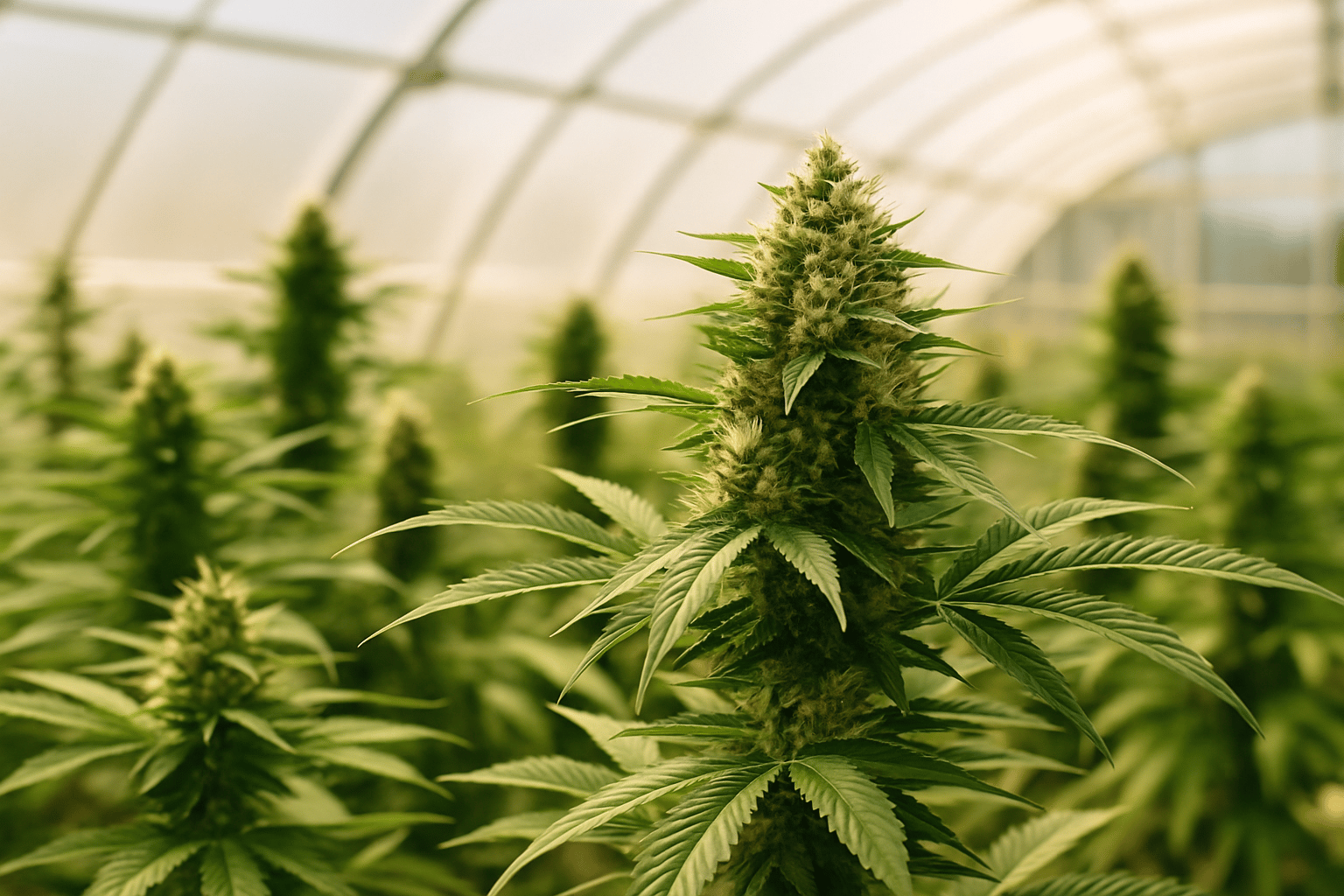
Why a Greenhouse Is So Interesting for Cannabis
Greenhouse cultivation sits right between classic outdoor growing and fully controlled indoor production. In our experience, that is one of the biggest advantages of all: you use free sunlight while also protecting the plants from some of the weather extremes, prolonged rain, hail, cold nights, and prying eyes. Especially in Central Europe, that is often the difference between a problematic late-summer flowering period and a truly mature, clean harvest.
Many growers underestimate how strongly a greenhouse changes the microclimate. Even a simple polytunnel can run 5 to 15 °C above outdoor temperature during the day. That significantly accelerates vegetative growth, but it can quickly become a problem in flowering if there is no active ventilation. Cannabis loves fresh air, stable root conditions, and dry flower surfaces. A greenhouse provides good conditions, but only if temperature, humidity, and air exchange are managed deliberately.
Another point is season extension. In practice, we often see that cuttings or young plants establish themselves safely earlier in a greenhouse than in an open garden. Later in the year, the structure protects against cold wind and wet nights. Anyone combining robust genetics with a well-managed greenhouse can noticeably improve yield and quality. For the basics of protected cultivation, our article Growing Cannabis in a Greenhouse is also worth reading.
The Right Location and the Right Greenhouse
The best greenhouse grow does not begin with fertilizer or training, but with the location. Ideally, choose a spot with maximum sun exposure from morning to evening. Morning sun is especially important because it dries off dew and surface moisture early. That is exactly what reduces pressure from fungal diseases. A partially shaded location may seem more pleasant in midsummer, but it usually costs flower mass and ripeness.
When it comes to the greenhouse itself, function matters more than luxury. In our experience, cannabis plants mainly need height, air volume, and large ventilation areas. Small, low structures heat up extremely quickly and are difficult to control. Better options are models with roof vents, side openings, and at least 2 m of height so warm air can escape upward. Polycarbonate insulates better than simple film, while polytunnels are cheaper and quick to set up. Both systems work if ventilation is right.
The ground beneath the greenhouse also matters. Plants set directly into the soil often develop the strongest root systems, as long as drainage and soil structure are suitable. On heavy, wet soils, we recommend raised beds or large fabric pots with 30 to 50 liters, and even more for long seasons. Waterlogging in a greenhouse is one of the most common mistakes because evaporation behaves differently inside than it does outdoors. If you work with substrates, you will find more in-depth information in The Best Substrates for Cannabis.
Keeping Climate Under Control: Temperature, Humidity, and Air Movement
When greenhouse cultivation fails, it is rarely because of light and very often because of climate. For the vegetative phase, around 22 to 30 °C during the day works well, while 16 to 20 °C at night is usually unproblematic. In flowering, we try to avoid peaks above 30 to 32 °C whenever possible, especially with dense plant structure. Excessive temperatures do not just slow photosynthesis, they also make flowers looser and increase water stress. It becomes especially critical when heat and high humidity occur together.
For relative humidity, a rough target range of 60 to 70% for young plants, 50 to 60% in vigorous vegetative growth, and 40 to 50% in late flowering has proven effective in practice. These are not rigid numbers, but good guidelines. The key is that flowers must not remain damp for hours. Morning condensation on the inside of the greenhouse is a warning sign: if water is running down the film or panes, the air is too humid at night and air exchange is too low.
Air movement is the underestimated key. In many setups, an open roof vent alone is not enough. We have had good results with circulation fans that do not blow directly onto the plants, but keep the air moving throughout the space. In addition, warm air should be able to escape upward actively or passively. The goal is not draft, but an even climate without stagnant pockets of moisture between the flowers. Botrytis in particular often does not begin at the visibly wettest spot, but deep inside the dense interior of the plant.
| Stage | Day Temperature | Night Temperature | Relative Humidity | Practical Note |
|---|---|---|---|---|
| Young plants | 22–26 °C | 18–20 °C | 60–70 % | Gentle acclimatization, no heat spikes |
| Vegetative growth | 24–30 °C | 16–20 °C | 50–60 % | Strong ventilation for compact growth |
| Early flowering | 22–28 °C | 16–19 °C | 45–55 % | Thin out the interior, monitor humidity |
| Late flowering | 20–26 °C | 15–18 °C | 40–50 % | Mold prevention takes priority |
Cultivar Selection: What Really Works in a Greenhouse
Not every genetic line is equally well suited to a greenhouse. One common mistake is simply choosing the highest-yielding or most exotic cultivar. In Central European greenhouses, mold resistance, flowering speed, internodal spacing, and response to humidity are often more important than pure lab values or marketing promises. Very late-flowering, extremely dense cultivars can become problematic in autumn despite having a roof overhead if the nights are damp and cool.
In our experience, medium-sized to vigorous hybrids with good lateral branching perform especially well. They use diffuse greenhouse light efficiently, can be trained, and remain well ventilated with proper care. For cooler regions or simple film structures, fast, robust cultivars are usually the safer choice. If you want to play it safe, look specifically for genetics described as suitable for outdoor or greenhouse cultivation. Our overview The Best Cannabis Strains for Outdoor Growing in Germany also fits well here.
The question of seeds or cuttings is also relevant in a greenhouse. Cuttings provide a more uniform crop, which makes climate and height management much easier. Seed-grown plants show more variation, but they are often somewhat more adaptable in root development. If you want to work predictably, healthy, vigorous clones are a real advantage. However, origin matters: only clean, strong material delivers the desired uniformity. For that, we recommend Growing Cannabis Cuttings Successfully.
Substrate, Irrigation, and Fertilization Under Greenhouse Conditions
In a greenhouse, plants drink differently than they do outdoors. The air is often warmer, wind is weaker, and transpiration through the leaf can temporarily decline despite high heat when humidity rises. This leads many growers to react incorrectly: they water too often in small amounts. That is exactly what keeps the root zone permanently wet, deprives it of oxygen, and paradoxically makes the plant look limp despite a wet pot. We get better results with clear watering cycles and full saturation, followed by a sensible drying phase.
In soil, a workable pH range is usually around 6.2 to 6.8, while in coco it is more like 5.8 to 6.2. Consistency is what matters. In a greenhouse, nutrient problems often show up faster because heat changes uptake and vigorous growth demands high amounts of calcium, magnesium, and potassium. Especially with soft water or heavily pre-fertilized substrates that later become depleted, we regularly see calcium-magnesium issues. If you notice spotted young leaves or unstable cell structure, do not blindly add more base fertilizer; check water values and pH first.
When it comes to fertilization, the rule is: manage cleanly rather than pushing aggressively. Sunlight can deliver enormous performance, but only if the roots can keep up. Excessively high EC values during hot periods increase the risk of salt stress. In practice, a moderate, continuous nutrient build-up usually works better than abrupt jumps. For more in-depth basics, we recommend Watering Cannabis Properly and Fertilizing Cannabis. Both topics are even more important in a greenhouse because small mistakes become visible faster under a dynamic climate.
Plant Training and Pruning for More Light and Less Mold
A greenhouse rewards open plant structures. While wind outdoors often handles part of the ventilation, in a greenhouse you have to shape plants more actively. In our experience, topping, gentle LST, and targeted thinning deliver far more than chasing maximum height. A broad, even canopy uses light better, keeps plants manageable, and reduces shady, damp zones inside.
Removing weak, lower shoots that will never become productive is especially important. These areas consume energy, block airflow, and often end up producing only small, vulnerable flowers. At the same time, you should not defoliate radically. Removing too much leaf mass at once means stress, especially if heat follows immediately afterward. Several moderate interventions over the course of the season are better. One common mistake is late, aggressive thinning in the middle of advanced flowering. At that point, you are creating wounds during a phase when the plant needs stability more than anything.
In practice, it has proven effective to keep the lower area clean up to about the first third of the plant and to remove only enough leaf mass inside the canopy for air and light to pass through. If you are unsure, always start by removing individual leaves and clearly weak shoots instead of making major structural decisions in a single day. You can find more on this in Defoliating Cannabis and Pruning Cannabis Properly.
Detecting Pests and Diseases Early in the Greenhouse
The greenhouse protects against many things, but it also creates ideal conditions for certain problems. Spider mites, thrips, aphids, whiteflies, and broad mites often feel very comfortable in warm, sheltered environments. The big difference from outdoor cultivation is that natural predators are rarer or less effective in a closed system. That is why a fixed inspection routine is worthwhile. We recommend checking leaves at least two to three times per week, especially at shoot tips and on leaf undersides.
When it comes to diseases, Botrytis is at the top of the risk list. Dense flowers, cool nights, high humidity, and little air movement are often enough. The tricky part is that gray mold frequently starts inside the cola and only becomes visible on the outside later. If individual sugar leaves suddenly protrude from the flower in a wilted state, inspect immediately. Infected sections must be removed generously. Anyone trying to cut away only the visible spot often leaves infected material behind. For a deeper look, we recommend Botrytis in Cannabis.
Prevention is far more effective in a greenhouse than reacting late. Cleanliness, quarantine for new plants, avoiding unnecessary entry with dirty shoes, regular removal of plant debris, and controlled airflow matter more than many products from the grow shop. A typical beginner mistake is only taking symptoms seriously once they appear across a wide area. In a greenhouse, by that point, you are often already several days too late.
Flowering Phase, Light Control, and Harvest Window
In a greenhouse, flowering in photoperiod plants is fundamentally triggered by day length, but the microclimate also determines how cleanly this phase progresses. Stretch in early flowering is normal, so the roof must not be too low. Anyone transplanting too late or allowing plants to grow unchecked for too long will quickly run into space problems later. We have often seen a seemingly moderate crop suddenly fill the entire volume within two to three weeks.
One interesting advantage of many greenhouses is the option of blackout or at least partial light control. With light-deprivation systems, flowering can be initiated earlier, which can be a real quality advantage in rainy regions. However, this only makes sense if blackout is absolutely reliable and carried out consistently every day. Irregularities easily lead to stress, delayed flowering, or, in the worst case, hermaphrodites. For many home growers, a natural seasonal window with suitable genetics is the lower-stress solution.
As for ripeness itself: do not rely only on calendar weeks. In a greenhouse, temperature patterns and light intensity can significantly influence development. Trichome inspection is mandatory. At the same time, you should factor in the weather situation. If several days of high humidity, fog, or cold snaps are forecast, harvesting slightly early while the crop is still healthy is often better than waiting for theoretically perfect ripeness and then risking mold. For details on the optimal cutting time, our article Harvesting Cannabis is a good fit.
Typical Mistakes When Growing Cannabis in a Greenhouse
In our view, the most common mistake is treating a greenhouse as “just easier outdoor growing with a roof.” That is exactly what it is not. A greenhouse is an active climate system. Anyone who does not ventilate, observe, and respond to weather changes will quickly create heat buildup, condensation, and disease pressure. Especially on sunny spring days, the temperature inside can rise above 35 °C in a short time even though it still feels pleasant outside.
Mistake number two is overly dense plant spacing. Many growers want to fill every square meter to the maximum, but cannabis in a greenhouse needs room to move. Spacing that is too tight makes inspection, maintenance, and air circulation more difficult. In the end, a looser plant stand often produces more marketable, healthy flowers than an overcrowded jungle. This is especially true for large-flowered cultivars with high final density.
Mistake number three is reacting too late to water and nutrient signals. Drooping leaves do not automatically mean thirst, burnt tips do not automatically mean “too much fertilizer,” and pale spots do not automatically mean pest infestation. In a greenhouse, causes often overlap: heat, high root pressure, salt buildup, pH drift, and humidity all interact. That is why it pays to check systematically instead of correcting impulsively. If you want to avoid general pitfalls, you will find more practical examples in Common Mistakes When Growing Cannabis Plants.
Sources
- Royal Queen Seeds – “Growing Cannabis in a Greenhouse: Pros, Cons, and Top Tips”, 2024
- Cervantes, Jorge – “Marijuana Horticulture: The Indoor/Outdoor Medical Grower’s Bible”, 2015
- Clarke, Robert C.; Merlin, Mark D. – “Cannabis: Evolution and Ethnobotany”, 2013
- University of California Agriculture and Natural Resources – “Integrated Pest Management Guidelines for Greenhouse Crops”, 2023

About the Author – Hannah
Hannah focuses on researching, contextualizing, and observing current developments in plant care and modern cultivation techniques. Her focus lies on new methods, optimizing growth conditions, and making complex topics accessible. Her content complements practical experience with analysis, updates, and a keen eye on emerging trends.
Content is regularly reviewed and updated.
This article was created with AI support and editorially reviewed.
More about the team behind LeafConnect