What Cannabis Main-Lining Really Is - and Why the Method Works So Well
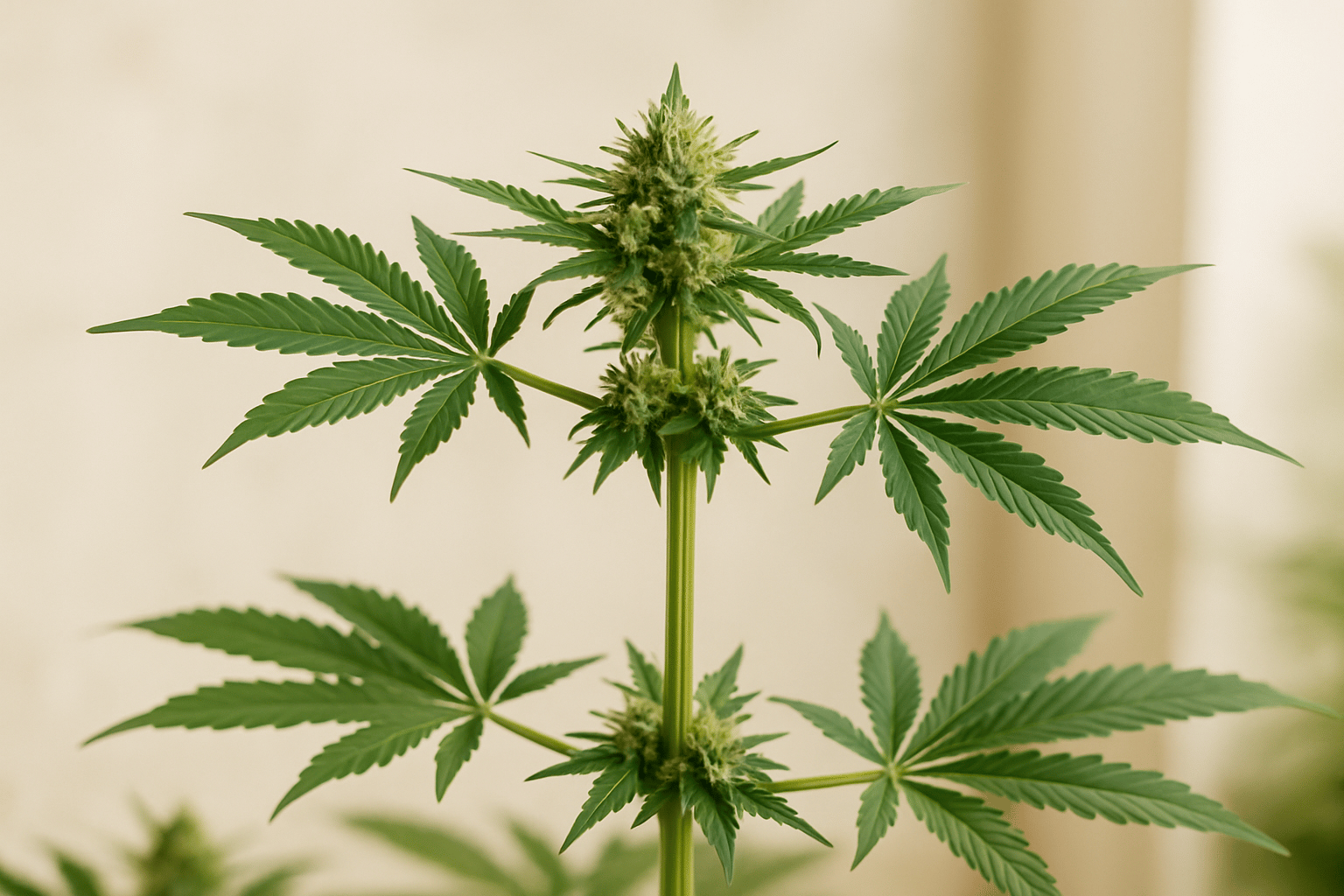
Main-lining is a training method in which you shape the plant early so that all main shoots emerge from one central, symmetrical node point. In practice, the technique combines hard pruning with targeted tie-down training. The goal is not simply “more tops,” but a plant with even sap flow, similar height across all main shoots, and a highly controlled canopy structure.
In our experience, that is exactly the real advantage: it is not the sheer number of bud sites that makes main-lining powerful, but the uniformity. When eight or sixteen main colas sit at a similar height, light can be used far more efficiently. Under LED, this is especially important because modern fixtures deliver high intensity, but an uneven canopy quickly leads to hotspots at the top and underdeveloped flowers lower down. If you want to understand lighting in more depth, the article Cannabis Lighting: Which Grow Light Really Fits and How to Use Light Strategically for Higher Yields is an excellent companion piece.
Main-lining is often confused with simple topping. The difference is crucial: with topping, you only remove the tip; with main-lining, you actively shape a new architecture. You remove lower side shoots, keep the structure symmetrical, and work in clear steps from 1 to 2, from 2 to 4, and from 4 to 8 main shoots. The result is a plant that can be controlled very precisely in small tents, dense indoor setups, and greenhouses alike.
That said, the method is not a cure-all. It costs vegetative time, requires clean timing, and is unsuitable for stressed, weak, or genetically unstable plants. With vigorous photoperiod plants, main-lining can deliver outstanding results. With autos, however, it is usually not a good idea because the narrow time window leaves little room for mistakes. For autoflowers, we recommend much more conservative interventions; you can read more in Effective Autoflowering Cultivation.
Which Plants and Setups Main-Lining Makes Sense For
Main-lining works best with healthy, vigorously growing photoperiod plants from stable genetics. It is especially suitable for plants that branch actively during the vegetative phase, form short internodes, and resume growth quickly after stress. We have usually seen the best results with clones or very uniform seed-grown plants because growth form and response are easier to predict. If you work with clones, it is worth reading Growing Cannabis Clones Successfully: The Guide from Arrival to Harvest.
Main-lining is particularly useful in grow tents with limited height. Instead of letting one dominant main cola grow into the lamp, you spread growth horizontally. This keeps the distance to the light manageable and makes better use of the tent’s floor area. In 80x80, 100x100, or 120x120 tents, that is a real advantage, especially if you prefer growing a few large plants instead of many small ones.
Main-lining can also be highly effective in a greenhouse if you have airflow and humidity under control. The open structure improves air movement through the plant, reducing the risk of damp microclimates inside the canopy. In late flowering weeks, that can help reduce mold pressure, but it does not replace proper climate control. For this area, Growing Cannabis in a Greenhouse: Climate, Protection, and Strong Yields Under Controlled Conditions is a useful addition.
The method is less suitable for plants already showing deficiency symptoms, root stress, or pest pressure. Every hard cut costs the plant energy. If calcium or boron, for example, are in short supply, new shoots often become unstable, branching remains weak, and regeneration takes significantly longer. Overwatered plants with a sluggish root zone are equally problematic. Main-lining is not a repair tool, but a technique for plants that are already healthy and actively growing.
The Right Timing: When You Should Start Main-Lining
The first intervention should only happen once the plant is truly established. In practice, that means at least 5 to 6 well-developed nodes, an active root system, and visible daily growth. With clones, we generally wait until they are clearly pushing vegetative growth again after rooting in and the leaf posture is upright. Cutting too early slows the plant unnecessarily and risks asymmetrical growth.
A common mistake is working by calendar days instead of vitality. Two plants can be completely different in development on “day 18.” A vigorous plant in an optimal climate can handle the first cut easily, while a plant kept too cool or too wet may need another week. In our experience, the growth rate over the last three days before cutting is a better indicator than age.
Environmental conditions should be stable before and after the intervention: around 24 to 28 °C during the day, not significantly below 20 °C at night, and relative humidity in veg roughly 60 to 70%, depending on plant age. The medium should be neither soaking wet nor dried out. We generally do not cut right after heavy watering or when visible drought stress is present. If you struggle with watering rhythm, the article Watering Cannabis Properly: Master Water, Timing, and Common Mistakes will help.
Nutrient supply also has to be on point. After cutting, the plant needs enough nitrogen, calcium, magnesium, and trace elements to build new shoots properly. Overfeeding, however, is just as problematic as underfeeding because excessive salt levels delay regeneration and stress leaf margins. That is why main-lining is always easiest when climate, irrigation, and nutrition are already dialed in.
Step by Step: How to Main-Line a Cannabis Plant Cleanly
The classic version starts with a first topping above the 3rd node. Everything below that node is removed so that only two opposite shoots remain at the 3rd node. These two arms form the basis of the later structure. A clean, sterile cut is essential here. We use sharp scissors or scalpel blades disinfected with alcohol beforehand. Dull tools crush tissue and prolong healing.
After the first cut, let the two remaining shoots grow a bit and gently tie them down horizontally away from each other. The goal is a horizontal line so both sides receive equal light and grow with similar vigor. This is often the stage where it is decided whether the main-line will later stay symmetrical. If one arm sits higher than the other, it quickly takes over dominance. Small corrections at this stage save a lot of work later.
As soon as both main arms have each formed 3 to 4 new nodes, top each arm again. Two become four main shoots. Then let them grow again, align them, and even them out. If the plant is strong enough, you can repeat the same step once more and go from 4 to 8. Advanced growers sometimes work up to 16 colas, but that only pays off with a long vegetative period, strong genetics, and enough root space. For most home grows, 8 main colas are the best compromise between control, yield, and time.
During the build, remove weak inner shoots and lower material that will not receive good light later anyway. This is not aggressive defoliation, but structural cleanup. If you remove too much at once, you slow the plant down. If you remove too little, you end up with a messy, overcrowded lower structure later on. The right balance is crucial. You can read more about targeted leaf removal in Defoliating Cannabis: When It Makes Sense, How to Do It Properly, and Which Mistakes Cost Yield.
Quick Overview: Building a Classic 8-Cola Mainline
| Phase | Action | Goal | Typical Interval |
|---|---|---|---|
| Vegetation established | First cut above node 3 | Create 2 main arms | at 5-6 total nodes of growth |
| Recovery | Tie both arms down horizontally | Maintain symmetry | 3-7 days depending on vitality |
| Second build | Top both arms | Create 4 main shoots | after 3-4 new nodes per arm |
| Third build | Top the four shoots again | Create 8 main colas | again after sufficient new growth |
| Pre-flower preparation | Clean up lower growth, level the height | Even canopy for the stretch | 7-10 days before the switch |
Care After Training: Recovery, Watering, and Nutrients
After every topping, the plant needs a short recovery phase. Many growers make the mistake of continuing to bend, repot, or change the climate immediately afterward. We have seen the best results when, after a hard intervention, as few additional stress factors as possible are introduced for a few days. The plant should heal, activate new tops, and rebalance its hormones.
Watering now requires finesse. Too much water right after cutting is a classic mistake because the plant looks smaller above ground and temporarily transpires less. The pot therefore dries more slowly. If you keep watering as you did before the cut, you quickly create oxygen deficiency in the root zone. At the same time, the medium must not dry out completely because the plant needs consistent availability for cell division and new growth. A clean wet-dry cycle matters more here than rigid liter amounts.
From a nutrient standpoint, the plant should be well balanced in veg without constantly being pushed to the upper limit. In coco or rockwool, a stable calcium-magnesium supply is especially important because new shoot tips and cell walls react sensitively to fluctuations. In soil, the overall saturation of the substrate is more decisive. If EC values are constantly jumping or pH is outside the useful range, main-lining becomes unnecessarily difficult. For nutrition, Fertilizing Cannabis: Master Nutrients, Dosage, and Common Mistakes is worth reading.
We also recommend consciously watching leaf signals after every training step: upright petioles, fresh light green in new growth, and rapid internode formation are good signs. Drooping leaves, twisted shoot tips, or stalled growth over several days, on the other hand, show that the plant is not yet ready for the next step. Here, patience almost always delivers better results than speed.
The Most Common Main-Lining Mistakes - and How to Avoid Them
The biggest mistake is working too early or too aggressively. If you prune a still-small plant hard, you are not only removing leaf mass but also its buffer. Beginners in particular underestimate how much energy goes into every cut site and every new branch. A vigorous plant rebuilds that quickly, while a marginally supplied plant can easily lose 7 to 14 days of development.
We also very often see poor symmetry. One shoot is tied slightly higher, one side gets more light, or a cut is made one node later on one side than on the other. That may sound minor, but it adds up. Main-lining depends on building the plant as evenly as possible. If one side dominates, you will have to keep correcting later, and the desired uniformity is lost.
Another classic mistake is switching to flower at the wrong time. Many growers send a main-lined plant into bloom too early, even though the structure is not finished or the canopy is not yet balanced. Then the stretch amplifies every imperfection. It is better to switch only once the main shoots are largely equal in height and strength and the lower structure has been cleaned up. In the Cannabis Flowering Phase: How to Control Yield, Resin Production, and Quality, this exact preparation is often underestimated.
Hygiene is also more important than many think. Open cut sites are entry points for pathogens. In very humid rooms or where pest pressure already exists, that can become a problem. Disinfect tools, avoid injuring plants unnecessarily, and ensure good air movement after cutting - these are simple measures with major impact. If you want to avoid training and pruning mistakes in general, the article Common Mistakes When Growing Cannabis Plants and How to Avoid Them offers more practical guidance.
Main-Lining Compared to Topping, LST, and ScrOG
Main-lining is not automatically the best method for every grow. Straight topping is faster and simpler, but often produces a less even canopy. LST alone is gentler because hardly any tissue is removed, but it requires more ongoing correction and does not always lead to the same clear structure. ScrOG can use space extremely efficiently, but it requires screen management that can make watering, plant care, and later harvest more difficult.
In our experience, main-lining is ideal for growers who want to deliberately control plant architecture and are willing to invest vegetative time to do it. If you prefer fast runs, light topping plus some LST is usually more efficient. If you are looking for maximum area utilization under a fixed light, some growers even combine main-lining with a loose screen - but only if the plant has been built cleanly and access to the plant remains intact.
Genetics also matter. Strongly stretching sativa-dominant plants respond differently than compact, indica-leaning hybrids. With stretch monsters, main-lining can help control height. With very bushy plants, you need to pay closer attention to air and light penetration inside the canopy. So the method should always be adapted to growth behavior, pot size, veg duration, and space - not the other way around.
When Main-Lining Is Especially Worthwhile - and When You Should Skip It
Main-lining is especially worthwhile with high-quality photoperiod clones or seed plants when you want a clean, repeatable structure. If you work with a limited plant count, you can build a highly efficient canopy from just a few plants. The method is also excellent for growers who value even ripening and easier canopy management. On a well main-lined plant, many tops sit at a similar height, which makes later light distribution and harvest planning much easier.
You should skip it with autoflowers, with a very short planned vegetative phase, with weak plants, and in unstable environments. If temperature, humidity, pH, EC, or watering practices are not yet dialed in, main-lining multiplies the consequences of mistakes. In that case, it is usually smarter to master the basics first and work with simpler training methods.
Even outdoors, the method is not always the first choice. In a sheltered garden or greenhouse, it can work well, but under harsh conditions with wind, pests, and changeable weather, a more robust, less heavily manipulated plant form is often more practical. Main-lining is a precision technique. It shines where you can observe the plant regularly and correct it promptly.
If you work cleanly, bring patience, and truly read your plants, main-lining is one of the most elegant methods in cannabis cultivation. It forces you to consciously manage growth, balance, and plant response - and over time, that is often exactly what makes the difference between “somehow good” and truly professionally structured plants.
Sources
- Jorge Cervantes - “Marijuana Horticulture: The Indoor/Outdoor Medical Grower’s Bible”, 2015
- Ed Rosenthal - “Marijuana Grower’s Handbook”, 2021
- Bruce Bugbee, Utah State University - “Crop Physiology of Cannabis”, 2021
- Royal Queen Seeds - “Main-Lining Cannabis Plants”, 2023
About the Author – Ben
Ben has been intensively involved in the cultivation and care of cuttings and the healthy development of plants during the growth phase for several years. His focus lies on low-stress training methods, stable growth conditions, and avoiding common care mistakes. The content is based on practical experience, proven methods, and real observations from daily work with young plants.
Expert contribution & updates: Hannah – Research, contextualization of current methods and observation of new developments.
This article was created with AI support and editorially reviewed.
More about the team behind LeafConnect