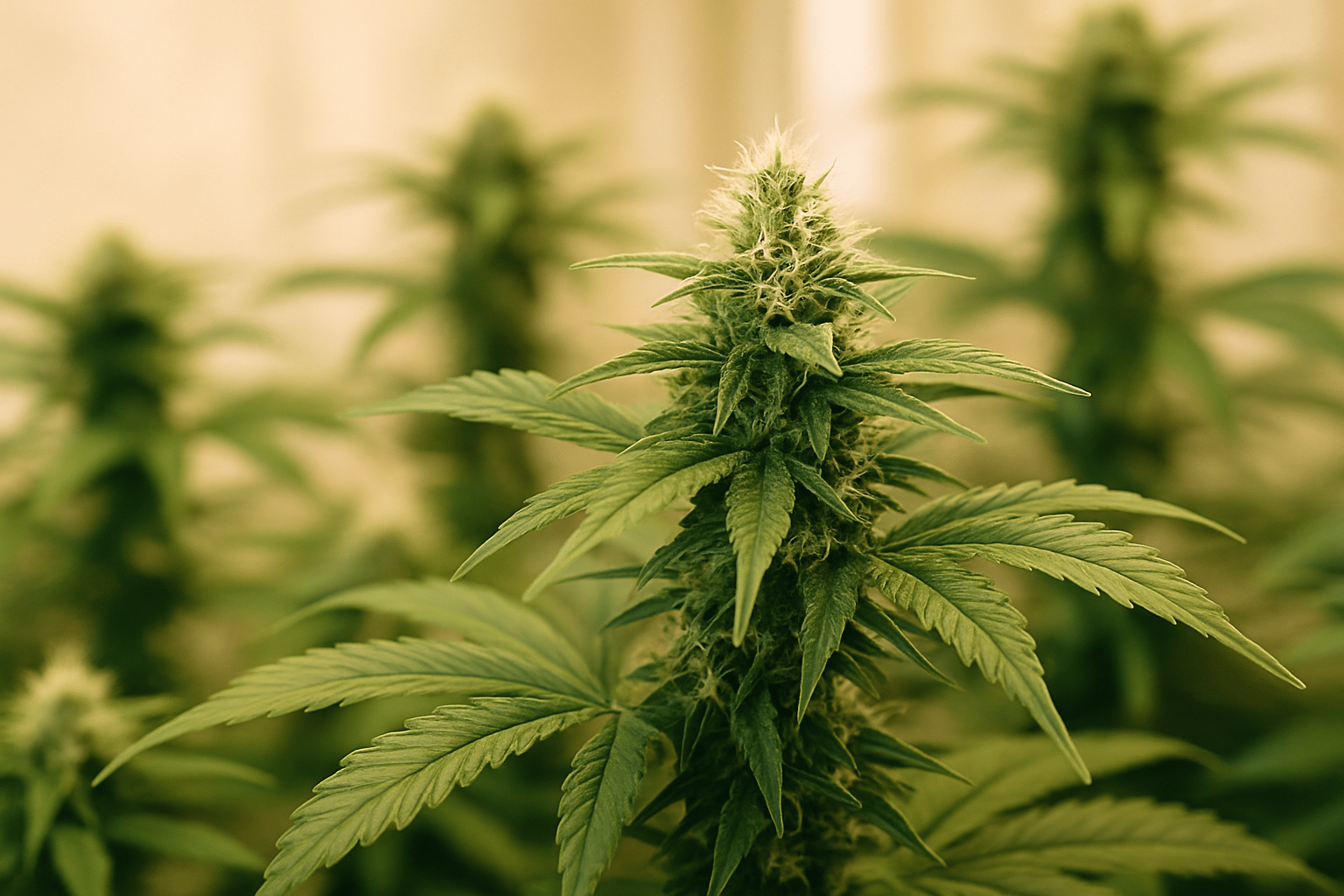
Why Humidity Has Such a Big Impact on Cannabis
Humidity is often underestimated in the grow, even though it directly determines how strongly a cannabis plant can transpire. This is exactly what drives water transport, nutrient movement, and plant cooling. In our experience, many supposed nutrient issues are actually climate issues: the EC is right, the pH is right, but the plant simply is not functioning properly because the relative humidity is off.
If the air is too dry, the plant evaporates water too quickly through the leaves. At first, this can look like a “strong metabolism,” but it often leads to curled leaf edges, increased water consumption, salt stress in the root zone, and stalled growth. If the air is too humid, transpiration drops. Then less calcium is transported, leaves stay soft, internodes become longer, and the risk of fungal diseases rises significantly. Especially with dense flowers, this is one of the main causes of Botrytis.
Another important point: humidity never works in isolation. It is always tied to temperature, air movement, leaf mass, pot size, and irrigation. Anyone who just sets up a humidifier without keeping the rest of the climate in view often solves one problem and creates two new ones. That is why experienced growers do not think only in RH percentages, but in terms of how the entire room works together.
Optimal Humidity by Growth Stage
Cannabis does not need the same humidity in every stage. Young plants without a large root system still take up little water from the substrate and therefore benefit from higher humidity. Older plants with strong root mass and dense leaf structure, on the other hand, need drier conditions so they can transpire steadily and avoid ending up in a fungus-friendly microclimate.
The following ranges have proven effective as practical guidelines. They are not rigid laws, but they are very good target corridors for healthy plants:
| Stage | Recommended Humidity | Daytime Temperature | Practical Note |
|---|---|---|---|
| Germination / fresh cuttings | 70–80% RH | 22–26 °C | High RH helps until roots are actively working |
| Young plants | 65–75% RH | 22–26 °C | Lower gradually, not abruptly |
| Vegetative stage | 55–65% RH | 23–28 °C | Strong transpiration and compact growth |
| Early flowering | 50–55% RH | 22–27 °C | Control stretch, reduce mold risk |
| Mid to late flowering | 40–50% RH | 20–26 °C | Especially important with dense buds |
| Last 1–2 weeks | 40–45% RH | 19–25 °C | Cleaner ripening, lower Botrytis risk |
High humidity makes sense for cuttings, but only temporarily. One common mistake is keeping rooted cuttings at 80% RH for too long. This causes them to adapt to “lazy” conditions and they often react with severe stress after transplanting. In practice, we lower RH gradually over several days once rooting is visibly established. If you work with clones, you can find additional details on acclimation in the article How to Successfully Grow Cannabis Cuttings.
During flowering, humidity becomes a quality factor. RH that is too high in weeks 5 to 8 is one of the most expensive mistakes in a grow, because mold often becomes visible only late, while it is already developing inside the bud. Anyone running dense genetics or large colas should be more conservative and aim for 42–47% RH rather than constantly pushing up against the 55% limit.
Understanding VPD: Why RH Alone Is Not Enough
Advanced growers do not work only with relative humidity, but also with what is known as VPD, or Vapor Pressure Deficit. Put simply, VPD describes the “pull” with which the air draws moisture out of the plant. This is much more meaningful than RH alone, because 60% RH at 22 °C means something different than 60% RH at 29 °C.
In our experience, VPD explains many situations where plants look unhappy despite seemingly correct RH. Example: 28 °C and 60% RH may look fine at first glance, but under strong light they can already create significantly higher transpiration pressure than 24 °C and 60% RH. Conversely, 24 °C and 55% RH can be very stable in late flowering, while 21 °C and 55% RH may already feel too “humid” for dense buds.
As a rough working range: during rooting, VPD should be on the lower to moderate side; in vegetation, moderate; and in flowering, somewhat higher. If you want to keep it simple, you can use RH tables as a guide, but you should always factor in temperature. This is especially important under LED lighting, because leaf and air temperature often differ from what you see under HPS. You can also learn more about the interaction between climate and light in our article Cannabis Lighting: Which Grow Light Really Fits.
How to Recognize Excess Humidity and Respond Correctly
Excess humidity does not always show up dramatically right away. Plants often even grow very “comfortably” at first: large, soft leaves, rich green color, low water consumption. This is often misunderstood as a positive sign. In reality, in such rooms we often see longer internodes, less stable petioles, and later problems with fungal pressure or nutrient transport, especially calcium.
Typical warning signs are:
- stretched, soft growth
- very slow drying of the pots
- stagnant, heavy air in the canopy
- condensation on walls, pipes, or windows
- musty smell in the room
- first signs of powdery mildew or Botrytis
The most important countermeasure is not blindly adding “more exhaust,” but making a proper diagnosis. Often the problem is too little air exchange during the dark phase, plant mass that is too dense, or surfaces that are too cold and cause moisture to condense. We have often seen growers have good values during the day, only to spike to 70% RH or more at night. These nighttime peaks are exactly what is critical, because air temperature drops and relative humidity rises as a result.
In practice, a properly sized dehumidifier, constant nighttime exhaust, more air movement below and above the canopy, and targeted thinning all help. Especially in flowering, sensible defoliating cannabis can significantly improve the microclimate within the crop. But it is important not to strip everything bare. The goal is better air circulation, not additional stress.
If mold is already suspected, you should act without compromise. Infected plant parts must be removed cleanly, and the room climate must be corrected immediately. If you want to dive deeper into the topic, the article Botrytis in Cannabis provides concrete guidance on identification and control.
Humidity Too Low: Symptoms, Causes, and Countermeasures
Air that is too dry is a classic problem, especially in winter and in small tents with strong exhaust. LED setups in heated rooms in particular often run at 30–40% RH, even though the plants actually need 60% or more. The result is often small, hard leaves, upward-curled leaf edges, accelerated drying of the substrate, and an overall “nervous” plant habit.
A common misconception: many people mistake these symptoms for heat stress or overfeeding. In reality, it is often the combination of high light intensity and a climate that is too dry. The plant partially closes its stomata to conserve water. As a result, CO2 uptake and growth decline. At the same time, salts accumulate more quickly in the root zone because watering becomes more frequent and water evaporates without the plant processing nutrients at the same rate.
The solution is a properly controlled humidifier, ideally with a humidistat, not just some open container of water in the tent. In practice, it works best to place the humidifier so that moist air does not hit leaves or sensors directly. Direct mist on the plants promotes localized problems and distorts readings. It also helps not to run exhaust unnecessarily high and to keep young plants in a smaller, easier-to-control area at first.
Watering behavior also plays into this. Anyone who waters too infrequently in dry air, but then waters extremely heavily, creates strong swings between drought stress at the top and wetness at the bottom of the pot. A clean irrigation strategy is therefore part of every climate correction. You can find more on this in How to Water Cannabis Properly.
Humidity During Flowering: Prevent Mold, Protect Quality
The flowering phase is the most delicate period climatically. At this point, the canopy becomes denser, the buds become more compact, and the plant produces more biomass in a confined space. Any extra moisture that remains trapped in the crop increases the risk of Botrytis, powdery mildew, and quality losses. This is especially true for indica-dominant varieties with tight flower structures.
We have usually seen the best results in mid and late flowering at 40–50% RH, depending on temperature, cultivar structure, and air movement. Anyone running large plants in a packed tent should work toward the lower end of that range. Not only because of mold: the surface of the flowers also stays drier, which makes post-harvest handling more stable.
Air movement within the crop is crucial. One oscillating fan above the tops is not enough. Good rooms have airflow below the canopy, between the plants, and in the upper area. Dead zones in corners or directly behind large colas are classic mold hotspots. The air should be moved, but not blasted aggressively onto individual flowers. Constant harsh airflow can dry out leaves and cause wind burn.
It is also worth checking humidity in the last hours of the dark phase. That is exactly when we see the highest RH spikes in practice. If you have problems there, stronger nighttime dehumidification, slightly higher night temperatures, or better air exchange can make a big difference. For the full process of this phase, our article Cannabis Flowering Stage: How to Control Yield, Resin Production, and Quality is also worth reading.
Indoor, Greenhouse, and Outdoor: Humidity by Growing Environment
Indoor humidity can be controlled most precisely, but even here only if room size, exhaust, and humidification are properly matched. In small grow tents, rapid fluctuations occur because even one watering event or a few degrees of temperature change can shift RH significantly. That is why we recommend multiple measurement points: at least at canopy height and ideally not directly in the airflow.
In the greenhouse, the situation is more complex. During the day, sunlight can make it very warm and seemingly dry, while RH often rises sharply at night. Condensation on film or glass is a warning sign. Ridge ventilation, side ventilation, air circulation, and good plant management help here. If you grow in a protected environment, you can find more in-depth practical information in Growing Cannabis in a Greenhouse.
Outdoors, humidity is naturally the least controllable. That makes site selection, cultivar selection, and plant structure all the more important. In humid regions of Germany, based on our experience, we recommend more robust, faster, and mold-resistant genetics instead of extremely compact late-finishing varieties. Adequate spacing between plants and an airy structure also pay off. Related articles include Growing Cannabis in the Garden and mold-resistant outdoor strains for Germany.
Measurement and Control: How to Achieve Stable RH Levels
The biggest beginner mistake is relying on a cheap hygrometer. Many low-cost devices are off by 5% or more. That may not sound like much, but in late flowering it is the difference between safe and risky. We recommend at least two calibratable hygrometers in the room, ideally one at flower height and one slightly lower in the canopy. This also helps identify whether moisture pockets are forming below the canopy.
A second common mistake is reacting to individual readings instead of patterns. More important than the perfect momentary value is stability over 24 hours. So record your daytime, nighttime, and peak values. If RH sits at 47% during the day but regularly jumps to 68% at night, the room is not under control. Data loggers or sensors with trend curves are worth their weight in gold here.
In practice, these components have proven effective for control:
- Humidifier for germination, cuttings, and dry winter rooms
- Dehumidifier especially in late flowering and in basement rooms
- Exhaust system matched to room size and heat load
- Circulation fans for movement without wind stress
- Heating or climate control to stabilize night and day values
- Plant management through defoliation, pruning, and sensible plant density
It is important not to let control devices work against each other. A classic example: dehumidifier and exhaust run uncoordinated while a humidifier is also feeding moisture into the room. That wastes electricity and creates an unstable climate. A clean setup is a coordinated system with clear setpoints for each phase.
Typical Mistakes Around Cannabis and Humidity
Very often, we see growers set RH by feel instead of by plant stage. Fresh cuttings are kept too dry because they want to “avoid mold.” Later in flowering, RH then stays too high because the room had worked so far without a dehumidifier. Both cost performance. Good climate management is dynamic and follows plant development.
Another mistake is looking only at room air and ignoring the microclimate in the canopy. If plants are standing too densely, even a correct sensor reading on the tent wall means little. Between the buds, it can be significantly more humid than in free airflow. That is exactly why plant spacing, thinning, and airflow management are so crucial.
Humidity also often rises noticeably after watering. In soil and coco, we regularly see that large waterings shortly before the dark phase push nighttime RH unnecessarily high. If possible, water earlier in the light cycle instead. This is especially true in flowering. If you want to go deeper into substrate and water balance, you will find helpful differences between soil, coco, and rockwool in our substrate comparison.
Finally, humidity should not be confused with foliar spraying. Spraying can make sense for cuttings or in special cases, but it does not replace a stable climate. In flowering, it is fundamentally risky on buds. Anyone who sprays regularly increases the local risk of spots, residues, and fungal infection.
Practical Guidelines for a Stable Day-to-Day Grow
If you want to work without complicated climate models, a disciplined basic plan is often enough. Keep young plants at 65–75% RH, lower to 55–65% in vegetation, move to 50–55% in early flowering, and from mid-flowering onward aim more for 40–50%. At the same time, temperatures should not fluctuate unnecessarily: 22–28 °C during the day and only moderately lower night values are usually ideal.
Always observe the plant itself as well. Healthy leaves stand actively, not limp; pots dry in a predictable rhythm; the crop smells fresh rather than musty; and there are no condensation zones. If these points are in place, humidity is usually not only “correct on paper,” but also practically in the safe zone.
Beginners in particular benefit from optimizing climate, watering, and light together instead of treating symptoms one by one. Anyone who manages the environment cleanly has less trouble with deficiencies, diseases, and quality losses. And that is what ultimately defines a truly well-run grow: not a single peak value, but stable conditions from rooting to harvest.
Sources
- University of Vermont Extension – “Managing Humidity in Controlled Environment Agriculture”, 2021
- Bugbee, Bruce – “Environmental Factors Controlling Cannabis Growth and Development”, 2021
- Caplan, Dixon; Zheng, Y. – “Optimal Rate of Organic Fertilizer during the Vegetative-Stage for Cannabis Grown in Two Coir-based Substrates”, 2018
- Punja, Zamir K. – “Flower and Foliage-Infecting Pathogens of Marijuana (Cannabis sativa L.) Plants”, 2018

About the Author – Hannah
Hannah focuses on researching, contextualizing, and observing current developments in plant care and modern cultivation techniques. Her focus lies on new methods, optimizing growth conditions, and making complex topics accessible. Her content complements practical experience with analysis, updates, and a keen eye on emerging trends.
Content is regularly reviewed and updated.
This article was created with AI support and editorially reviewed.
More about the team behind LeafConnect