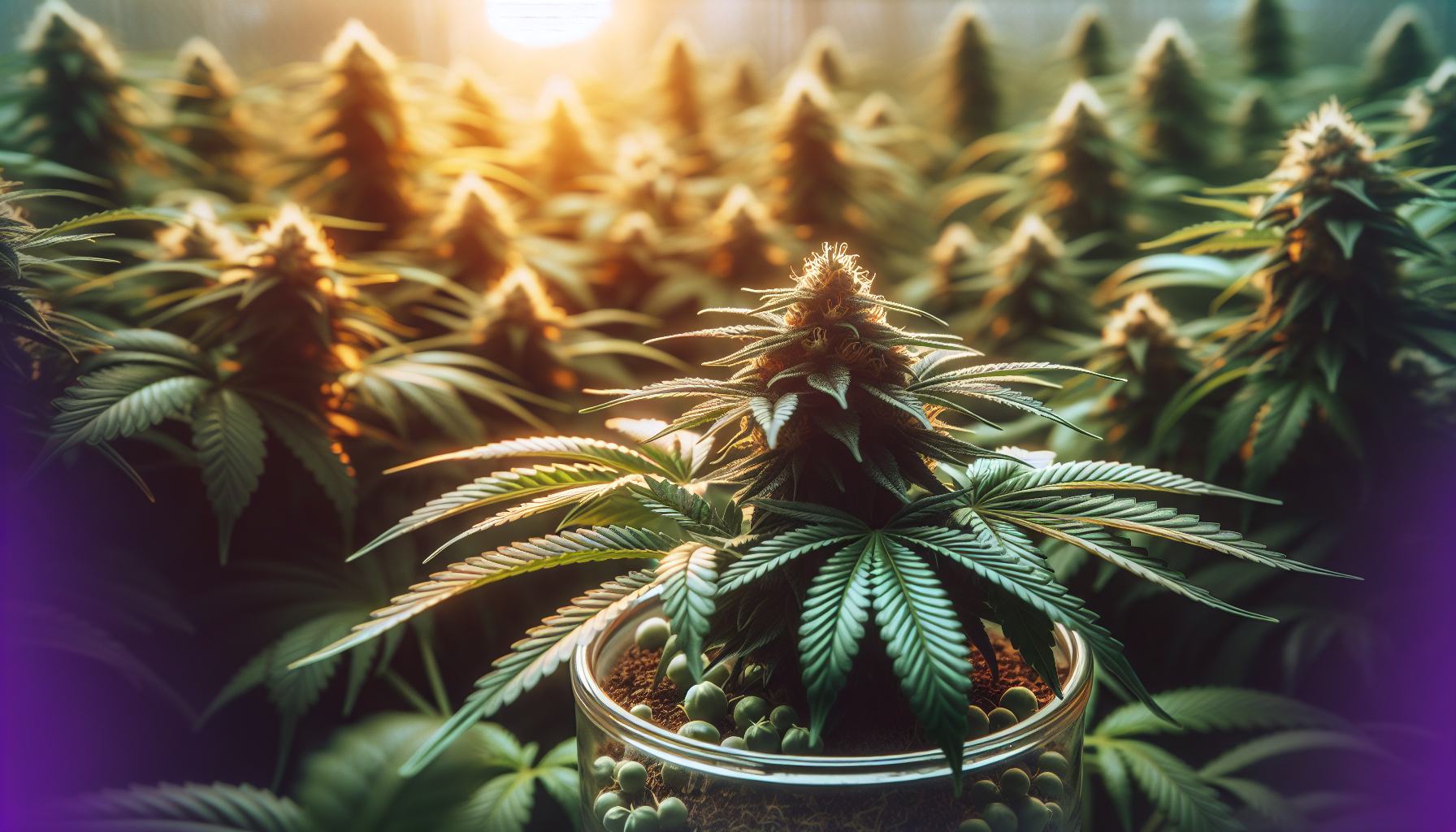
Why lighting so often determines success or failure in cannabis cultivation
For indoor cannabis, light is not just one factor among many, but the true engine of the entire grow. Water, nutrients, and CO2 can only be used effectively if the plant receives enough usable light energy. In our experience, this exact point is underestimated surprisingly often: many growers invest a lot of time in feeding schedules or training methods, but work with a lamp that is either too weak, poorly distributed, or hung incorrectly.
The consequences quickly show in the plant’s appearance. Too little light leads to long internodes, thin stems, low leaf mass, and loose flowers. Too much light or overly aggressive intensity, on the other hand, shows up as curled leaf edges, bleached tips, slowed metabolism, and unnecessary stress. Especially under modern LEDs, we often see growers overestimate output or place the fixture too close because LEDs emit less radiant heat than HPS. The leaves may not feel hot, but the plant can still be under photic stress.
Anyone who truly understands cannabis lighting therefore thinks not only in watts, but in light quantity, light distribution, photoperiod, and plant signaling. The goal is not simply “as bright as possible,” but a stable environment in which the plant can efficiently convert light into growth and flower mass. That is exactly why the lamp must always match the setup: the tent size, the cultivar, the number of plants, the substrate, and the climate control.
Genetics also play a role. Compact indica-dominant plants often respond differently to high intensities than strongly stretching sativa-leaning lines. If you are generally looking into growth structure and cultivar characteristics, it is also worth reading Sativa vs. Indica: What Really Matters. Lighting can only be optimized when you understand how the specific plant responds to the space and the light.
LED, HPS, CMH, and fluorescent tubes compared directly
For most home grows, LED is now the first choice. Good full-spectrum LEDs deliver high efficiency, relatively even spectral distribution, and significantly less heat output than traditional high-pressure sodium lamps. In practice, that means lower electricity costs per gram produced, more climate control, and more flexible placement in the tent. Quality is the deciding factor, however. Cheap LED panels with inflated wattage claims or poor diode configuration often lead to disappointing results.
Despite the LED boom, HPS still has its place. Very good flowering results can be achieved under 400- or 600-watt HPS, especially when the room is cool and the extra heat is welcome. The spectrum is flower-focused, light penetration is solid, but power consumption and heat generation are clear disadvantages. In small tents, we regularly see problems with excessive leaf and room temperatures, especially in summer.
CMH or LEC is spectrally interesting and often produces a very pleasing plant structure with vigorous growth and strong terpene profiles. However, this technology is less common in the home-grow sector, the initial investment is not always cheap, and the efficiency of good LEDs is usually superior. Fluorescent tubes or T5 systems can work for propagation, clones, and young plants, but they quickly reach their limits in flower.
| Technology | Advantages | Disadvantages | Suitable for |
|---|---|---|---|
| LED | High efficiency, low heat output, good full spectrum, long lifespan | Major quality differences, good models cost more upfront | Almost all indoor setups |
| HPS | Proven flowering results, strong light penetration, low entry cost | High heat, higher power consumption, ballast required | Cool rooms, classic flowering grows |
| CMH/LEC | Very good spectrum, vigorous growth, often strong resin and terpene development | Less efficient than top LEDs, heat output, higher system costs | Experienced growers focused on quality |
| T5/Fluorescent | Gentle for clones and seedlings, affordable | Too weak for high-yield flowering | Propagation, rooting, early veg |
If someone asks us for a clear recommendation today, it is almost always: a high-quality LED sized appropriately for the grow area. For 60 x 60 cm, realistic 100 to 150 watts of good LED power is often enough. For 80 x 80 cm, many solid setups fall between 150 and 250 watts, and for 100 x 100 cm, usually 250 to 350 watts. These values are not rigid rules, but in practice they are a sensible starting point.
What really matters in cannabis: PPFD, DLI, spectrum, and photoperiod
Many growers still focus almost exclusively on watts. That is understandable, but technically inaccurate. Watts only tell you how much electricity a lamp consumes, not how much plant-usable light actually reaches the leaf surface. For cannabis, terms like PPFD and DLI are therefore much more meaningful. PPFD describes the amount of photosynthetically active photons per square meter per second. DLI relates that light quantity to the daily lighting duration.
As rough practical values, the following ranges have proven effective for many setups: young plants and freshly rooted clones often perform well at around 150 to 300 µmol/m²/s. In the vegetative phase, 300 to 600 µmol/m²/s is usually appropriate. In flower, many healthy plants without added CO2 work most efficiently at around 600 to 900 µmol/m²/s. Above that, things quickly become more demanding, because climate, nutrient supply, irrigation, and VPD must then be dialed in very precisely.
The light spectrum also influences plant behavior. More blue generally promotes more compact growth and shorter internodes, while red wavelengths have a stronger effect on flowering and stretch. Modern full-spectrum LEDs usually combine these ranges sensibly. Pure “blurple” lamps from older generations are, in our view, hardly up to date anymore. They do work in principle, but full spectrum is much more pleasant in practice for observing plants and often delivers more balanced results.
The photoperiod is the next key point. Photoperiod plants are classically kept under 18/6 or 20/4 in the vegetative phase and switched to 12/12 for flowering. Autoflowering cultivars respond differently because they do not enter flower based on day length. This also ties in with the growth stages of cannabis: each stage has different light requirements, and anyone who does not adapt lighting to the plant’s development gives away potential or creates stress.
The right light intensity in every phase: seedlings, clones, vegetative growth, and flowering
Fresh seedlings and clones need significantly less light than many assume. One common mistake we see again and again is too much intensity immediately after rooting or germination. At this stage, the plant does not yet have a sufficiently developed root system to support high metabolic rates properly. The result is drooping leaves, slowed establishment, and unnecessary early stress. A gentler start with greater lamp distance or dimmed output is better.
For clones, a range of 100 to 200 µmol/m²/s has proven effective in many rooms, at temperatures around 24 to 26 °C and slightly higher humidity of about 70 to 80% in the first days after cutting or immediately after arrival. If you work with clones, you can find additional practical details in the article How to Successfully Grow Cannabis Clones. Especially with clones, light dosing often determines whether they root quickly or stall at first.
In the vegetative phase, intensity can then be increased gradually. In practice, we usually raise it every few days, as soon as the plants are visibly growing actively, to around 300 to 500 µmol/m²/s. This promotes a compact structure and strong side branching. Anyone training, topping, or using LST in this phase benefits from even light distribution across the entire area. Otherwise, a dominant main top quickly develops while the lower branches fall behind.
In the flowering phase, light becomes a direct yield factor. From week 2 to 3 after switching to 12/12, healthy plants can usually handle significantly more intensity. Good target values are often around 700 to 900 µmol/m²/s at canopy level. Homogeneity is crucial, however. Better 750 evenly across the entire canopy than 1000 in the center and 350 at the edges. For a clean canopy, targeted training or defoliation often helps as well; the article Pruning Cannabis is relevant here if you want to improve light distribution in the lower zone.
Distance to the lamp, light coverage, and typical mistakes in the grow tent
The correct lamp distance depends on the technology, output, optics, and plant stage. General values are therefore only a starting point. With many modern LEDs, the distance for young plants is often 40 to 60 cm, in veg 35 to 50 cm, and in flower, depending on the model, 25 to 45 cm. If you have a dimmable model, it is usually better to dim at the beginning rather than hang the lamp extremely high. That keeps the light distribution more even.
A common mistake is trusting manufacturer specifications without checking the plant’s appearance. In our experience, a PPFD meter is ideal, but even a good smartphone app used as a rough guide can help avoid major misconfigurations. Watch for signals: praying leaves shortly after lights-on are usually a good sign. Upward-curling edges, pale tops, or stalled growth point more toward excessive intensity. Strong stretching and large spacing between nodes indicate too little light.
Coverage across the area is at least as important as peak output. A 100 x 100 cm tent with a lamp that only properly covers the center will inevitably produce uneven plants. The result is hard, dense colas in the middle and airy popcorn buds around the edges. Good bar-style LEDs often have an advantage here because they spread light more broadly than compact boards. Especially when multiple plants stand at different heights, even distribution is worth its weight in gold.
Reflections inside the tent also play a role. Clean, reflective inner walls help, but they do not replace a properly matched lamp. Equally important: keep the canopy level. Anyone letting tall and short plants grow side by side without structure will always light part of the crop incorrectly. That is why lighting and plant management are closely linked. This is especially true in dense grows with many clones or highly vigorous cultivars.
Lighting and climate must work together
More light increases the plant’s metabolism. That sounds obvious, but it is one of the most common mistakes in indoor growing. Anyone increasing light intensity almost always also needs to adjust climate, air movement, irrigation, and nutrient availability. Under powerful LEDs, plants often perform best at leaf temperatures around 24 to 28 °C, depending on stage and genetics. If the temperature drops too much despite high light levels, the plant works inefficiently. We see this especially in basement rooms during winter.
Humidity is another factor. In the vegetative phase, around 60 to 70% is often appropriate, in early flower more like 50 to 60%, and in late flower usually 40 to 50% so dense buds do not become unnecessarily prone to mold. More light without sufficient air movement increases the risk of heat buildup in the canopy and can indirectly promote disease in flower. If buds become very dense, it is also worth reading Botrytis in Cannabis, because strong lighting alone does not protect against moisture problems inside the flowers.
The substrate also affects how well plants can process high light levels. In coco or rockwool, water and nutrient inputs can be corrected more quickly than in heavy soil. That does not mean soil is worse, but the response speed is different. Anyone increasing light intensity should always consider how quickly the chosen medium reacts to changes. For a deeper look, see the articles on the best substrates for cannabis.
In very ambitious setups with CO2 enrichment, cannabis can utilize significantly higher light intensities. For most home growers, however, that is not a realistic first lever to pull. We almost always recommend first getting temperature, air exchange, root health, and irrigation fully under control. Otherwise, additional lighting power brings little besides a higher electricity bill.
How to choose the right grow light for your setup
The best lamp is not automatically the most powerful one, but the one that lights your area evenly and efficiently. For a small 60 x 60 cm tent, an oversized 300-watt unit is usually unnecessary and tends to make climate management harder. Conversely, a weak 100-watt no-name panel on 100 x 100 cm will almost always be insufficient. So pay attention to actual power draw, efficiency ratings in µmol/J, the shape of the fixture, and reliable PPFD maps.
Important quality features include dimmable output, good passive or quiet active cooling, high-quality diodes, and a solid driver concept. In practice, we also value lamps where the driver can be mounted outside the tent. This noticeably reduces heat inside the grow space. Anyone already operating near the temperature limit in summer often gains more from that than from theoretically better spectral values.
If you work with clones, predictability is especially important. Uniform plants benefit greatly from even lighting because the canopy stays more homogeneous and the lamp can be used more efficiently. If you are still looking for healthy starting material, it makes sense to check the THC clones category or the Grow Guide to better align your setup and genetics.
One final point that is often forgotten: electricity costs are part of lamp selection. A more efficient LED often pays for itself faster than expected if you grow regularly. Not only because of consumption, but also because less heat output usually means less fan power, fewer climate issues, and more stable conditions. That indirectly reduces the risk of growth stalls, nutrient problems, and quality losses.
Sources
- Bugbee, Bruce – “Toward an Optimal Spectral Quality for Plant Growth and Development,” 2016
- Cannabis Business Times / Dr. Nadia Sabeh – “Light Intensity, Photoperiod and Cannabis Production,” 2020
- Rodale Institute – “Understanding Daily Light Integral and Its Role in Crop Production,” 2021
- University of Florida IFAS Extension – “Environmental Management for Controlled Environment Agriculture,” 2022

About the Author – Hannah
Hannah focuses on researching, contextualizing, and observing current developments in plant care and modern cultivation techniques. Her focus lies on new methods, optimizing growth conditions, and making complex topics accessible. Her content complements practical experience with analysis, updates, and a keen eye on emerging trends.
Content is regularly reviewed and updated.
More about the team behind LeafConnect