What Defoliation Really Does in Cannabis
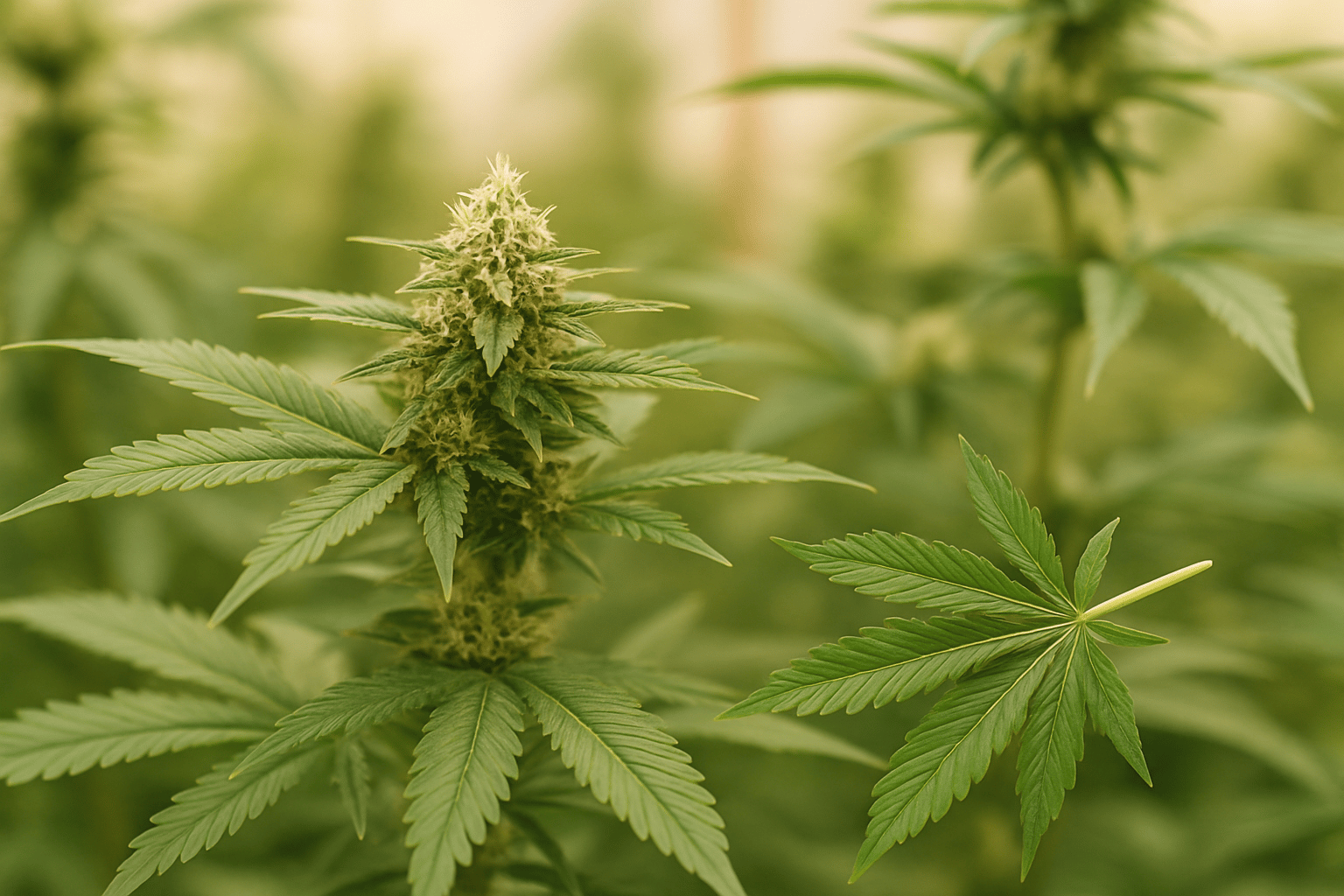
Defoliation involves selectively removing large fan leaves to bring light and air deeper into the canopy. That sounds simple, but in practice it is often misunderstood. Many growers either cut too cautiously and achieve little effect, or they remove too much and stress the plant unnecessarily. In our experience, defoliation is not an end in itself and certainly not a mandatory step in every run. It is a tool that only provides benefits when the plant is healthy, vigorous, and sufficiently strong.
The real benefit lies in three points: better light distribution, less stagnant moisture in dense foliage, and a more controlled microclimate around the flower sites. Especially in indoor setups with LED lighting and compact growth, we often see large fan leaves shading entire side branches. The plant may then produce a lot of leaf mass, but the lower bud sites remain airy and immature. By selectively removing individual leaves, these areas can be activated without reducing the plant's photosynthetic performance more than necessary.
The key is understanding why: leaves are not useless appendages, but the plant's solar panels. They also store mobile nutrients, especially nitrogen, and serve as a buffer during short-term stress. So anyone who defoliates is directly intervening in the plant's energy balance. That is exactly why you should never work from a rigid formula, but always according to plant condition, canopy density, cultivar, and environment. It is especially helpful to combine defoliation with other cultivation measures such as suitable cannabis lighting, a clean watering rhythm, and targeted airflow management.
When Defoliation Makes Sense – and When It Does Not
Defoliation is especially useful for densely branched, bushy plants with tight internodal spacing, in Scrog setups, in humid rooms, or in greenhouses with limited air movement. In these situations, moisture builds up between leaf and flower, increasing the risk of powdery mildew and botrytis. Especially from mid to late flowering, an overly dense canopy can become problematic. Anyone who has ever seen a beautiful, visually perfect main cola rot from the inside knows that air circulation is not a minor detail, but yield protection.
Defoliation is not advisable for weakened plants, after transplant stress, in the presence of clear deficiencies, or immediately after heavy training such as topping, supercropping, or intensive LST. The plant first needs time to stabilize its metabolism. A common mistake we see repeatedly is defoliating a plant that is already suffering from overwatering, nutrient imbalance, or heat stress. This often makes the situation worse because the plant lacks the capacity to recover. If you are unsure, first dial in the basics properly, for example through correct watering cannabis properly and balanced nutrient supply.
Caution is also advised with autoflowers. Due to their short lifespan, they have little time to compensate for stress. Minor leaf corrections are possible, but aggressive defoliation can quickly cost valuable growth days that will not come back. With photoperiod plants, the time window is much larger. Even so, the rule remains: the healthier and stronger the plant, the better it tolerates intervention.
The Right Timing in Vegetative Growth and Flowering
During the vegetative phase, defoliation can make sense when large fan leaves completely cover important side branches. The goal here is not to make the plant "naked," but to expose growth points. In our experience, small, repeated interventions work better than one radical action. It is better to remove only the leaves every few days that are truly shading multiple shoots or lying directly on top of each other. This keeps the plant moving smoothly and usually results in stronger lateral growth.
A classic time for a stronger, but still controlled, defoliation is shortly before switching to 12/12 or during the first 2 to 3 weeks of flowering. In this phase, the plant stretches, forms new shoots, and builds the later flower structure. If the canopy is too dense now, light distribution quickly becomes uneven. That is why many experienced growers work in two steps: once before the flip and a second time after the stretch, when it is clear which branches carry the canopy and which areas will remain permanently shaded.
After about week 4 of flowering, you should become much more cautious. At that point, the plant invests more heavily in flower mass, resin, and ripening. Larger interventions during this phase can slow metabolism, delay maturity, or even trigger stress reactions in sensitive cultivars. You can still remove individual problematic leaves, but no more heavy thinning. If you want to manage flowering more precisely, you will find additional background in our overview of the cannabis flowering stage.
Which Leaves Can Go – and Which Should Stay
What should primarily be removed are large fan leaves that permanently shade multiple bud sites, leaves in the plant interior with no real light function, damaged or diseased leaves, and leaf mass in poorly ventilated zones near the stem. Especially in the lower third, leaves often accumulate that barely contribute to photosynthesis anymore but retain moisture. There, a clean cut is usually more effective than half-hearted thinning.
Healthy, well-lit fan leaves in the upper and middle areas should remain as long as they are not actively causing problems. These leaves drive sugar production and buffer smaller cultivation mistakes. A common misconception is that every flower must be directly exposed. That is not necessary. Cannabis does not need a completely open skeleton, but a balanced ratio between leaf mass and light penetration. If a leaf only lies slightly over a flower, you can often simply tuck it, meaning gently place it under a branch instead of cutting it off.
Sugar leaves in the buds should generally be left alone during cultivation. They are part of the flower structure and contribute to resin production. Anyone who removes these leaves early damages flower tissue and increases the risk of stress and infection. Sugar leaves should only be evaluated, if at all, during trimming after harvest.
Step by Step: How to Defoliate Cannabis Properly
Before cutting, the plant should be healthy, well hydrated, and not standing in the room dripping wet immediately after watering. The ideal time is shortly after the light period begins, when metabolism is active. Tools must be clean and sharp. We always disinfect scissors with isopropanol, especially when multiple plants are in the room. That is not perfectionism, but basic hygiene practice to avoid mechanically spreading diseases and viroids.
- Look at the plant from the outside: Where are the shaded zones? Which branches are supposed to carry later?
- Mark major blockers: First identify only the fan leaves that cover multiple flower sites.
- Work from the bottom upward: Start in the lower and inner area so the structure becomes clearer.
- Cut cleanly at the petiole: Do not tear, do not bend, and do not leave half stubs behind.
- Stop after each section: Take a step back and reassess instead of continuing to cut in tunnel vision.
As a rough guideline, with healthy photoperiod plants we rarely remove more than 10 to 20 percent of the functional leaf mass per session. That is not a rigid law, but a good safety framework. Anyone removing significantly more should know exactly why. In very dense Scrog plants, slightly more may make sense in individual cases, but even then the rule applies: better in two sessions than in one radical treatment.
After defoliation, plants need stable conditions: a constant temperature of about 24 to 28 °C under light, moderately cooler at night, and relative humidity depending on the phase at roughly 55 to 65 percent in veg and 45 to 55 percent in early to mid flower. Immediately after major leaf loss, you should not unnecessarily increase feeding or light intensity too aggressively. The plant first needs to regain balance. A clean supply of water and nutrients is now more important than any booster; you can read more in fertilizing cannabis.
Defoliation, Lollipopping, Suckering, and Pruning: The Differences
Many terms are mixed up even though they have different goals. Defoliation primarily means removing leaves. Lollipopping aims to remove lower weak branches and small flower sites that will not make it into the light anyway. Suckering is closely related, but often means the targeted removal of unwanted side shoots to direct energy into the main structure. Pruning is the umbrella term and can include topping, cutbacks, or shape corrections.
Why is this distinction important? Because each intervention stresses the plant differently. Anyone who defoliates, suckers, and heavily trains at the same time is stacking stress factors. In our experience, it is much more efficient to stagger these measures over time. First build structure, then thin out if needed, then guide flowering cleanly. If you want to dive deeper into side shoots, you should also read suckering cannabis, because many yield problems are not caused by too little defoliation, but by too many weak shoots below the productive canopy.
| Measure | Goal | Typical Timing | Risk if Overdone |
|---|---|---|---|
| Defoliation | Improve light and airflow | Veg, before flowering, after stretch | Slowed growth, stress |
| Lollipopping | Remove lower popcorn zones | Before flowering to early flowering | Too little leaf mass, yield loss |
| Suckering | Remove unwanted side shoots | Early veg to early flowering | Unbalanced structure |
| Pruning | Control shape and growth | Mainly veg | Long recovery |
Typical Defoliation Mistakes and How to Avoid Them
The most common mistake is being too radical. Beginners in particular see before-and-after images on social media and want to achieve the same look. What appears "clean" in photos is often unnecessarily harsh for the plant. An overly defoliated specimen often responds with slowed growth, upward-curling leaves, increased transpiration, or smaller flower sites. The problem is then often misinterpreted as a feeding error, even though the real cause is simply a disturbed leaf-to-root balance.
Another mistake is poor timing. Defoliating shortly before or during a stress phase, such as in heat, after transplanting, with pH problems, or after pest pressure, worsens the situation. Working with dull or dirty tools is equally problematic. Especially in clone runs and with mother plants, this can open the door wide to pathogens. Anyone regularly working with multiple genetics should take hygiene as seriously as irrigation and climate.
It is also often underestimated how strongly genetics influence the ideal intervention. An airy, sativa-leaning plant usually needs much less defoliation than a compact, broad-leafed indica hybrid. Then there are differences between indoor, greenhouse, and outdoor cultivation. In open ground, wind provides part of the air movement; in a tent, you have to create it actively. If you grow in a protected environment, you will find practical additions in our article growing cannabis in a greenhouse.
Indoor, Greenhouse, and Outdoor: Adapting Defoliation to the Environment
Indoors, defoliation is the most predictable because light angle, airflow, and climate can be controlled. Under LED lighting, a dense, flat canopy often develops with strong top-side illumination and comparatively weak penetration into depth. Here, targeted thinning helps light reach mid-level bud sites. At the same time, you must not make the plant too open, or it will lose its natural buffer zone against VPD fluctuations. In small tents with high plant density, we often see that the issue is not weak light, but an overly compact canopy structure.
In the greenhouse, the main issue is usually humidity. Morning dew, temperature fluctuations, and limited air movement create ideal conditions for mold if the plants stand too densely. There, defoliation is often less about yield optimization and more about protection. Especially in the plant interior and lower area, removing individual fan leaves and weak shoots can significantly improve the microclimate. Anyone growing there should always consider defoliation together with ventilation, plant spacing, and cultivar selection.
Outdoors in open ground, restraint is usually the better strategy. Sunlight is intense and moves throughout the day, so deep shading is often less critical than in a tent. At the same time, leaves protect the plant from wind, heavy rain, and short-term heat. We only defoliate outdoors selectively: in the case of diseased foliage, extremely compact inner areas, or when mold risk becomes real. Especially in humid regions, it is often more sensible to choose robust cultivars and an airy plant structure from the start rather than frantically removing leaf mass later.
How to Tell Whether Your Defoliation Worked
Successful defoliation is not shown by the plant looking spectacularly bare, but by it continuing to function steadily after 24 to 72 hours. The leaves become active again, the shoot tips keep growing, and the previously shaded bud sites receive visibly more light. Ideally, airflow through the canopy also improves without the plant looking generally "hollowed out." The canopy should be open enough for air to pass through, but closed enough for the plant to remain productive.
Warning signs are drooping petioles for several days, clearly slowed growth, strong paling after cutting, or a general impression that the plant has been "held back." In most cases, too much was removed or the intervention came at the wrong time. In such cases, you should not respond with even more measures. No additional pruning, no drastic fertilizer correction, no sudden increase in light output. First observe, keep the climate stable, and give the plant time.
In the long term, success is visible in more even flower development, fewer popcorn buds, better ventilation, and lower mold risk. But defoliation never replaces good basic cultivation. If light, pH, root space, watering behavior, or nutrient balance are off, even perfect leaf management will not save the run.
Sources
- Cervantes, Jorge – "Marijuana Horticulture: The Indoor/Outdoor Medical Grower's Bible", 2015
- Rosenthal, Ed – "Marijuana Grower's Handbook", 2021
- Bugbee, Bruce – "Cannabis Physiology and Production Practices", 2021
- Caplan, Dixon, Zheng, Smith – "Plant Responses to Defoliation and Canopy Management in Controlled Environment Cannabis Production", 2019

About the Author – Hannah
Hannah focuses on researching, contextualizing, and observing current developments in plant care and modern cultivation techniques. Her focus lies on new methods, optimizing growth conditions, and making complex topics accessible. Her content complements practical experience with analysis, updates, and a keen eye on emerging trends.
Content is regularly reviewed and updated.
This article was created with AI support and editorially reviewed.
More about the team behind LeafConnect