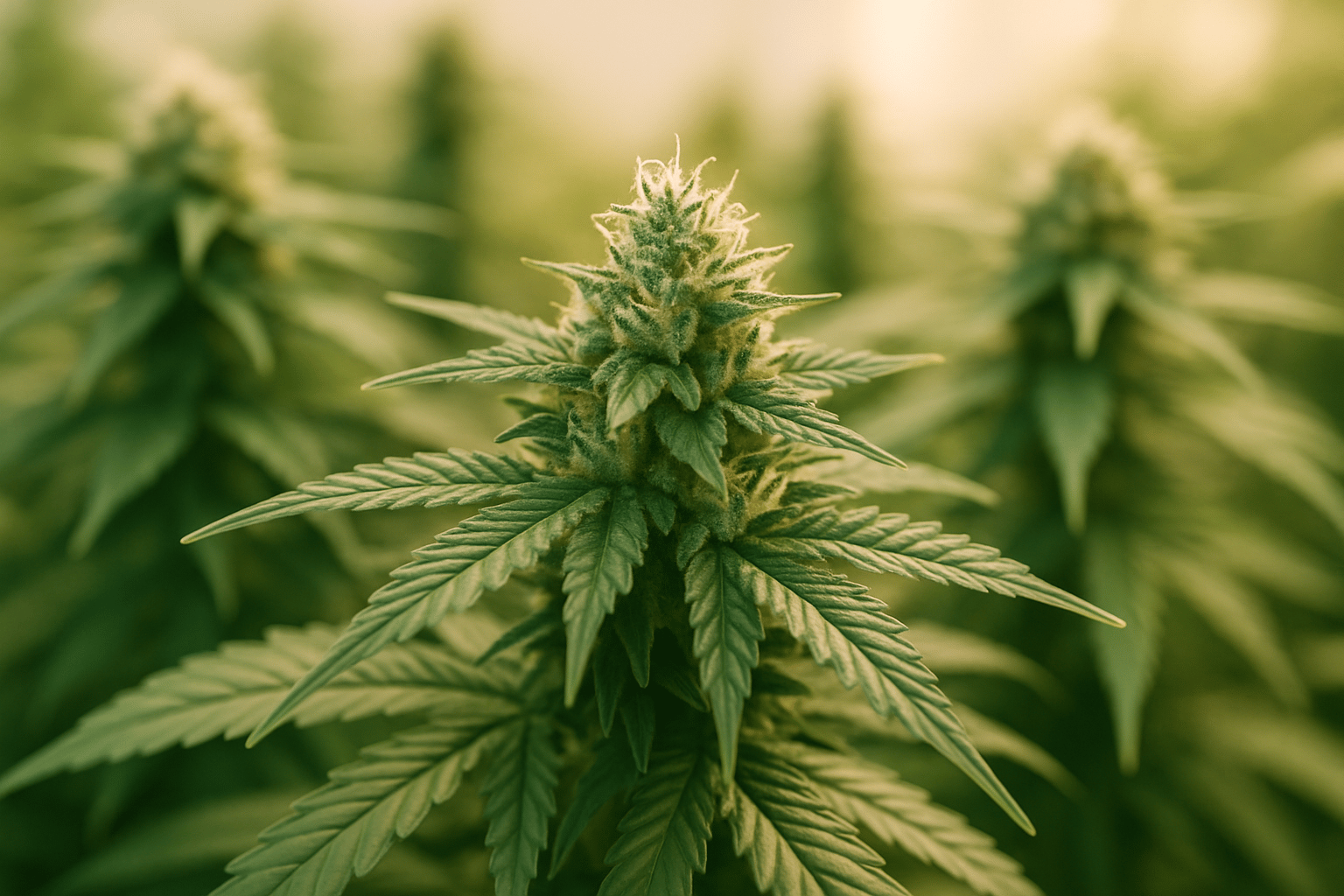
What “flushing cannabis” actually means
When growers talk about flushing, they usually mean two very different measures that are often mistakenly lumped together in everyday practice. First, the emergency flushing of a substrate to reduce excess salts, incorrect nutrient concentrations, or pH problems. Second, the runoff period before harvest, where only water is given during the last few days or 1–2 weeks. These two applications have different goals, different risks, and different chances of success.
In our experience, this is exactly where most mistakes happen: many growers flush routinely without knowing why they are doing it. A substrate with a toxic salt load needs different treatment than a healthy plant in week 8 of flowering. Treating both the same way risks yield loss, unnecessary stress in the root zone, or a plant that declines too early.
So flushing is not a magical quality lever. It is a tool. Used correctly, it can solve problems or make the final stretch cleaner. Used incorrectly, it often worsens more than it improves. If you want to understand the basics of water management and fertilization more clearly, our articles on watering cannabis properly and fertilizing cannabis will also help, because flushing mistakes almost always begin with watering or nutrient mistakes.
When flushing really makes sense—and when it doesn’t
True flushing is mainly useful when the substrate is visibly or measurably out of balance. Typical cases include overfertilization, strongly elevated EC in the root zone, nutrient lockout caused by incorrect pH, or a substrate that has been watered for weeks with too little drain. We see this regularly, especially in coco, rockwool, and mineral systems: the plant shows deficiency symptoms even though enough fertilizer has actually been given. The reason is not too little nutrition, but impaired uptake.
Flushing is less useful as a blanket standard measure for every crop. In living organic soils, especially in well-built living soil, heavy flushing can even be counterproductive. In those systems, the soil life works for you. Large volumes of water can push air out of the substrate, cause microbial stress, and disrupt nutrient cycles. In such systems, it is usually better to correct the cause directly instead of flooding the entire pot.
Flushing before harvest is not a law of nature either. Many growers report clean smoke from 7 to 14 days of water-only, while others continue with reduced nutrient input until shortly before the end and also achieve very good results. Our experience: post-harvest quality depends far more on ripeness, drying, and curing than on a dogmatic flush. If you want to do this properly, you should also master harvest timing and post-ripening, for example with a look at harvesting cannabis and curing cannabis.
The most common reasons for an emergency flush in a grow
Overfertilization and salt buildup
The classic case is overfertilization. Leaf tips burn, the leaves turn dark green, curl downward, or show patchy stress symptoms. In the runoff, you often measure a significantly higher EC than in the nutrient solution. This happens especially often with small pots, high evaporation pressure under strong LEDs, and with growers who feed by schedule at every watering even though the plant is taking up less.
In coco and rockwool, even a period with too little drain is enough for salts to accumulate in the root zone. The plant then effectively sits in an increasingly concentrated solution. Flushing can make sense here to bring the root zone back to a level where calcium, magnesium, potassium, and phosphorus can be absorbed in balance again.
pH drift and nutrient lockout
Sometimes a plant looks underfed even though there is plenty of fertilizer in the pot. That is typical of pH-related lockout. In soil, the useful watering range is usually around pH 6.2 to 6.8, in coco more like pH 5.7 to 6.0, and in rockwool often pH 5.5 to 5.8. If watering has been off target over several irrigation cycles, the availability of individual elements shifts significantly.
Flushing with correctly adjusted water or a mild nutrient solution can help bring the root zone back into a range where uptake works again. The key point: do not blindly pour in water. Measure first, then act. If you want to understand EC and PPM systematically, you should also take a closer look at EC and PPM in cannabis cultivation.
Imbalances after additive or booster mistakes
A common practical mistake is not the base fertilizer, but an overdosed PK booster, CalMag supplement, or sugar/enzyme mix. Especially in mid to late flowering, the ratio can tip quickly. The plant often does not react immediately, but 3 to 7 days later. If even more products are then added in a panic, the situation gets worse.
In such cases, a controlled flush is often the cleanest reset. Afterward, you do not immediately “feed full strength” again, but rebuild with reduced nutrient strength. In our experience, this is where experienced growers differ from beginners: they do not try to solve a problem with even more bottles.
How to flush cannabis properly—depending on the substrate
The right method depends heavily on what you are growing in. Soil, coco, and rockwool respond very differently to water management, oxygen in the root zone, and salt movement. That is why a blanket “run three times the pot volume through it” is too crude. It can work, but it is not always the best solution.
| Substrate | Typical pH when flushing | Recommended approach | What to pay special attention to |
|---|---|---|---|
| Soil | 6.2–6.5 | Flush slowly in stages until runoff drops significantly | Avoid waterlogging, then let it dry back well |
| Coco | 5.8–6.0 | Flush with a light nutrient solution or pH-adjusted water, then refeed | Maintain calcium/magnesium balance |
| Rockwool | 5.5–5.8 | Several short flush cycles with controlled drain | Measure EC before and after flushing |
| Living Soil | usually no classic flushing | Correct the cause directly instead of washing it out | Protect soil life and structure |
Soil
In soil, we tend to flush more slowly and in a more controlled way in practice. Instead of applying huge amounts all at once, we work in stages. Example: an 11-liter pot does not simply get 33 liters in one go, but several passes with breaks so the water moves evenly through the profile. The goal is to dissolve accumulated salts without turning the substrate into an air-poor mass of mud.
After flushing, patience matters. Many people make the mistake of watering again the next day or immediately ramping nutrients back up. The root zone is often still far too wet. Wait until the pot becomes noticeably lighter and the roots get oxygen again.
Coco
Coco is more tolerant of frequent watering, but sensitive to incorrect ion balance. Large amounts of plain water can help in the short term, but they can also throw calcium and magnesium out of balance. In our experience, flushing with a mild nutrient solution often works better than using completely empty water—for example with clearly reduced EC but properly adjusted pH.
The refeed afterward is important. Once the runoff is back in a reasonable range, coco should not be run “empty” for long, otherwise nutrition can quickly tip into real deficiencies. Anyone growing in coco generally benefits from a good understanding of the substrate; see also growing cannabis in coco coir.
Rockwool and hydroponic systems
In rockwool and hydro, flushing is the most technical. Here, pH and EC can be controlled very precisely, but mistakes also show up faster. Several shorter flushing intervals are usually more useful than one single major intervention. The goal is to lower EC in the root zone step by step and bring it back toward the desired target range.
A common mistake is raising the nutrient solution back to the old level immediately after flushing. A controlled restart with moderate concentration and close monitoring over 24 to 72 hours is better. Otherwise, especially under strong lighting, the plant can quickly fall back into stress.
How much water does a flush really need?
The old rule of thumb of 2 to 3 times the pot volume is useful as a rough starting point, but it is not a law of nature. Whether a 15-liter pot really needs 30 to 45 liters depends on how severe the salt load is, how dry the medium was, and whether you are working in soil or an inert substrate. In practice, we focus less on rigid liter counts and more on the runoff: EC, pH, color, and smell tell you more than any internet rule.
If the first runoff is extremely dark, odorous, or highly concentrated, flushing continues. If the values gradually stabilize, much less water is often enough than expected. Conversely, pointless continued watering eventually brings no additional benefit, but still burdens the roots. A well-planned flush ends when the medium is back in a usable range—not when a fixed number of liters has been reached.
For many hobby growers, measuring is the decisive quality upgrade. A solid pH meter and an EC meter cost less than a ruined flowering phase. Anyone who regularly works with drain usually recognizes problems before the plant visibly suffers.
Flushing before harvest: useful finishing touch or overrated myth?
Hardly any topic is discussed as emotionally among growers as flushing before harvest. One side says: without 10 to 14 days of water-only, the smoke will be harsh and the ash dark. The other says: what matters is ripeness, drying, and curing—not removing fertilizer in the final days. Our experience lies in between: a moderate runoff period can make sense, but it is not a substitute for good post-harvest management.
In mineral-fed systems, many growers reduce nutrient strength significantly in the last 7 to 10 days or give only water. That can help the plant use up mobile reserves and avoid going into the finish with an unnecessarily high salt content. In organic soils, the effect is often smaller or harder to control because soil life continues mineralizing nutrients.
Timing is crucial. If you flush too early, you give away weight, resin maturity, and density. Especially long-flowering cultivars react sensitively if they are starved in the last 14 days even though they are still actively building. If you are unsure, learn to read plant development properly in the cannabis flowering stage instead of relying only on calendar days.
How to tell when a plant should no longer be fed
A plant entering its natural final stage behaves differently from a plant with an acute deficiency. That is an important distinction. During normal ripening, you often see a slow fading of older fan leaves, less nitrogen green, but still stable flower development and healthy sugar leaves. That is not a disaster, but often a sign that the plant is mobilizing reserves.
It becomes problematic when the leaves suddenly turn heavily necrotic, the buds lose firmness, or the plant collapses overall. In that case, flushing was usually started too early or done too aggressively. A clean finish does not mean starving the plant, but letting it taper off in a controlled way. Especially at high temperatures above 28 °C or very low humidity, plants still use surprisingly large amounts of water toward the end—but not necessarily much fertilizer.
From practice: with vigorous, well-fed plants in soil, 5 to 10 days of reduced feeding or water-only is often enough. In coco, more like 3 to 7 days, depending on crop management. These are not rigid rules, but experience-based values. What matters are trichome maturity, leaf appearance, pot weight, and the plant’s overall vitality.
Typical flushing mistakes we keep seeing
- Reacting too late: Only flushing once the plant is already badly damaged. At that point, the flush can only help to a limited extent.
- Working without measurements: If you do not monitor EC and pH, you are often flushing blindly.
- Using water that is too cold: Around 20 to 22 °C is ideal. Cold water stresses the roots unnecessarily.
- Feeding heavily again immediately after the flush: This often leads straight back to the same problem.
- Treating living soil like coco: Organic systems usually do not need aggressive washing out.
- Going to zero too early before harvest: This costs yield and can reduce ripeness quality.
Another common mistake is poor environmental control after flushing. A wet pot in a room with little air movement, high humidity, and cool nights is an open invitation to root stress and, in late flowering, also mold problems. Dense flowers in particular should be monitored carefully during this phase, especially if there is already a risk of Botrytis.
Many symptoms that growers answer with “I need to flush” would actually be better prevented through clean basic management: correct watering, appropriate EC, sensible pH, and a substrate that fits the grower’s style. If you have recurring problems, you should review the crop system as a whole instead of just flushing away symptoms.
Flushing outdoor and greenhouse plants
Outdoors, the issue is somewhat different. In open ground, rain sometimes unintentionally takes over part of the flushing process—but completely uncontrolled. In pots on balconies, patios, or in greenhouses, however, a considerable salt load can still build up, especially with liquid fertilizers in summer. Here, it is worth occasionally checking drain and leaf appearance, especially during long heat periods.
In garden beds, classic flushing is usually hardly practical and often not necessary. There, the focus is more on preventing overfertilization in the first place. In greenhouses, we see salt problems more often than in open gardens because rain is excluded and evaporation can be high. If you grow in these environments, you can find additional practical guidance in growing cannabis in a greenhouse and growing cannabis in the garden.
Giving only water shortly before harvest can make sense for outdoor potted plants. In the ground, the effect is much harder to control. There, cultivar choice, weather windows, and clean harvest timing often matter more than any flush strategy.
A practical process for a safe flush
- Identify the problem: Check leaf appearance, watering behavior, fertilizer history, pH, and EC.
- Measure runoff: Record the values before the intervention so you have a comparison.
- Prepare suitable water: Adjust pH according to the substrate, temperature around 20–22 °C.
- Flush in stages: Do not do everything at once; work in a controlled way with drain.
- Measure runoff again: Check whether EC and pH are moving in the right direction.
- Let it dry back: Re-aerate the root zone; do not water again too early out of fear.
- Refeed if necessary: Especially in coco and hydro, restart with reduced strength.
- Observe for 48–72 hours: Has new damage stopped? Is leaf posture better? Has consumption normalized?
This process sounds simple, but it prevents most secondary damage. In our experience, the real skill is not the flushing itself, but the diagnosis beforehand and the crop management afterward. Anyone who just runs water through without understanding the cause will often see the same problem again a week later.
Sources
- Royal Queen Seeds – “Flushing Cannabis Plants: What It Is And When To Do It”, 2023
- Cervantes, Jorge – “Marijuana Horticulture: The Indoor/Outdoor Medical Grower’s Bible”, 2015
- Bugbee, Bruce – contributions and lectures on plant nutrition and substrate management in controlled cultivation, 2021
- Runkle, Erik and colleagues, Michigan State University Extension – publications on EC, pH, and root zone management in container crops, 2022

About the Author – Ben
Ben has been intensively involved in the cultivation and care of cuttings and the healthy development of plants during the growth phase for several years. His focus lies on low-stress training methods, stable growth conditions, and avoiding common care mistakes. The content is based on practical experience, proven methods, and real observations from daily work with young plants.
Expert contribution & updates: Hannah – Research, contextualization of current methods and observation of new developments.
This article was created with AI support and editorially reviewed.
More about the team behind LeafConnect