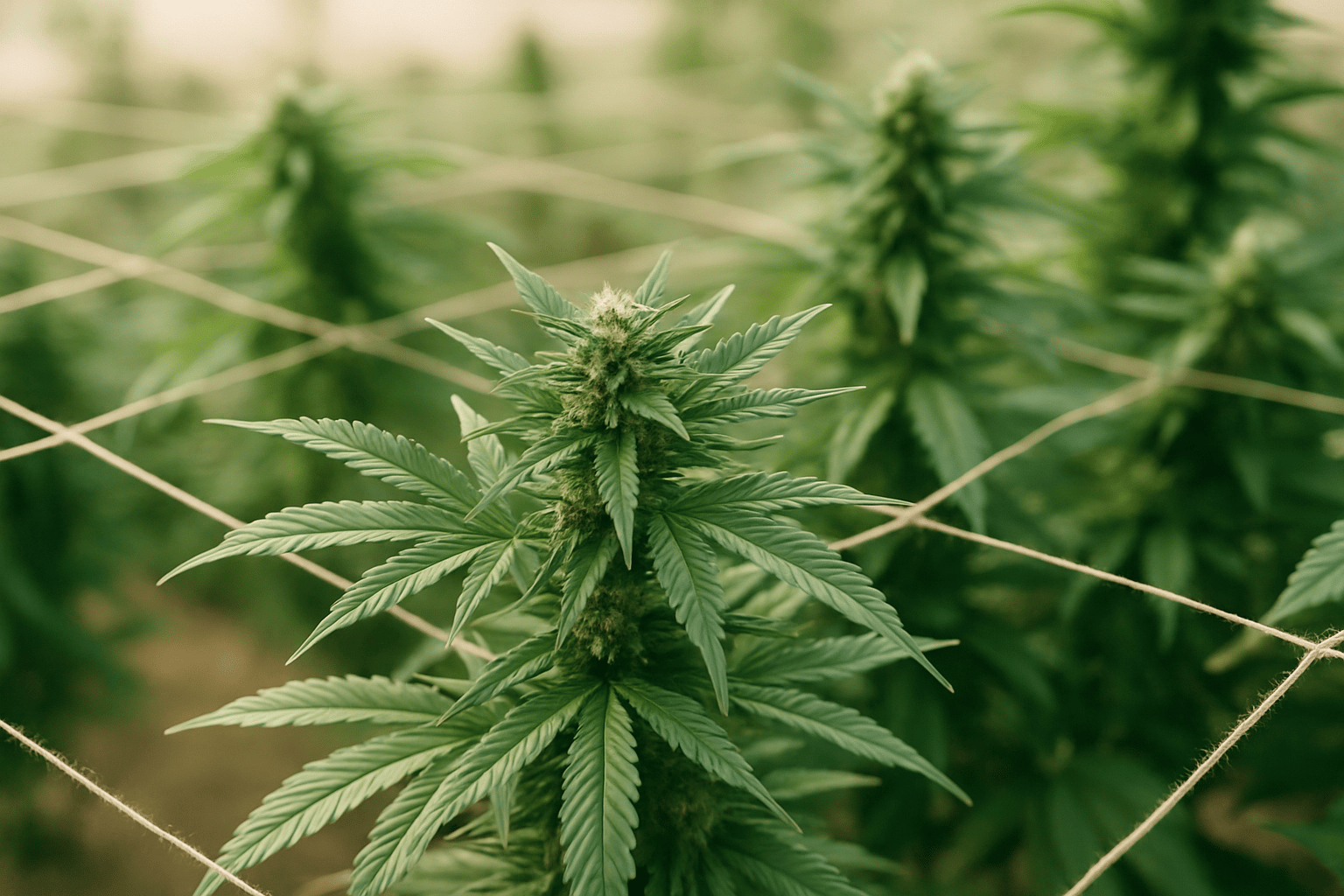
Why a Trellis Makes Such a Big Difference in Cannabis Cultivation
A trellis is far more than just a climbing aid. Used correctly, it becomes a tool that lets you actively control plant structure, light distribution, air exchange, and later the stability of the flower sites. In our experience, this is exactly the point where many grows move from “just letting plants grow” to truly controlled cultivation. Especially with vigorous photoperiod plants, strongly stretching hybrids, and fast-growing clones, a trellis can make the difference between an uneven canopy and a cleanly structured, productive surface.
The biggest advantage is the more even canopy. Instead of one dominant main top with many smaller side branches, you create a broad, flat plant surface. That allows light to hit more bud sites at a similar intensity. Indoors, this directly affects yield because lamps only work efficiently within a limited distance. Outdoors and in the greenhouse, the open structure mainly helps wind and sunlight penetrate deeper into the plant. This reduces damp pockets inside the canopy and significantly lowers the risk of Botrytis. This ties in directly with our article on Botrytis in cannabis, because dense, poorly ventilated plant material is one of the classic triggers.
Another point many people underestimate: a trellis mechanically relieves the plant. Late flowering, heavy tops, rain, or irrigation pressure after hot days can quickly lead to bent or snapped branches without support. A net or horizontal guidance system distributes the weight across many contact points. That is not only convenient, but also protects vascular tissue and prevents stress during a phase when the plant should run as consistently as possible.
What “Trellis” Means in Cannabis Cultivation
In cannabis cultivation, “trellis” usually refers to a horizontal net, a wire grid, or a system of strings through which branches are guided. In practice, there are three useful variants: a classic SCROG net above the pot or bed, a vertical trellis system on walls or fences, and a support trellis used later in flowering for stabilization. Most growers, however, mean horizontal training, where branches are spread under or through a net.
The goal varies slightly depending on the system. With the SCROG approach, you fill an area evenly with shoot tips. With a vertical trellis, the focus is more on opening plants along a structure and controlling height. With a support trellis, load-bearing capacity is the main priority. In practice, these methods are often combined. Outdoors, we often see LST and branch spreading first during the vegetative phase, followed later by a second net or yoyos for stabilization in flowering.
It is important not to confuse a trellis with aggressive pruning. The net does not replace good plant care; it complements it. If you work too late, too hard, or without a plan, you are more likely to slow the plant down. If you want to go deeper into proper pruning technique, also read How to prune cannabis properly: timing & guide and Defoliating cannabis. Both directly affect how well a trellis works.
Which Genetics and Growing Systems Benefit Most from a Trellis
A trellis works best with photoperiod strains that get enough vegetative time to fill the space. Medium to highly vigorous hybrids with good lateral branching are especially rewarding. Sativa-leaning plants often benefit enormously because they naturally bring more stretch and longer internodes. That exact growth pattern can be spread outward very effectively with a net. Compact indica types can also be trellised, but in those cases defoliation and opening up the interior are often more important than pure area distribution.
With clones, the whole process is usually even more predictable than with seed-grown plants. Clones grow more uniformly, respond more evenly to training, and can be brought onto one level more cleanly across multiple plants. In our experience, a trellis in a clone grow is often much more efficient because you have fewer different phenotypes to compensate for. If you work with clones, it is worth reading our guide to cannabis clones.
Autoflowering plants are a special case. Light spreading or gentle LST can work, but a classic SCROG net is often impractical for autos. The reason is simple: they have a fixed time window. If they respond to training or transplant stress with stalled growth, they do not have enough time to recover. That is why, with autos, we prefer early, very gentle guidance rather than a fully occupied trellis.
| Growing situation | Is a trellis useful? | Why |
|---|---|---|
| Indoor, photoperiod strains | Very useful | Optimal light distribution, controlled height, even canopy |
| Greenhouse | Very useful | Better airflow, stability, efficient use of space |
| Outdoor in garden beds | Useful | Wind stability, open structure, easier management of large plants |
| Autoflowering | Limited | Only gentle training, as recovery time is short |
| Small, compact plants without veg time | Less useful | A net is hardly worth it if the space is not filled |
The Right Timing: When to Install the Trellis and When to Train
The best time to install the net is earlier than many people think. Indoors, we usually place the first net 20 to 35 cm above the rim of the pot or above the substrate surface. With very small plants, this is not yet a training signal, but preparation. If the net is only installed once the plant has already shot far above it, guiding becomes unnecessarily stressful and branches break more easily.
We begin the actual training as soon as the branches reach the net or are just below it. The tips are then carefully guided sideways under the next free square. Do not let them grow upward first and then push them back later; guide them early. That is a classic mistake. Young branches are elastic, older ones become fibrous and snap more easily. Especially in the first 10 to 14 days after switching to 12/12, the area can still be filled well because many strains push hard during this stretch phase.
Outdoors and in the greenhouse, the calendar is less important than plant development. As soon as a plant has built enough side branches and can clearly be guided outward, a trellis becomes worthwhile. In the greenhouse, we often use two levels: a first one for shaping during the vegetative phase and a second, higher level as flower support. If you grow under glass, you will find additional tips in Growing cannabis in the greenhouse.
How to Build a Flat, Productive Canopy
The basic idea is simple: every shoot tip should get its own place in the light. In practice, that means repeatedly bending dominant tops sideways and giving weaker branches room to rise upward. This turns one main top into many equally strong tops. We have seen the best results when the area is filled to about 70 to 80 percent before the switch to flowering. The rest is closed during the stretch. If you switch to flower at 100 percent coverage, you often end up with overcrowding and too little airflow later on.
The mesh size should match the plant size. For most indoor grows, 10 x 10 cm to 15 x 15 cm is practical. Mesh that is too small makes the work fiddly, while mesh that is too large provides too little guidance. The net must be taut; otherwise it flexes with the plant and does not provide real control. With large outdoor plants, wider spacing can also work as long as the structure remains stable.
A common misconception is that more branches automatically means better results. In reality, a trellis only increases performance if the plant’s energy goes into well-lit, vigorous tops. Weak, low branches below the net often produce only airy flowers and consume resources. That is why targeted cleanup underneath is useful. Not radically in one session, but gradually. This avoids unnecessary stress and keeps the plant moving smoothly.
Pruning, Defoliation, and Thinning in Combination with the Net
A trellis alone does not solve problems caused by overly dense leaf mass. Especially with plants trained wide, a dense roof of fan leaves forms quickly. That can block light and drive transpiration too high. In our experience, moderate, targeted defoliation around large shading leaves is often more effective than extreme thinning. The main leaves to remove are those that completely shade several shoot tips, grow inward, or rest on damp contact points.
Below the net, the plant should be kept clean. Anything that remains permanently in the shade, gets little airflow, or will not receive full light later can be removed. Many growers call this lollipopping, even though the intensity varies. The reasoning is simple: the plant distributes assimilates more efficiently when it does not have to support too many weak secondary branches. At the same time, air movement beneath the canopy improves significantly.
Timing matters. We prefer to make larger interventions at the end of veg or very early in flowering, not in the middle of bulk formation. In weeks 4 to 6 of flowering, many strains react more sensitively to stress. At that point, it is better to make only minimal corrections. Excessive defoliation during this phase can slow the plant down or disrupt the transpiration balance, which in turn affects irrigation and nutrient uptake.
Irrigation, Feeding, and Climate for Trellis-Trained Plants
Plants trained wide behave differently in terms of climate than upright single-cola plants. Leaf area is often larger, transpiration is distributed more evenly across the surface, and the air beneath the canopy must be actively moved. Indoors, that usually means at least one airflow under the net and one above the canopy, without blasting the plants constantly. The goal is leaf movement, not wind stress. In flowering, depending on the week and genetics, we generally aim for around 40 to 55 percent relative humidity so dense flowers do not enter critical moisture ranges.
Irrigation also changes in practical terms. Once a net is full, access to the pots becomes more difficult. That is why clean planning in advance is worthwhile: saucers, drainage access, a watering wand, or drip irrigation. A common mistake we see is uneven watering around the edge of the pot because access is restricted. That leads to dry zones, salt buildup, and later deficiency symptoms that are wrongly interpreted as a feeding problem. For the basics, How to water cannabis properly is a good companion article.
As for nutrient supply, an even canopy often also means more even metabolic performance, but not automatically higher demand at every stage. Many growers overfeed plants after heavy training because they expect “more performance.” In practice, a stable EC level is more important than aggressive increases. Especially in coco or mineral systems, you should watch leaf color, leaf posture, and drain EC response. If you want to go deeper, you will find the right fundamentals in Fertilizing cannabis and Understanding EC and PPM in detail.
Common Trellis Growing Mistakes and How to Avoid Them
The first major mistake is training too late. Once branches have become woody, bending them quickly leads to crushing or breaks. Smaller injuries often heal, but every repair costs energy. It is better to make small adjustments every two to three days than to intervene roughly once a week. With trellising, consistency matters more than force.
The second mistake is overcrowding. Many growers are happy when every square is occupied, only to realize later that the canopy has become too dense. The result is shaded zones, damp microclimates, and small flowers in the interior. A good canopy is not just full, but also permeable. If, from above, you can barely see more than a few centimeters into the plant, there is usually too much material in play.
The third mistake concerns strain selection. Not every genetic responds the same way. Very sensitive or already stressed plants should not be trained hard on top of that. Restraint is also advisable under disease pressure, root problems, or pest infestations. A trellis is not a tool for rescuing weak plants. It is a tool for guiding healthy plants more effectively. That is exactly why the foundation has to be right: vigorous starting material, a clean root zone, suitable climate, and stable irrigation.
Adapting Trellising Properly for Indoor, Greenhouse, and Outdoor Grows
Indoors, trellising can be controlled most precisely. You work with a defined light source, a clear area, and a predictable stretch phase. This is where the classic SCROG system is strongest. Especially in tents with limited height, it offers major benefits because you can control the distance to the lamp and avoid hotspots. The key is that the lighting must match the spread-out area. A broad, flat plant under a lamp that is too weak or uneven loses the main advantage of the system. This pairs well with our article on cannabis lighting.
In the greenhouse, moisture management plays a major role alongside light. Plants can become very large very quickly there, while warm days and cool nights increase the risk of condensation and mold. A trellis helps keep the structure open and branches distributed cleanly. We like to use robust, UV-resistant nets there and maintain enough distance from glass panes or plastic walls so no plant material rests against damp surfaces.
Outdoors, the system has to withstand wind, rain, and growth surges. Pure plastic nets are sometimes too flexible here. More stable frames, bamboo, metal grids, or tensioned ropes often work better. Especially with large bed-grown plants, a modular setup is worthwhile: early spreading, later support level, and possibly additional individual ties for heavy tops. If you grow outdoors, also take a look at Growing cannabis in the garden and Growing cannabis seeds outdoors.
Harvest Planning for Plants in a Net
By flowering at the latest, it becomes clear whether the trellis was built well. An even canopy usually ripens more uniformly because the tops receive similar amounts of light. Still, you should not blindly assume everything will finish at the same time. Some edge areas or tops that rose later may develop differently. That is why we check ripeness not only on the highest, prettiest flowers, but at several positions across the canopy.
One practical point matters: plants in a net cannot simply be carried out of the tent or greenhouse. So plan access, trimming workflow, and harvest procedure early. In densely scrogged grows, many growers free individual branches directly at the net and harvest in sections. That is cleaner than trying at the last moment to remove the whole plant from the structure. Drying should also be prepared, because a full trellis often produces more uniform flower material than it appears at first glance.
If you want to optimize harvest timing and post-harvest handling, Harvesting cannabis and Curing cannabis will help. Especially with dense, well-ripened flowers, proper drying determines whether structure, aroma, and smoke quality are preserved.
When a Trellis Makes Less Sense
A trellis is not automatically the best solution. If you are growing very few plants with lots of space and a natural growth habit, simple tying down or selective support may be completely sufficient. It is also less useful when plants need to be moved frequently, access is tight, or crop times are very short. We often see this with growers who want to work spontaneously: as soon as watering, defoliation, or inspection is needed, the net becomes a barrier.
It is also less useful with unstable frame constructions. A poorly tensioned net creates a false sense of security. As soon as the flowers become heavy, everything sags and the branches end up lying on each other again. Then you get the disadvantages of a dense canopy, but hardly any guidance. If you trellis, do it with a clean construction, sufficient accessibility, and a realistic plan for the entire crop through harvest.
So the key question is not whether a trellis looks “modern” or “professional,” but whether it fits your genetics, space, and workflow. Used correctly, it is one of the most effective tools for building cannabis plants in a controlled, healthy, and high-yielding way. Used incorrectly, it makes the grow unnecessarily complicated. That is exactly why it is worth using the technique deliberately rather than just following a formula.
Sources
- J. C. Cervantes – “Marijuana Horticulture: The Indoor/Outdoor Medical Grower’s Bible”, 2006
- Ed Rosenthal – “Marijuana Grower’s Handbook”, 2010
- Royal Queen Seeds – “SCROG Growing Guide: How to Use the Screen of Green Method”, 2023
- Ohio State University Extension – “Trellising Vegetable Crops”, 2021

About the Author – Ben
Ben has been intensively involved in the cultivation and care of cuttings and the healthy development of plants during the growth phase for several years. His focus lies on low-stress training methods, stable growth conditions, and avoiding common care mistakes. The content is based on practical experience, proven methods, and real observations from daily work with young plants.
Expert contribution & updates: Hannah – Research, contextualization of current methods and observation of new developments.
This article was created with AI support and editorially reviewed.
More about the team behind LeafConnect