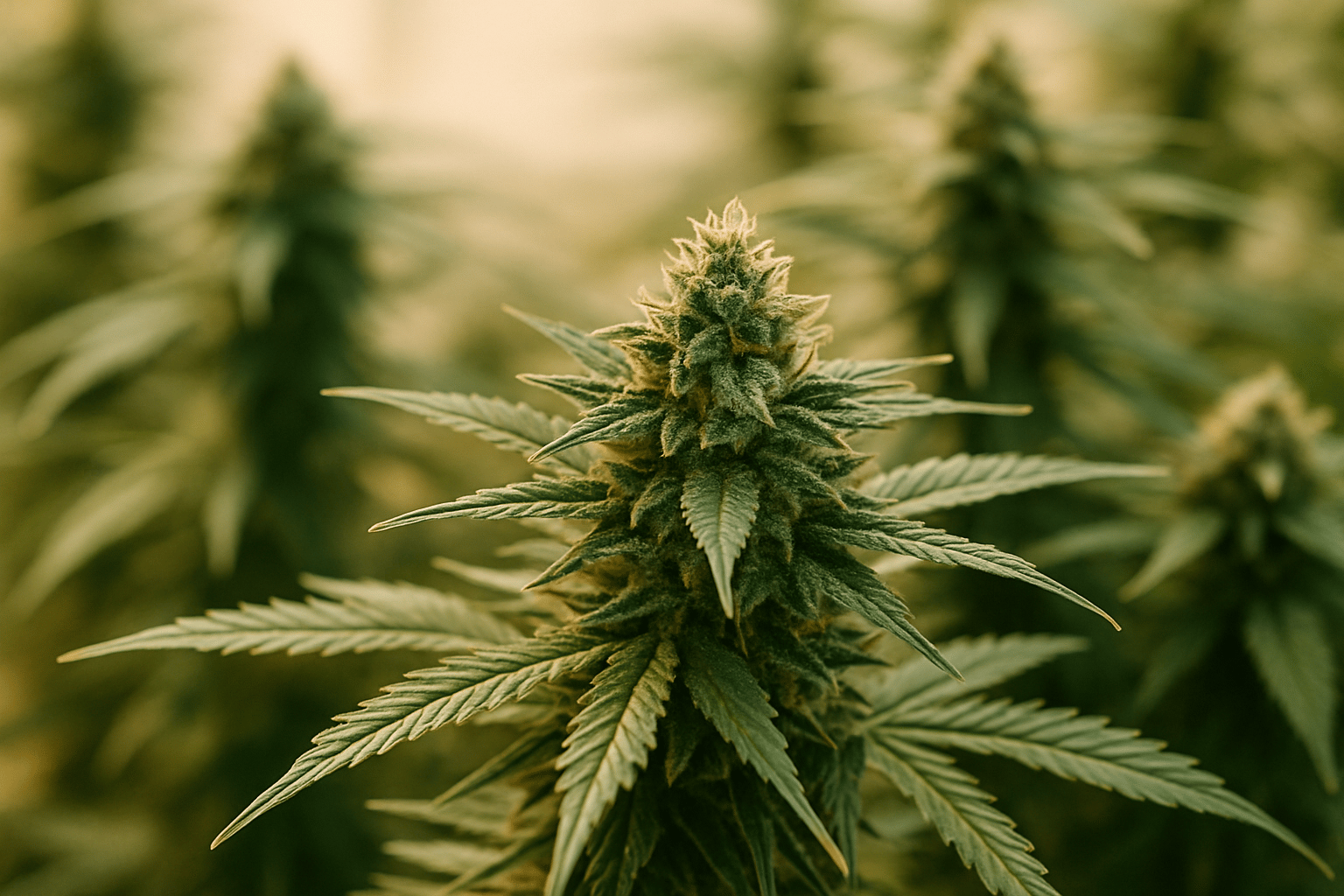
Why Cannabis Smells at All
The typical cannabis odor does not arise by chance, but is the result of a complex chemical mixture. The main compounds responsible are terpenes—volatile aromatic compounds that the plant produces in its resin glands. These substances determine whether a cultivar smells more like citrus, pine, diesel, herbs, earth, or sweet fruit. In our experience, many growers underestimate how strongly even small differences in the terpene profile can change perception. Two plants with similar THC content can present themselves in completely different olfactory ways.
There is also this: odor is not only a matter of genetics, but also of the concentration of volatile compounds in the air. As soon as flowers, sugar leaves, or fresh plant material are moved, cut, or warmed, more aromatic compounds are released. That is why cannabis often smells significantly more intense in late flowering, during trimming, and especially during drying than in the vegetative stage. Anyone who wants to understand odor must therefore look not only at the cultivar, but also at the plant’s current working or ripening stage.
A common misconception is that only THC-rich plants smell strongly. That is not correct. CBD-rich genetics can also be very aromatic if they come with a pronounced terpene profile. Anyone specifically looking for milder plants should therefore pay attention not only to cannabinoids, but also to the genetic expression of aroma. Depending on the goal, both THC seeds and CBD clones can be of interest.
Terpenes, Resin Glands, and the Actual Odor Carriers
The most important odor carriers are found in the trichomes, the resin glands on flowers and small leaves. In addition to cannabinoids, terpenes and other secondary plant compounds are also formed there. In practice, we most often encounter myrcene, limonene, caryophyllene, pinene, terpinolene, and humulene. Myrcene often comes across as earthy, musky, and heavy; limonene as fresh and citrus-like; while caryophyllene contributes peppery and spicy notes. This explains why some cultivars smell “loud” and pungent, while others are softer, sweeter, or more herbal.
What matters here is this: it is not only the amount of a single terpene that determines the effect, but the interaction of many components. In practice, we have often seen plants with a moderate overall odor perceived as stronger when certain pungent notes dominate. A “gassy” or sulfurous-diesel phenotype is often noticed more quickly in enclosed spaces than a sweet, fruity plant with similar resin production. Anyone who wants to control odor should therefore take cultivar choice and phenotype selection seriously.
Flavonoids also play a role in the overall sensory impression, even if less directly than terpenes. They influence aroma, flavor, and the sensory depth of the final product. Anyone interested in these relationships can find additional background in the article Cannabis flavonoids. This knowledge is especially worthwhile for demanding growers because it helps them understand aroma not only as a problem, but also as a quality trait.
When Cannabis Smells the Strongest: From Veg to the Jar
During the vegetative stage, the odor is usually still manageable. Healthy plants can already be aromatic when touched, but major odor development normally begins with the onset of pre-flowering and increases significantly from weeks 3 to 5 of flowering. Especially in the last two to three weeks before harvest, intensity often rises sharply again. At this stage, resin production is high, flower mass increases, and the plant releases more volatile compounds. That is exactly why many beginners are surprised that a grow can remain relatively inconspicuous until shortly before the end and then suddenly “explode.”
It becomes even more intense during work on the plant. Defoliating, pruning, bending, trimming, or moving mature colas immediately releases additional waves of odor. This is especially true at warm room temperatures above 26 °C, because terpenes evaporate faster under those conditions. In our experience, it is therefore not only the flowering phase itself that is critical, but above all everything related to harvest and post-harvest handling. Anyone who ignores this often ends up with a well-filtered box—and yet the whole apartment suddenly smells as soon as harvest begins.
The issue also does not end after harvest. During drying, fresh material often smells “green,” grassy, and moist. Only during the subsequent curing does the actual cultivar aroma develop more clearly. How closely odor and quality are linked at this stage is also shown by the processes involved in fermenting cannabis. Poorly dried flowers not only smell less controllable, but also often lose valuable terpenes or develop undesirable notes.
Which Factors Intensify or Reduce Cannabis Odor During Cultivation
The first major factor is genetics. Some lines are naturally more discreet, while others are notorious for extreme pungency. Kush, Skunk, Diesel, or modern US hybrids are often much more odor-intensive than milder, herbal, or CBD-dominant cultivars. That does not mean quieter cultivars are automatically worse—they are simply often more practical for discreet setups. Anyone growing outdoors should choose cultivars especially carefully. Our notes in growing cannabis in the garden also fit this topic well.
The second factor is climate. Higher temperatures and excessively low humidity promote the evaporation of volatile aromatic compounds. Indoors, we have had good results with flowering temperatures of around 22 to 26 °C with lights on and 18 to 22 °C with lights off. If temperatures remain above that range, the odor often becomes more aggressive and terpene stability suffers. Air that is too dry can also stress the plant. A certain amount of stress sometimes increases resin production, but too much of it reduces overall quality.
The third factor is plant health. Overfertilization, root stress, waterlogging, or pest pressure affect not only growth and yield, but also aroma. Plants that are constantly struggling often develop an unbalanced scent profile. That is why odor and clean cultivation practices are closely linked. Anyone who wants to improve water and nutrient management should also look into watering cannabis properly and fertilizing cannabis. In practice, we repeatedly see that supposed “odor problems” are actually cultivation problems.
Controlling Odor in an Indoor Grow: What Really Works
The most important measure in indoor cultivation is a properly matched exhaust system with a sufficiently sized carbon filter. Everything else is secondary. A filter only works reliably when airflow, duct diameter, fan output, and system airtightness all match. One common mistake is using a filter that is too small with a fan that is too powerful. In that case, the air’s contact time with the activated carbon decreases, and odors are not fully captured. Conversely, even a good filter does little if hoses and connections are leaking.
In our experience, the room or tent should always run under slight negative pressure. In a tent, you can recognize this by the walls pulling inward slightly. If this negative pressure is missing, unfiltered air escapes through zippers, cable ports, or small leaks. That is exactly where the classic “I can’t smell anything at the filter, but the hallway stinks” problems come from. In addition, the air in the tent should be moved evenly so that no stagnant odor pockets form.
Ozone, fragrance sprays, or gel products are often sold as quick fixes. For the grow room itself, however, they are at best supplementary measures outside the plant area, never a substitute for filtration. Ozone can harm plants and human health if used incorrectly. Fragrance gels only mask odors superficially and can negatively affect the aroma of the harvest. If discretion matters, there is no way around good equipment. Anyone working in a greenhouse should also keep in mind that different airflow patterns and temperature spikes occur there than in a tent; the article growing cannabis in a greenhouse is relevant here as well.
Odor Outdoors and in the Greenhouse: Different Rules Than in a Tent
Outdoors, odor cannot be “filtered,” only mitigated through site selection, cultivar choice, and timing. Wind direction, neighbors, hedges, walls, and the microclimate play a bigger role than many people initially think. A plant that seems harmless in the garden itself can suddenly become noticeable much farther away in damp morning air or warm evening wind. This becomes especially problematic in late summer, when flower mass increases and the air often becomes heavier and more stagnant.
We have had good results by not placing highly aromatic plants directly along property lines or frequently used paths. Companion plants such as lavender, rosemary, mint, or tomatoes do not solve the problem completely, but they can break up odor perception at close range. This is not a magic trick, but rather a sensory buffer. Anyone who believes cannabis can be invisibly “perfumed away” with this method will be disappointed. This measure only makes sense as part of an overall concept.
In the greenhouse, the situation is mixed: on the one hand, the structure protects against rain and creates a more controllable climate; on the other hand, odor can build up inside and escape suddenly during ventilation. Especially on hot days with automatic window openers or open doors, this can create a pronounced odor spike. That is why it is worth planning ventilation times and temperature management deliberately instead of simply reacting to maximum heat removal.
Harvest, Drying, and Storage: Where the Biggest Odor Mistakes Happen
The single strongest odor event in many grows is not flowering, but harvest. As soon as ripe plants are cut and handled manually, trichomes are damaged and terpenes are released massively. Anyone who needs to work discreetly should therefore not trim during the day with open windows, and should not underestimate how long the smell lingers in textiles and room air. In our experience, a separate, well-controlled drying room with its own exhaust is often more important than perfection in the flowering tent.
For drying, around 16 to 20 °C and 55 to 60 % relative humidity have proven effective. Under these conditions, flowers usually dry evenly in 7 to 14 days without hardening too quickly on the outside while remaining moist inside. Drying too warm and too fast drives terpenes out of the flower, which initially shifts the odor strongly into the room, but often leaves a flat aroma in the final product. Drying too damp, on the other hand, increases the risk of musty notes and mold.
After drying, storage determines odor stability. Airtight jars, cool temperatures, and darkness are the foundation here. Anyone storing flowers in warm rooms or unsuitable plastic containers often loses part of the cultivar character within just a few weeks. At the same time, poorly sealed containers can release odor to the outside. This is one reason why professional-looking harvest work always includes cleanly organized storage. For the right harvest timing and gentle processing, it is also worth consulting harvesting cannabis.
Odor as a Quality Trait: When Intense Is Good—and When It Is Not
A strong odor is not automatically proof of quality, but it is often an indication of good terpene development. High-quality flowers generally smell clear, cultivar-typical, and layered. It becomes problematic when the odor seems dull, hay-like, ammonia-like, musty, or sharply chemical. Such notes often indicate mistakes in drying, storage, contamination, or microbial issues. Musty nuances in particular should be taken seriously, as they may indicate moisture or mold.
Another practical point: fresh flowers do not always smell “perfect” right away. Directly after drying, the aroma is often still unsettled, somewhat green, or edgy. Only after several weeks of proper curing does the profile become rounder. This is one reason why many beginners judge their harvest too early. Anyone who judges too quickly mistakes immature aroma for poor genetics. Conversely, a flower that is initially extremely loud can lose expression surprisingly fast after improper storage.
Pests, diseases, or latent stress factors also influence odor indirectly. Botrytis, for example, can begin unnoticed in dense flowers and first become apparent through a slightly musty undertone before visible symptoms become clear. If aroma suddenly turns, you should therefore not think only about terpenes, but always also check plant health and post-harvest conditions.
Quick Overview: Odor Sources and Suitable Measures
To keep odor from becoming a matter of chance, it helps to assess it soberly by phase and cause. The following overview reflects very well what we most commonly see in practice.
| Phase / Situation | Typical Odor Intensity | Common Cause | Useful Measure |
|---|---|---|---|
| Vegetative stage | Low to medium | Leaf mass, contact, early resin formation | Light exhaust, clean airflow, cultivar choice |
| Early flowering | Medium | Increasing terpene production | Check filter performance, ensure negative pressure |
| Late flowering | High to very high | Maximum resin and flower mass | Keep carbon filter fresh, seal leaks |
| Harvest / trimming | Very high | Mechanical release of terpenes | Separate room, good exhaust, short work windows |
| Drying | High | Moisture + evaporation of aromatic compounds | 16–20 °C, 55–60 % RH, filtered exhaust |
| Storage | Low to medium | Leaky containers, heat, light | Airtight jars, store cool and dark |
Typical Misconceptions About Cannabis Odor
A very widespread misconception is: “If I defoliate the plant often, it will smell less.” In reality, the opposite is usually true, at least in the short term. Every cut and every mechanical stress releases aromatic compounds. Defoliation can make sense for cultivation reasons, such as air circulation or light distribution, but it is not an odor strategy. Anyone doing it should only carry out the measure when it makes sense from a plant-physiological standpoint—not as improvised odor control.
The next misconception: “Cold temperatures make the smell disappear completely.” A cooler climate does reduce the evaporation of volatile compounds, but it does not solve the problem. Temperatures that are too low can also slow metabolism and ripening. The goal is not to “freeze the smell out” of the plant, but to create a stable climate that supports both quality and discretion. Extreme fluctuations between day and night are usually counterproductive.
And then there is the assumption that odor can be reliably neutralized with household remedies. Coffee, vinegar, scented candles, or essential oils may mask things somewhat in living spaces for a short time, but they do not remove odor molecules from the exhaust air. Anyone who seriously wants to remain discreet should not rely on tricks. Solid equipment, suitable genetics, and clean post-harvest handling are the solutions that work in the long term.
Sources
- National Academies of Sciences, Engineering, and Medicine – “The Health Effects of Cannabis and Cannabinoids”, 2017
- Potter, David J. – “The Propagation, Characterisation and Optimisation of Cannabis sativa L. as a Phytopharmaceutical”, 2009
- McPartland, John M.; Russo, Ethan B. – “Cannabis and Cannabis Extracts: Greater Than the Sum of Their Parts?”, 2001
- Hazekamp, Arno; Fischedick, Justin T. – “Cannabis – From Cultivar to Chemovar”, 2012

About the Author – Hannah
Hannah focuses on researching, contextualizing, and observing current developments in plant care and modern cultivation techniques. Her focus lies on new methods, optimizing growth conditions, and making complex topics accessible. Her content complements practical experience with analysis, updates, and a keen eye on emerging trends.
Content is regularly reviewed and updated.
This article was created with AI support and editorially reviewed.
More about the team behind LeafConnect