
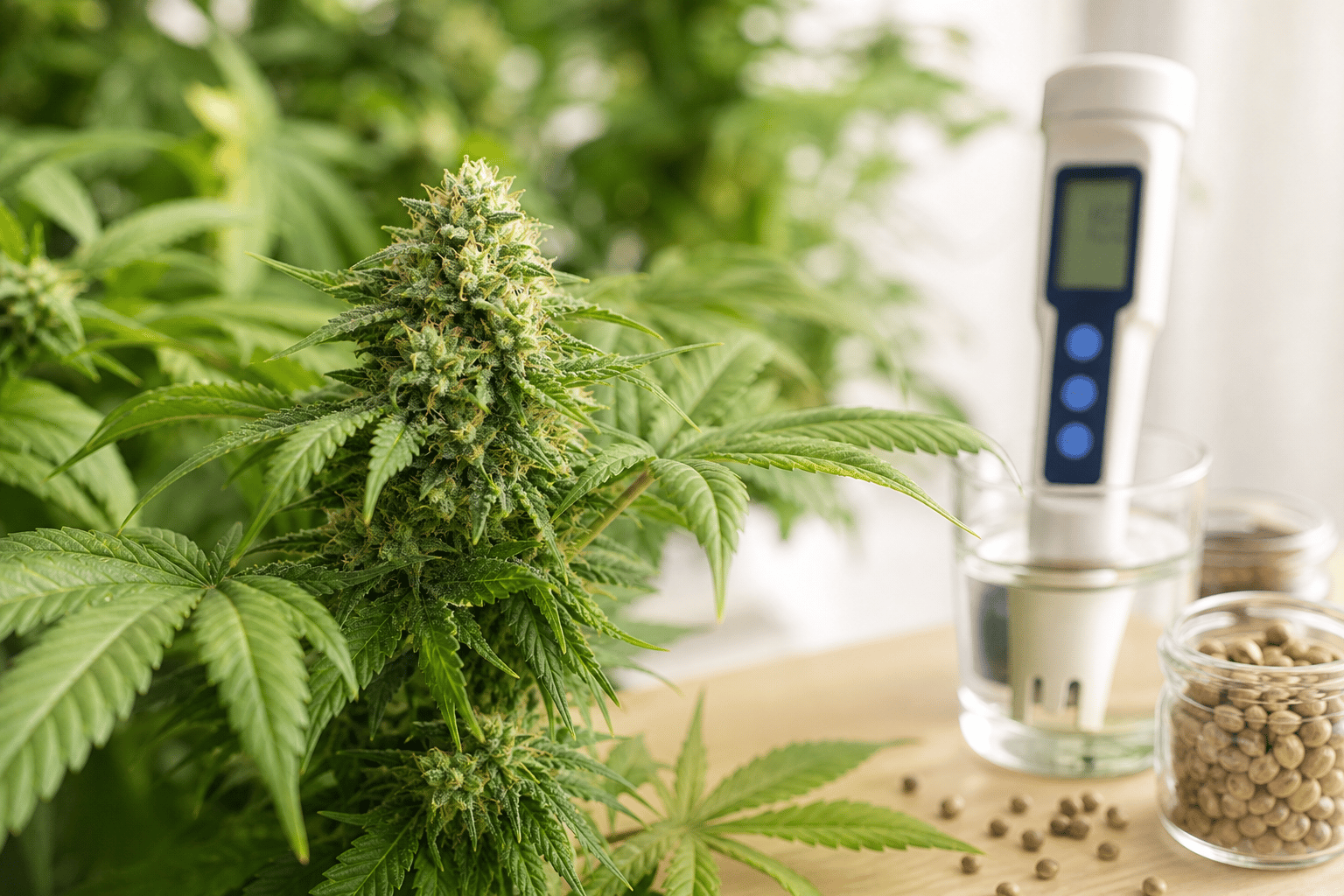
Why EC Is So Important in Cannabis Cultivation
EC is one of the measurements that is regularly misunderstood in cultivation. Many growers treat it like an isolated target value: dip in the meter, read the number, feed according to a chart. In practice, that rarely works cleanly. First and foremost, EC only tells you how well a solution conducts electricity. This conductivity increases with the amount of dissolved salts in the water – typically nutrients, but also existing lime, sodium, or other minerals from the source water.
That is exactly why EC is not a direct “feeding command,” but a control tool. In our experience, it is especially valuable when you read it together with pH, substrate, watering rhythm, temperature, and plant appearance. An EC of 1.6 can be perfectly suitable in coco, but already too much in heavily pre-fertilized soil. Conversely, a low value in rockwool can indicate underfeeding, while the same number has little meaning in living soil. Anyone who understands this makes far better decisions than someone who simply copies charts.
A common mistake we keep seeing: only the EC of the freshly mixed nutrient solution is measured, but the runoff or the medium itself is never monitored. As a result, salt buildup, root zone stress, and creeping pH shifts go unnoticed for a long time. When plants then show burnt leaf tips, dark foliage, or blocked calcium uptake, even more fertilizer is often added – even though the real problem is already an overloaded root zone. If you want to dive deeper into the interaction between nutrients and dosing, our article Fertilizing Cannabis: Nutrients, Dosage, and Common Mistakes Under Control is also worth reading.
What EC Actually Measures – and What It Does Not
EC stands for Electrical Conductivity. It is usually measured in mS/cm. The higher the concentration of dissolved ions, the higher the conductivity. That sounds simple, but there is a catch: the meter does not detect which ions are in the water. It does not distinguish between useful nitrate, calcium, and magnesium or unwanted sodium and chloride. Two solutions with the same EC can be nutritionally completely different.
This is especially important with hard tap water. If your source water already has an EC of 0.5 to 0.8, that does not automatically mean you already have a good base supply of calcium and magnesium. Sometimes a large part of the conductivity comes from bicarbonates, which tend to push your pH up rather than supply the plant in a meaningful way. In soft water with an EC of 0.1 to 0.2, on the other hand, buffering capacity is often lacking, which also has consequences for your nutrient strategy.
PPM values add even more confusion. Many meters display a PPM number instead of EC, which is only converted from conductivity. The problem: there are different conversion factors, such as 500, 640, or 700 scales. A value of 900 ppm can mean significantly different things depending on the scale. That is why, in practice, we prefer to work directly with mS/cm whenever possible. If you want to break this topic down in more detail, you can find a suitable fundamentals article here: Understanding EC and PPM in Cannabis Cultivation in Detail.
EC, pH, and Substrate: Why a Target Value Alone Is Never Enough
The biggest misconception in EC management is the assumption that plants take up nutrients based on concentration alone. In reality, the root environment determines what is available. The pH value directly affects which elements remain in solution and which are taken up less efficiently. So you can run a “perfect” EC and still see deficiency symptoms if the pH is outside the useful range or the root zone is too wet, too cold, or too saline.
The substrate also massively changes how meaningful the EC value is. In soil, organic components and cation exchange sites buffer fluctuations. That makes soil slower to react, but also less transparent. In coco, the response is faster and EC is much more meaningful because the medium is less forgiving and must be managed more tightly. In rockwool, control is the most direct: what you feed affects the root zone almost immediately. But that is also where measurement errors or overdosing become visible the fastest.
In our experience, this interaction is especially important when growers switch between substrates. Anyone moving from soil to coco while keeping the same watering style often runs into problems. Coco usually requires more frequent, controlled nutrient applications with a clean runoff strategy. Our article Growing Cannabis in Coco Coir fits well here. For an overview of the differences between soil, coco, rockwool, and living soil, The Best Substrates for Cannabis Compared Directly is also helpful.
Practical Ranges for Different Growth Stages
There are no universal ideal values that apply to every genetic, every water source, and every setup. Still, guideline ranges are useful as long as you understand them as a starting point. Young plants and freshly rooted clones are sensitive to high salt concentrations. At this stage, less is almost always better than too much. A plant with a small root system cannot process high EC values cleanly, even if the foliage above ground still looks vigorous.
As root mass increases, tolerance rises. In the vegetative phase, EC can be increased gradually, provided the plant is actively growing, taking up water regularly, and showing no signs of stress. In flowering, growers often run slightly higher values, but the same principle applies here: demand does not rise linearly. Values that are too high often lead, especially in later weeks, to burnt tips, dark foliage, blocked micronutrient uptake, and unnecessarily high salt levels in the substrate.
The following table is intended as a rough working range, not a rigid recipe. It refers to the finished nutrient solution including source water and is mainly suitable for mineral-fed systems in coco or rockwool. In pre-fertilized soil, sensible addition values are often lower.
| Stage | Typical EC Range | Practical Note |
|---|---|---|
| Rooted young plants / fresh clones | 0.4–0.8 mS/cm | Feed only lightly, establish roots first |
| Early vegetative stage | 0.8–1.2 mS/cm | Only increase if the plant is visibly progressing |
| Strong vegetative growth | 1.2–1.6 mS/cm | Watch leaf color, internode spacing, and water uptake |
| Early flowering | 1.4–1.8 mS/cm | Make the transition in small steps, not abruptly |
| Mid flowering | 1.6–2.0 mS/cm | Only with a healthy root zone and stable runoff |
| Late flowering | 1.2–1.8 mS/cm | Often, slightly less is cleaner than constantly increasing |
These ranges are deliberately conservative. In our experience, many home growers are more successful with moderate EC values than with aggressive feeding plans. Especially under LED, with relatively cool roots, or in smaller pots, nutrient uptake is often slower than manufacturer charts suggest.
How to Measure EC Correctly
A meter is only as good as the way it is used. Calibration is often neglected, even though small deviations can have major consequences in day-to-day practice. Good practice is to check the EC meter regularly with a suitable calibration solution and keep the probe clean. Fertilizer residue on the electrode distorts the reading. Equally important: the temperature of the solution affects conductivity. Many modern meters have automatic temperature compensation, but even that is not a free pass for sloppy measuring routines.
You should measure at least three points: the source water, the finished nutrient solution, and – with mineral feeding – the runoff. Only these three values together show you what is really happening. If your irrigation water starts at 0.3, your nutrient solution is at 1.5, and the runoff consistently comes out at 2.2, salts are building up in the medium. That is a clear signal to review the strategy: lower concentration, more even irrigation, or a proper reset of the medium.
The mixing order also matters. First water, then base nutrients, then additives, mix everything thoroughly, and only adjust pH at the end. Anyone pouring components in at the same time risks precipitation – especially with calcium- and phosphate-heavy products. In that case, the measured EC may still look correct, but nutrient availability no longer is. That is one reason why two tanks with the same final value can perform completely differently in practice.
Reading Runoff EC: What Is Really Happening in the Root Zone
In day-to-day growing, runoff is one of the most underestimated indicators. Especially in coco and rockwool, it is worth its weight in gold because it shows how the root zone is developing compared to the feed solution. If runoff EC is only slightly above the input, that is usually not critical. If it rises significantly above it, salts are accumulating. If it is lower, that can indicate strong uptake, dilution from residual moisture, or overall feeding that is too weak – depending on watering frequency and plant condition.
What matters is the trend, not a single reading. A one-time high value after a dry phase is different from a runoff EC that rises over several days. That is why we focus less on snapshots and more on patterns: how does the value develop over several irrigations? What does the runoff pH look like at the same time? Is the plant getting lighter, darker, thirstier, or more sluggish? Only this combination makes the measurement truly useful.
A classic practical example: in coco, the plant is watered at 1.8 mS/cm, runoff rises to 2.4 to 2.6, the leaf tips become slightly necrotic, but the leaves remain dark green. Many interpret this as a phosphorus or potassium demand in flowering and increase feeding further. In reality, the root zone is often already overloaded. In such cases, a slight reduction in input EC and a proper runoff percentage usually helps more than additional fertilizer.
Typical Mistakes in EC Management
Increasing too quickly: One of the most common beginner mistakes is aggressively raising EC as soon as the plant looks good. Healthy growth is not a signal to automatically keep increasing concentration. In our experience, many plants respond better to stability than to maximum feeding. Especially after transplanting, pruning, temperature drops, or lighting changes, you should not add extra pressure through EC.
Ignoring source water: Anyone focusing only on the target number of the nutrient solution often overlooks water quality. Hard water can supply calcium and magnesium, but it can also bring a lot of buffering. Very soft water often requires a different strategy. Without a water analysis or at least a basic measurement, you are quickly guessing in the dark when deficiency symptoms appear.
Confusing EC with “more food = better”: High values do not automatically make plants stronger. Too much salt increases osmotic pressure. The root then has to work harder to take up water. Paradoxically, the result can look like thirst even though there is enough moisture in the pot. The plant droops, the leaf edges burn, and many growers then water even more often – which further worsens oxygen supply in the root zone.
Only reacting to leaf damage: By the time tip burn, clawing leaves, or interveinal chlorosis become visible, the problem has often been developing for a while. Anyone regularly checking input and runoff spots missteps earlier. Our guide How to Water Cannabis Correctly: Water, Timing, and Common Mistakes Under Control also fits well here, because in practice irrigation and EC cannot be separated.
Recognizing EC Problems on the Plant and Interpreting Them Correctly
EC that is too high often shows up first at the leaf tips. The tips dry out and turn yellow to brown, while the rest of the leaf initially remains dark green. Later, leaves may claw downward, growth slows, and the plant appears unsettled despite sufficient moisture. Especially under strong light, such symptoms become more severe because transpiration and nutrient flow are more tightly linked. The problem can then quickly look like light stress or calcium deficiency, even though the cause lies in the root zone.
EC that is too low usually looks different: lighter leaf color, slower growth, thinner shoots, and overall less vigor in the plant. But caution is needed here as well. Not every pale leaf automatically means “more fertilizer.” If the pH is off or the roots are too cold, the plant may struggle to absorb certain elements despite sufficient EC. That is why you should never react to just one symptom, but always read the whole picture.
One point many underestimate: environmental conditions shift the ideal EC range. At root temperatures below about 18 °C, uptake performance drops noticeably. In very dry air, evaporation behaves differently than in high humidity. Under such conditions, a value that was suitable last week can suddenly seem too high or too low. Good growers therefore manage not just the fertilizer, but the entire system.
Differences Between Soil, Coco, Rockwool, and Outdoor
In soil, EC is useful, but only directly interpretable to a limited extent. Pre-fertilized soils, organic components, and microbial processes buffer a lot. A low irrigation EC there does not automatically mean underfeeding, and a high runoff EC is not always as clear-cut as it is in inert media. In soil, we therefore work more through plant observation, watering behavior, and restrained supplemental feeding than through hard target numbers.
In coco, EC control is much more practical. The medium holds water well, but it does not buffer nutrients as strongly as soil. That allows more precise control, but also requires more consistent measuring. A stable supply of calcium and magnesium is especially important here, along with a watering rhythm that prevents salt accumulation. Anyone treating coco like soil and watering too infrequently often creates high root zone EC without realizing it.
In rockwool, the response is the most direct. Small mistakes in concentration, pH, or irrigation intervals show up quickly. In return, the system can be controlled very precisely. Outdoors, on the other hand, EC is more of a tool for the nutrient solution than for the overall assessment of the root zone. Rain, soil life, soil type, and temperature make rigid target values less meaningful. Anyone growing outdoors should see EC more as a guideline for liquid feed applications and factor the site in more strongly. Depending on your setup, our articles Growing Cannabis in the Garden and Growing Cannabis in the Greenhouse are a good fit here.
A Practical Strategy for Stable EC Values
The most reliable growers work in small steps. Instead of reinventing EC at every watering, a calm rhythm is worthwhile: measure source water, mix the nutrient solution properly, adjust pH, record input, check runoff regularly, and document plant appearance as well. Even a simple log with date, EC, pH, room temperature, and notable observations saves a lot of guesswork later.
We have had good results making only moderate changes – often in steps of 0.1 to 0.2 mS/cm. That is more than enough to see a response without abruptly stressing the root zone. If plants are very dark, drinking little, and runoff remains high, it is better to reduce. If they turn light green, drink actively, show stable runoff, and growth slows, you can raise it carefully. This approach is slower than rigid feeding charts, but in a real grow room it is usually much more precise.
If you have persistent problems, do not just keep adjusting the fertilizer. Then it is worth looking at root temperature, pot size, oxygen in the medium, water quality, and irrigation frequency. Recurring calcium or magnesium issues in particular are often not simply a matter of “giving more,” but an interaction of pH, salt level, and evaporation. That is why EC is not an end in itself. Used correctly, it is an early warning system that helps make the root zone readable.
Sources
- Royal Horticultural Society – “Electrical Conductivity (EC) and Plant Nutrition in Container Growing", 2022
- Cornell University Controlled Environment Agriculture – “Nutrient Solution Management in Hydroponic Systems", 2021
- University of California Agriculture and Natural Resources – “Managing Salinity and Nutrient Concentration in Soilless Culture", 2020
- Jones, J. B. – “Hydroponics: A Practical Guide for the Soilless Grower", 2016

About the Author – Ben
Ben has been intensively involved in the cultivation and care of cuttings and the healthy development of plants during the growth phase for several years. His focus lies on low-stress training methods, stable growth conditions, and avoiding common care mistakes. The content is based on practical experience, proven methods, and real observations from daily work with young plants.
Expert contribution & updates: Hannah – Research, contextualization of current methods and observation of new developments.
This article was created with AI support and editorially reviewed.
More about the team behind LeafConnect