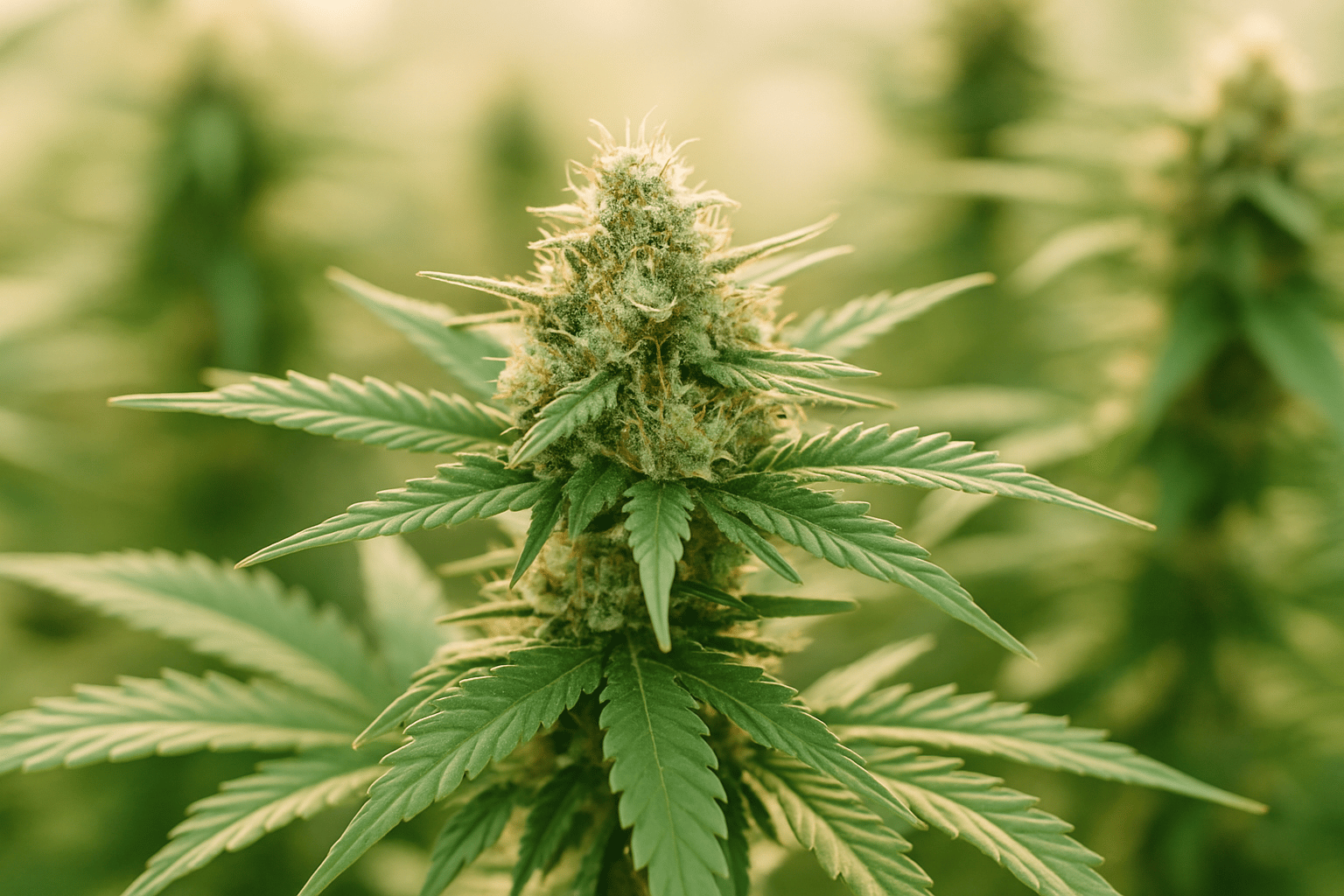
What Lollipopping Really Means in Cannabis
Lollipopping describes the targeted removal of lower shoots, small side branches, and weakly lit bud sites in the lower part of the plant. The name comes from the typical shape: a largely bare stem at the bottom and a compact, productive canopy at the top. In practice, the goal is not to make the plant look “pretty,” but to distribute its resources more efficiently.
In our experience, lollipopping is especially useful in dense indoor setups, in tents with limited light penetration, and with bushy, heavily branching genetics. Lower flower sites that remain in the shade often produce nothing but airy popcorn buds. The plant still invests water, sugars, and nutrients into them. When these areas are removed early, more energy goes into the tops and the well-lit side branches.
What matters, however, is this: lollipopping is not a miracle technique and not a mandatory step for every plant. An open, evenly trained outdoor plant with plenty of side lighting often needs far less intervention than a tight indoor grow under a single LED. If you want to understand the benefit, you should first look at light distribution, plant architecture, and your own cultivation method.
Why Lollipopping Can Improve Yield and Quality
The biggest advantage is better prioritization by the plant. Cannabis responds strongly to light intensity. Areas receiving only a fraction of the PPFD found in the upper canopy almost always lag behind in flower development. In many grows, we have seen lower growth look visually “full,” but in the end produce a disproportionate amount of trim and very little usable flower. Lollipopping reduces exactly this inefficient biomass.
Then there is air circulation. Dense, unmanaged undergrowth traps moisture, slows air movement, and increases the risk of mold and microclimates with high relative humidity. This becomes a real factor especially in mid to late flower, when buds get denser. If you want to dive deeper into flowering, you’ll find additional guidance in our article on the cannabis flowering stage. Especially with compact indica-dominant plants or full Scrog setups, a cleanly cleared lower zone makes a noticeable difference.
Another point is maintenance. Watered plants dry back more evenly when air can move beneath the leaf canopy. It also becomes easier to inspect for pests, deficiencies, or dead material. In day-to-day practice, we often see growers fail not because they prune too much, but because they prune too late and too half-heartedly: too much weak material remains in the lower zone, which later contributes neither quality nor weight.
The Right Timing: When Lollipopping Makes Sense
The best timing depends on genetics, growth habit, and cultivation system. Two windows have proven effective: once in late veg shortly before switching to 12/12, and a second, moderate cleanup during the first 10 to 21 days of flower, during the stretch. In this period, the plant shows relatively clearly which shoots will make it into the canopy and which will remain behind below.
We recommend not doing the main pruning too late. If you heavily defoliate and lollipop in week 4 or 5 of flower, you create unnecessary stress during a phase when the plant should really be building flower mass and resin. Small corrections are possible later, but the basic structure should be set early. With very vigorous clones showing even growth, you can often decide cleanly what can go from the bottom even before the flip. If you work with clones, our guide on successfully growing cannabis clones is also helpful.
Outdoor and greenhouse grows need to be assessed a bit differently. Under natural light, the sun penetrates from the sides, which often keeps lower areas productive longer than under a point-source lamp. In the greenhouse, lollipopping can still be very useful, especially for moisture control and hygiene. You can find more on this in our article growing cannabis in the greenhouse.
How Much Should Be Removed?
One of the most common questions is: do you remove the lower third, half the plant, or just individual shoots? The honest answer is: there is no fixed percentage rule that always fits. As a rough guideline, the lower third of the plant or the area below the evenly lit canopy works well for many indoor plants. What matters is not height alone, but the quality of light at that point.
In our experience, it pays to consistently remove three things: first, thin, weak side branches that clearly will not make it into the light zone; second, small bud sites deep in the shade; third, old, damaged, or substrate-resting leaf material. By contrast, strong side branches with good positioning should not be cut reflexively. Many growers confuse lollipopping with radical stripping. That costs potential.
A good practical test is simple: if a shoot already ends below the leaf canopy before or shortly after the stretch, and you are already sure it will only produce loose mini buds, it can usually go. If, on the other hand, a side branch will form its own small top in the upper light zone, it is better left in place. The goal is selection, not destruction.
Step-by-Step Guide to Clean Lollipopping
Always work with clean, sharp tools. Fine pruning shears or bonsai scissors are ideal. Before cutting, we disinfect the blades with isopropyl alcohol, especially when working on multiple plants. This reduces the risk of transmitting pathogens. Pruning is best done under stable conditions: around 22 to 26 °C, no extreme heat, and not on a plant that has just dried out or is heavily overwatered.
- Assess the plant from bottom to top: Get at eye level with the lower zone and mentally mark all shoots that receive no direct light.
- Remove weak inner and lower shoots: Start with thin, soft shoots that remain in the shade.
- Remove small bud sites and unnecessary nodes: Especially where several small sites are stacked closely on top of each other.
- Only remove individual fan leaves if needed: Not every leaf has to go. Large leaves are energy reserves and drive photosynthesis.
- Keep the climate stable after pruning: Good air movement, moderate watering, no overfeeding as a “recovery aid.”
Right after pruning, we monitor plants more closely for 24 to 72 hours. Healthy plants usually perk back up quickly. If leaves hang limp, growth stalls, or the plant feels very soft, the issue often is not the pruning alone, but an existing stress factor such as overly wet substrate, high EC levels, or root problems. For this, we recommend our articles on watering cannabis correctly and fertilizing cannabis.
Lollipopping, Defoliation, and Suckering: The Practical Differences
These terms are often mixed up. Lollipopping focuses on the lower, unproductive part of the plant. Defoliation, by contrast, means the targeted removal of fan leaves, usually to bring more light and air into the canopy. Suckering is more about removing weak secondary shoots or suckers that take structure and energy from the plant. In practice, these measures overlap, but they are not identical.
A common mistake is combining everything in one single major session. Then lower shoots are removed, too many leaves are taken from the top, and side branches are heavily reduced as well. Even robust plants can be slowed down by that. We get better results by splitting the measures: first create structure, then make only fine corrections after the stretch. If you want to explore the topic further, you’ll find additional details in our articles on defoliating cannabis and suckering cannabis.
The most important difference is the purpose. Lollipopping asks: which lower areas will never become high-quality flower? Defoliation asks: which leaves are blocking light or air? Suckering asks: which shoots consume energy without delivering real added value? If you understand this logic, you will make much better pruning decisions.
Which Plants Benefit Most from Lollipopping
Lollipopping is especially useful with dense indoor canopies, Scrog nets, SOG setups with many plants, and genetically bushy cultivars with tight internodal spacing. It is also often more effective under LEDs with strong top-down lighting than under fixtures with very broad spread. When light is dominated from above, productivity in the lower zone drops off quickly.
Sativa-leaning plants with longer internodal spacing often require a more nuanced approach. They grow more openly and can still carry some lower sites surprisingly well if the plant has been trained openly. Compact indica or hybrid plants, by contrast, more often form dense shadow zones. In our experience, heavily pre-fertilized, very vigorous plants also benefit from a clear structure because otherwise they build excessive leaf and lower-growth mass.
Aggressive lollipopping is less suitable for autoflowers. Their vegetative window is short, and any stronger stress can directly reduce yield. If done at all, it should be very cautious and early. Anyone working with autos should take a much more conservative approach than with photoperiod plants.
Typical Mistakes That Cost Yield
The most common mistake is removing too much too late. If the plant is already deep into flower, it often responds to major intervention with stalled growth, unnecessary stress responses, or slowed ripening. The second classic mistake is overdoing it: everything is removed from the bottom even though some side branches would still have been productive. The result may be a visually clean plant, but not maximum yield.
Lollipopping is also problematic on plants that are already stressed. If roots are suffering from lack of oxygen, pH and EC are off, or deficiency symptoms are visible, the cause should be solved first. Pruning is not a repair tool. We often see growers “clean up” a weak plant even though the real problem lies in the root zone. Especially in coco or rockwool, poor nutrient management can quickly look like a structural issue.
An underestimated mistake is poor hygiene. Dull scissors crush tissue, and dirty tools can spread pathogens. This is especially relevant in densely packed crops or mother plant rooms. Anyone working with clones should always prioritize plant health and cleanliness; our article on HLV-free clones also fits well here.
Practical Comparison: When Lollipopping Is Worth It
The following overview helps with decision-making. It does not replace plant observation, but it shows typical real-world situations.
| Situation | Is lollipopping useful? | Reason |
|---|---|---|
| Indoor tent, dense canopy, LED from above | Yes, usually clearly | Lower areas receive too little light and often produce only popcorn buds. |
| Scrog with a closed leaf canopy | Yes | Anything below the net without access to light rarely becomes high quality. |
| Outdoor, free-standing plant with plenty of side light | Only moderately | Side sunlight often keeps lower shoots productive for longer. |
| Greenhouse with high humidity | Yes, in a controlled way | Better air circulation lowers the risk of mold and botrytis. |
| Autoflower in a short veg phase | Rather no or only very carefully | Too little recovery time after stress. |
| Weakened or diseased plant | No for now | Fix the cause first, then think about pruning. |
In practice, the deciding factor is often not the method alone, but the combination of light, pot size, genetics, irrigation, and plant density. That is why a template from the internet does not automatically work in your own tent. Good growers do not prune by dogma, but by observation.
Post-Pruning Care: Keeping the Plant in Rhythm
After lollipopping, the plant should not be exposed to extreme conditions. During veg, we usually keep relative humidity at around 60 to 70%, in early flower more around 50 to 60%, and later often 45 to 50%, depending on density and climate. Daytime temperatures ideally sit around 24 to 27 °C, with nights slightly cooler. This supports fast recovery without unnecessary transpiration stress.
When watering, restraint is better than overreaction. Many growers give too much water or extra nutrients after pruning because they want to “do something good.” That rarely makes sense. The plant has just lost leaf and shoot mass, so its water demand may temporarily decrease slightly. If you water in soil, watch pot weight and dry-back time. In coco or hydro, what matters most is stable nutrient management without hectic changes.
If individual leaves droop slightly after pruning, that is not unusual for a short time. It becomes critical when the plant declines over several days, new tips are deformed, or stems and petioles remain soft. In that case, check the climate, root zone, and pest pressure instead of continuing to cut.
Sources
- Jorge Cervantes – “Marijuana Horticulture: The Indoor/Outdoor Medical Grower's Bible”, 2015
- Ed Rosenthal – “Marijuana Grower’s Handbook”, 2021
- Bruce Bugbee, Utah State University – “Cannabis Physiology and Production Practices”, 2021
- Ryan Lee, University Extension Publications – “Pruning and Canopy Management in Controlled Environment Crops”, 2020

About the Author – Ben
Ben has been intensively involved in the cultivation and care of cuttings and the healthy development of plants during the growth phase for several years. His focus lies on low-stress training methods, stable growth conditions, and avoiding common care mistakes. The content is based on practical experience, proven methods, and real observations from daily work with young plants.
Expert contribution & updates: Hannah – Research, contextualization of current methods and observation of new developments.
This article was created with AI support and editorially reviewed.
More about the team behind LeafConnect