Introduction
Anyone working with THC cuttings will sooner or later ask themselves:
Do you need to trim the leaves of your cutting as it grows?
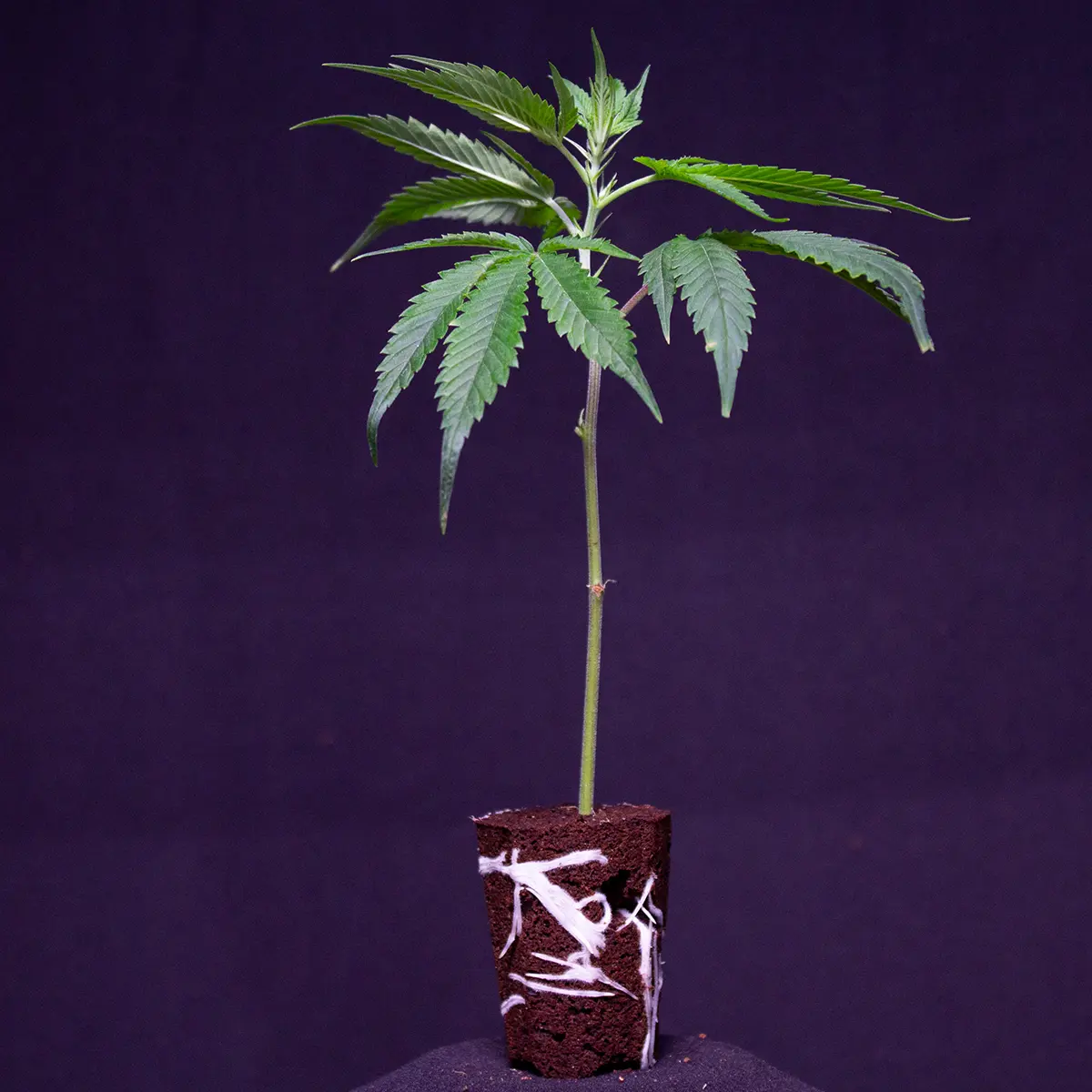
Many growers are unsure whether removing large fan leaves—defoliation—helps or harms the plants. In practice, it is often shown that cuttings react more sensitively to early or strong interventions than mature plants. Especially in the first weeks, your handling of the leaf mass determines whether a cutting develops stably or permanently lags behind its potential.
In this article, you will learn:
- when you should trim leaves,
- when you must absolutely avoid it,
- which techniques are useful,
- and how to train cuttings stress-free to achieve stable yields.
1. Basic Knowledge: What Function Do the Leaves of a Cutting Have?
Leaves are not decoration for cuttings but vital organs. They perform several central tasks:
- Photosynthesis – the plant produces energy and sugars, which not only drive above-ground growth but are also needed for the development of the root system.
- Root Development – especially in the first days and weeks, as cuttings must first develop their root system.
- Moisture Regulation – evaporation over the leaf surface, which is crucial for water balance and temperature management.
- Nutrient Storage – reserves for stress situations.
Without healthy, strong leaves, a cutting cannot grow stably or reach its full developmental potential. Therefore, it is important to understand when trimming is sensible—and when it harms the plant.
2. Should You Trim Leaves on Cuttings?
Recommendation: Trim leaves only rarely and very selectively.
Situations When You Should Not Trim
In the following phases, you should refrain from trimming leaves:
- directly after inserting the cutting,
- while the plant is forming roots,
- if the cutting appears visibly stressed (drooping leaves, light colors, dry edges),
- during additional stress such as repotting, strong pH fluctuations, or temperature shocks.
Any removal of leaf mass reduces the active photosynthesis area. A weakened cutting grows slower, recovers poorly from stress, and develops less stably overall.
3. When Is Trimming Leaves Sensible?
There are situations where careful trimming of leaves is sensible or at least justifiable:
- Too Dense Leaf Mass and Poor Air Circulation: When leaves lie closely together, moisture can accumulate, promoting mold.
- Leaves Touch the Soil or Pot Edge: This increases the risk of leaf rot and fungal infestation.
- Large Fan Leaves Block Light: If important shoots are permanently in the shade, growth can suffer.
- Targeted Defoliation as Part of Training Methods: In low-stress training forms, light defoliation can be supportive.
As a rough guideline: Remove only as many leaves as necessary and ideally not more than about 10–20% of the large fan leaves during the growth phase. Depending on genetics, light intensity, and plant condition, this value can vary.
4. Step-by-Step Guide: Trim Leaves Correctly
1. Observe the Plant
Before defoliating, check if your cutting:
- appears stable and strong,
- has already developed a good root system,
- shows even growth.
2. Remove Only Fan Leaves
Trim only large fan leaves. Small leaves in the shoot or flower area should not be removed during the growth phase, as they actively contribute to photosynthesis.
3. Use Clean Tools
Use a clean, sharp pair of scissors or a scalpel and disinfect the tool before trimming to avoid infections and fungal infestations.
4. Remove Only a Few Leaves at a Time
Especially with young cuttings, restraint is crucial. Remove only individual leaves that:
- lie on the substrate,
- completely cover other shoots,
- cause friction or heat build-up.
5. Plan Recovery Time
Give the plant a few days of rest after defoliation. Avoid repotting, strong training, or major changes in light, temperature, or nutrient supply during this time.
5. What Happens If You Trim Too Much?
Excessive defoliation can have significant disadvantages:
- slowed growth,
- reduced root volume,
- weaker development,
- drooping or discolored leaves,
- increased stress up to growth stops.
Cuttings are more sensitive than plants from seeds, as they initially rely on stored energy. Every unnecessary intervention increases the risk here.
6. Alternative to Defoliation: Tie Leaves Instead of Trimming (LST)
In many cases, it is better to tie leaves instead of trimming them. This method is called Low Stress Training (LST).
With this, you can:
- carefully tie leaves down or to the side,
- expose shoots without losing leaf mass,
- distribute light more evenly in the plant canopy.
The advantage: The plant retains its full photosynthesis area, is less stressed, and develops more evenly.
7. Differences Between Indica and Sativa-Dominant Cuttings
Not every cutting reacts the same to defoliation. Genetics play an important role:
Indica-Dominant Plants
- usually broad, large leaves,
- compact growth,
- often tolerate light defoliation better.
Sativa-Dominant Plants
- long, narrow leaves,
- taller growth and longer internodes,
- react more sensitively to strong interventions.
For many modern hybrid varieties: Light, targeted defoliation is possible, but in most cases, restraint is the better choice. Helpful is also the overview, how to find high-quality cannabis cuttings.
8. Frequently Asked Questions (FAQ)
Answers to more typical questions about care, climate, and growth can be found in our FAQ.
9. Trim Leaves Only If There Is a Clear Reason
In summary, the following applies to you:
- Leaves are central energy sources and should not be removed lightly.
- Defoliation is only sensible if there is a clear reason, such as mold risk or extremely dense leaf mass.
- Low Stress Training is often the better alternative.
- Young cuttings react particularly sensitively to stress.
The recommendations described here are based on practical experience, proven methods, and ongoing observation of current developments in plant care. If you want to delve deeper into the topic, you will find suitable specialist books and additional content in our selection of literature.
About the Author – Ben
Ben has been intensively involved in the cultivation and care of cuttings and the healthy development of plants during the growth phase for several years. His focus lies on low-stress training methods, stable growth conditions, and avoiding common care mistakes. The content is based on practical experience, proven methods, and real observations from daily work with young plants.
Expert contribution & updates: Hannah – Research, contextualization of current methods and observation of new developments.
More about the team behind LeafConnect