Why mold on cannabis is so dangerous
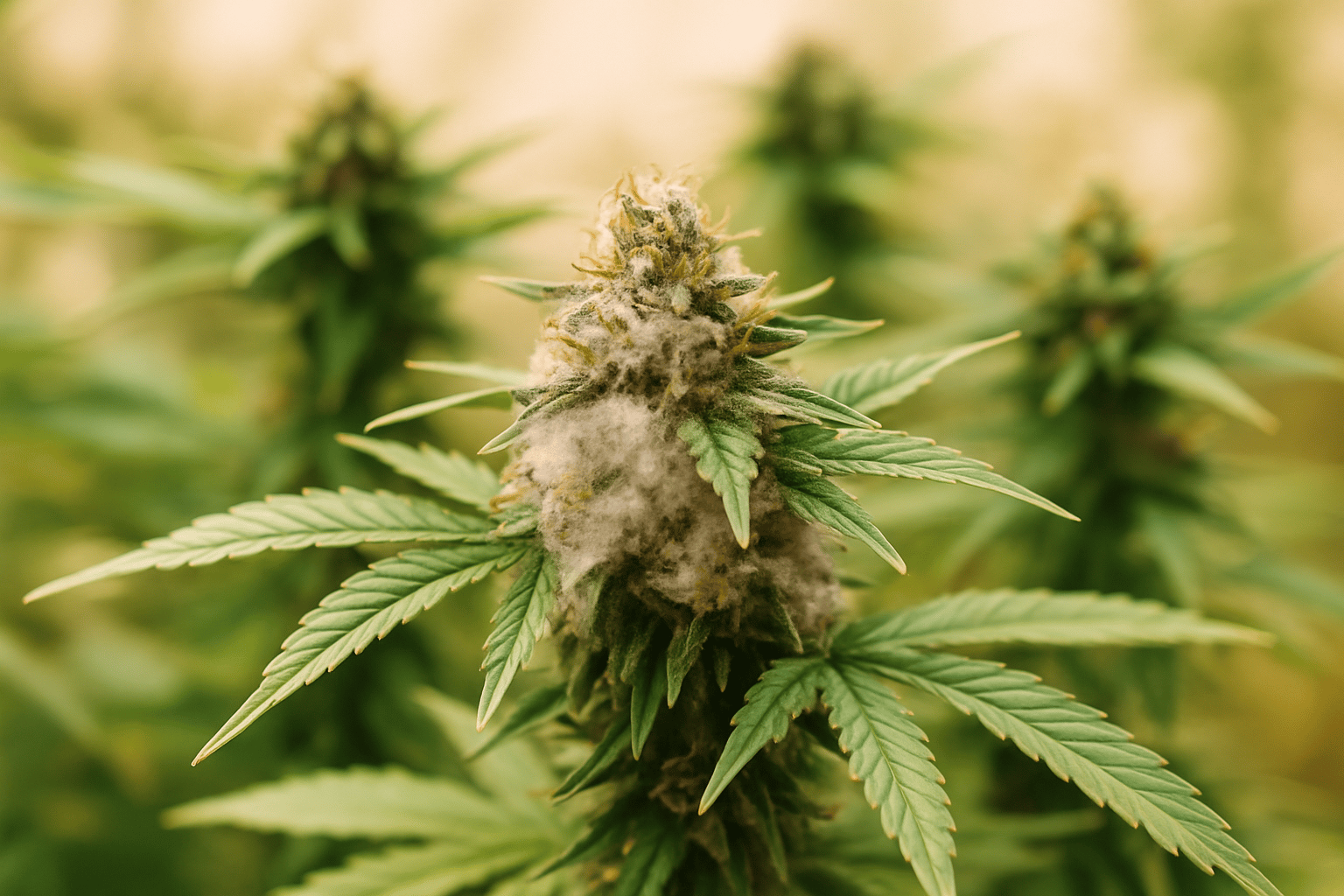
In cannabis cultivation, mold is not a cosmetic issue but a genuine destroyer of quality and health. When flowers or plant tissue are infected by fungi, the structure suffers first: the tissue becomes soft, damp, or brittle, and the flower loses density and resin quality. After that, the aroma usually deteriorates as well. Instead of clear terpene notes, infected material smells dull, musty, or like a damp basement. In our experience, this shift in smell is often the first clear warning sign, even before the infestation becomes widely visible.
What makes mold especially critical is that it does not only sit on the surface. Many growers believe a small infected area can simply be cut away and the rest is still usable. That is a common mistake. Fungal threads can extend deeper inside the flower than is visible from the outside. In compact, resin-rich colas, the risk is especially high because moisture can remain trapped inside for a long time. Anyone consuming infected buds is taking unnecessary health risks, especially when inhaling them.
Mold problems do not occur only during the classic outdoor autumn season. We see them just as often in indoor rooms with excessive humidity, poor air movement, or an overcrowded canopy. In greenhouses, the issue is also significant because daytime heat spikes and nighttime condensation can occur together. Anyone who manages their environment cleanly gains not only yield, but above all safety and final quality.
Which types of mold most commonly affect cannabis
When growers talk about “cannabis mold,” they usually mean several different fungal problems. The best known is Botrytis cinerea, also called gray mold or bud rot. This form primarily attacks dense flowers in the late flowering stage. From the outside, you often initially see only a single wilting sugar leaf that pulls out unusually easily. When the flower is opened, brown, gray, or mushy tissue appears inside. If you want to explore the topic in more depth, our article on Botrytis in cannabis covers the typical characteristics and control strategies in detail.
Powdery mildew is another common issue, especially as a white, powdery coating on leaves. True powdery mildew tends to sit dry on the surface, while downy mildew is more strongly associated with damp conditions and often causes patchy leaf damage. Beginners frequently confuse powdery mildew with dust, lime residue, or spray marks. The difference is that the coating spreads, returns after being wiped off, and often follows a typical pattern along the leaf surface.
Less common but still relevant are storage and drying molds after harvest. These do not primarily develop on living plants, but during drying or curing when flowers are hung too densely, the room air is too humid, or material is placed into jars too early. That is exactly why mold prevention does not end when the plant is cut down. It continues through storage. For post-harvest handling, our guide on curing cannabis is a useful addition, because the critical moisture windows are especially important there.
Typical causes: Why cannabis molds in the first place
At its core, mold needs three things: moisture, usable plant material, and time. Cannabis provides plenty of organic tissue, so in practice the climate is usually the deciding factor. It becomes especially risky when relative humidity remains too high during flowering. As a rough guideline, we have often seen problems in late flowering at 60 to 65 percent, especially when air movement is also limited. It is safer to work in the 40 to 50 percent range during the final weeks of flowering, depending on genetics, flower density, and temperature.
Temperature differences are also a major driver. When warm, humid air meets cooler surfaces, condensation forms. This often happens shortly before lights-on or lights-off, in greenhouses during cold nights, or outdoors after fog and dew. The flower may appear dry on the outside while moisture remains trapped inside for hours. In our experience, these microclimates are more dangerous than a single room reading, because hygrometers are rarely positioned directly in the densest flower zone.
Another trigger is overly dense plant material. Excessive nitrogen feeding, infrequent thinning, tightly spaced plants, and large fan leaves can block air channels. Watering mistakes also play a role. Anyone watering too late in the evening or keeping the substrate constantly wet increases evaporation within the crop and therefore humidity. You can find more on this in our articles on watering cannabis properly and defoliating cannabis, because both directly influence mold risk.
How to interpret early signs correctly
The most dangerous mold is often the one noticed too late. With Botrytis, the infection frequently begins inside the flower. From the outside, the cola may still look fine while tissue is already breaking down inside. A classic early sign is a sugar leaf that turns brown without resistance or comes loose with a gentle pull. Healthy sugar leaves stay firmly attached. If individual parts of the flower suddenly look duller or dry out unusually fast, a close inspection is worthwhile.
Smell is also a strong indicator. Healthy flowers smell sweet, fruity, gassy, spicy, or skunky depending on the cultivar. Mold shifts this profile toward musty, fungal, or hay-like damp notes. Experienced growers notice this quickly, especially in highly terpene-rich cultivars. If you are unsure, carefully break open individual suspect flowers and inspect the inside. Always work cleanly and do not shake the material unnecessarily in the room, so spores are not spread.
With powdery mildew, the warning signs are more visible. Small white dots on the upper leaf surface grow together into a flour-like film. Many growers wait too long at this stage because the plant still appears vigorous at first. The problem is that even if the infestation initially remains on the leaves, photosynthesis performance declines and the spore load in the room increases. The earlier you intervene, the better the chances of protecting the rest of the crop.
Risk zones by growing environment: indoor, greenhouse, and outdoor
Indoors, mold usually develops due to management errors. Too little exhaust, weak air circulation, poorly placed fans, overcrowded tents, and excessive nighttime humidity are the classic causes. A common misconception is that strong lighting alone guarantees a “dry climate.” That is only partly true during the day. At night, relative humidity often rises significantly because the temperature drops. If dehumidification or sufficient air movement is lacking, the moisture settles exactly where it does not belong: deep inside the flowers.
In the greenhouse, the situation is more complex. It can become very warm during the day, while the space cools down sharply at night. This fluctuation promotes condensation on plastic sheeting, glass, and plant surfaces. In our experience, only active control helps here: ventilate in time, provide shading during heat, use dry morning air, and never place plants too close together. Anyone growing under protection should also read the article growing cannabis in a greenhouse, because climate management and protective measures are closely tied to mold prevention there.
Outdoors, the final flowering stage is especially delicate. Long rainy periods, fog, cool nights, and heavy, compact buds are a problematic combination. Here, cultivar choice often makes the difference. Mold-resistant, fast-finishing genetics have clear advantages in Central Europe. In that context, we recommend our overview of mold-resistant outdoor strains. In humid regions, this is not a marketing detail, but often the difference between a clean harvest and total crop loss.
Prevention in practice: The most effective measures
The best mold control is a setup in which fungi never find favorable conditions in the first place. During the vegetative stage, humidity can be higher, but by early flowering at the latest, the climate should be run progressively drier. Good practical values are roughly 55 to 60 percent in early flowering and 40 to 50 percent in late flowering. At the same time, temperature should remain stable, ideally around 24 to 28 °C during the day, without major drops at night. Large temperature deltas drive relative humidity upward.
Air movement within the canopy is just as important. Fans should move leaves and flowers gently, but should not constantly blast individual tops with drying airflow. Direct continuous wind can cause stress, while dead zones with stagnant air encourage mold. We have had good results with several gentle airflows at different heights rather than a single powerful fan. What matters is that the lower and middle canopy also receive airflow.
Canopy management is often underestimated. Defoliation, pruning, and a clean plant structure are not just yield techniques, but hygiene measures. Anyone removing weak inner shoots and reducing excessive leaf mass improves light penetration and drying of the plant surface. The rule here is targeted rather than radical action. Excessive defoliation stresses the plant and can reduce growth. Clean cuts, sterile tools, and a clear plan matter more than overreacting.
| Area | Recommendation | Why it helps |
|---|---|---|
| Late flowering humidity | 40–50% RH | reduces the risk of Botrytis in dense buds |
| Daytime temperature | 24–28 °C | stable transpiration, less condensation |
| Nighttime drop | moderate, ideally 3–5 °C | prevents sharp humidity spikes |
| Air movement | gentle, multi-level | avoids stagnant moisture pockets |
| Plant spacing | do not place too tightly | better airflow through the canopy |
| Watering time | preferably at the start of the light cycle | excess moisture is removed during the day |
What to do in the event of an acute infestation
If you discover mold, speed matters. The first step is isolation. Infected plant parts should be removed carefully and taken out of the grow room immediately. Do not squeeze them, do not shake them out dry, and do not trim them next to healthy plants. In such cases, we work with gloves, disinfected scissors, and separate bags or containers. Afterward, tools, hands, and ideally contact surfaces should be cleaned so spores are not spread.
With Botrytis, the rule is to cut generously. Do not remove only the visibly brown area, but cut into healthy tissue with a safety margin. How large that margin should be depends on the severity of the infection, but cutting too narrowly is one of the most common mistakes. If a main cola is rotting inside, more is often affected than is visible from the outside. In our experience, honesty pays: better to sacrifice one more flower than contaminate the entire room.
After that, the cause must be corrected immediately. Lower humidity, optimize air circulation, thin the plants, remove wet areas, and monitor the crop closely. In cases of advanced flower infection, spray treatments are no longer a sensible solution, because residues, moisture, and quality loss can make the problem worse. Especially shortly before harvest, the priority should be damage control and product safety, not questionable rescue attempts.
Mold after harvest: Drying and storage without risk
A clean grow can be ruined by poor post-harvest handling. Many mold problems arise only in the drying room. Freshly harvested flowers release a great deal of moisture. If they are hung too densely, dried without sufficient air exchange, or kept in a room with more than 60 percent relative humidity, the risk rises significantly. Proven conditions are around 18 to 20 °C and 50 to 60 percent RH with gentle air circulation that does not blow directly onto the flowers.
A common beginner mistake is storing material in jars or containers too early because it already feels dry on the outside. Inside, however, residual moisture may still be high. Moisture then migrates from the flower core outward, creating a perfect microclimate for mold inside the sealed container. In our experience, patience matters more here than speed. Better to dry one day longer under controlled conditions than lose an entire batch to residual moisture.
Curing also requires discipline. Jars should be opened regularly at first, and every batch must be checked for smell, feel, and condensation. If a flower smells dull instead of aromatic, it should be inspected separately immediately. If you are unsure, do not compromise. Mold in storage is not something that “grows out” or improves with longer curing.
Genetics, plant structure, and cultivar choice as an underestimated lever
Not every cultivar molds at the same rate. Very dense, compact flowers with little air space are significantly more susceptible in humid environments than looser, better-ventilated structures. That does not mean compact cultivars are inherently bad, but they require more precise climate management. For outdoor growers in Germany, Austria, or similar climates, genetics are often the single most important prevention factor of all.
We have repeatedly seen robust, early-finishing cultivars with a more open flower structure come through cleanly under the same conditions, while late-finishing, extremely dense genetics collapse in the final two weeks. Especially if you regularly struggle with autumn rain, fog, or dew-soaked mornings, you should choose cultivars strategically and not base the decision only on THC percentage or yield promises.
Clone quality also plays a role. Weak or stressed plants react more sensitively to environmental stress and often develop an uneven canopy in which moisture pockets form more easily. Anyone working with clones should rely on healthy, vigorous mother stock. Our guide on successfully growing cannabis clones shows how important a clean start is for the entire crop cycle.
Common misconceptions we keep seeing in practice
The first misconception is: “A little mold is not a big deal, I’ll just cut it away.” That is risky. Visible infection is often only the part you can recognize. Especially in flowers, contamination can extend deeper. The second misconception: “More resin automatically means more protection.” Resin does not make flowers immune. On the contrary, very dense, mature buds with a lot of biomass are often especially attractive to Botrytis when moisture remains trapped.
The third misconception concerns home remedies. Milk, baking soda, hydrogen peroxide, or various sprays are often recommended online in blanket terms. During the vegetative stage, some measures may be useful under certain conditions, but caution is essential during flowering. Anything that adds extra moisture to the flowers or leaves residues behind can make matters worse. We therefore recommend managing late flowering problems primarily through hygiene, removal of infected parts, and climate correction.
Another mistake is focusing only on the hygrometer reading in the middle of the tent. What matters is the microclimate in the densest parts of the crop. Humidity there can be significantly higher than at the sensor. Anyone dealing with repeated problems should place sensors at flower height, log nighttime conditions, and critically assess airflow patterns. It often becomes clear that the room is not generally too humid, but that individual dead zones are causing the issue.
When material should be discarded
With visible flower mold, infected material should generally not be consumed. This applies especially to anything intended for inhalation. Even though some growers try to extract from problematic buds or “save” them in other ways, this is not good practice from a safety standpoint. Mold and possible mycotoxins are not an area for improvisation. If you have doubts, treat the material as unusable.
With mild powdery mildew on leaves in earlier stages, it may still be possible to intervene and save the crop if you act quickly and flowering is not yet far advanced. However, with severe infestation, advanced Botrytis, or recurring problems in the same room, a hard reset is often necessary: remove material, clean the room thoroughly, check filters, disinfect tools, and plan the next run more cleanly.
Professional help or laboratory analysis can be useful if larger batches are affected, if you supply medically sensitive users, or if you experience repeated unexplained losses despite good climate values. Sometimes the cause lies deeper, such as structural moisture issues, hidden condensation zones, or permanently contaminated infrastructure.
Sources
- United States Department of Agriculture – “Botrytis cinerea”, 2023
- Royal Horticultural Society – “Grey mould (Botrytis)", 2024
- Penn State Extension – “Powdery Mildew Management in Greenhouse Crops”, 2022
- University of California Agriculture and Natural Resources – “Botrytis Blight”, 2021

About the Author – Ben
Ben has been intensively involved in the cultivation and care of cuttings and the healthy development of plants during the growth phase for several years. His focus lies on low-stress training methods, stable growth conditions, and avoiding common care mistakes. The content is based on practical experience, proven methods, and real observations from daily work with young plants.
Expert contribution & updates: Hannah – Research, contextualization of current methods and observation of new developments.
This article was created with AI support and editorially reviewed.
More about the team behind LeafConnect