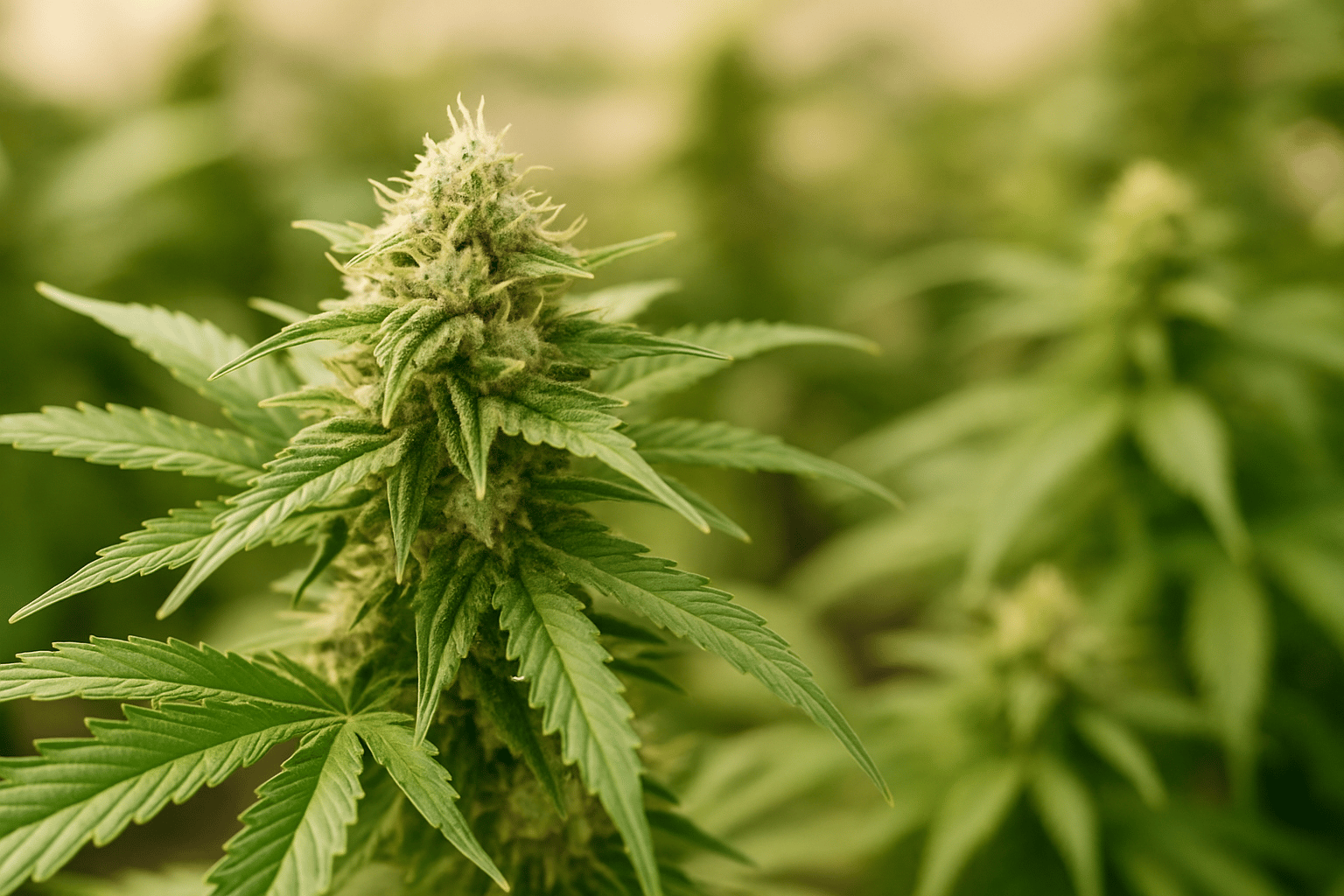
What Decarboxylation Really Means for Cannabis
Raw cannabis contains cannabinoids predominantly in their acidic form, especially THCA and CBDA. These precursors occur naturally in the plant and are not the same as the actively effective THC and CBD. Only heat removes a carboxyl group, releasing carbon dioxide in the process. That exact process is called decarboxylation. In practice, this means: if you simply add flowers to butter, oil, or batter without heating them properly first, you give away a large part of the desired effect.
Many people confuse decarboxylation with drying or fermentation. However, these are different processes. Drying primarily reduces water content, while curing further develops aroma, smoking behavior, and sensory quality. If you want to dive deeper into post-harvest handling, our article on fermenting cannabis is also worth reading. In our experience, this confusion is one of the most common reasons homemade edibles turn out either too weak, uneven, or unnecessarily grassy in flavor.
Decarboxylation also occurs during smoking or vaporizing, but directly at the moment of consumption. For edibles, tinctures, capsules, or topical applications, you need to control it deliberately beforehand. If you do it properly, you not only get more effect from the material, but also a much more predictable dosage. That is especially crucial with potent strains.
Why Temperature and Time Matter More Than “Just Baking It”
Decarboxylation is not a switch, but a temperature-time process. Too little heat or too short a duration leaves part of the THCA and CBDA unactivated. Temperatures that are too high or heating for too long degrade cannabinoids and volatile terpenes. With THC, there is also the added issue that under unfavorable handling it can partially oxidize further into CBN. This often leads to a heavier, sleepier effect and less clarity in the experience.
In our experience, most mistakes happen in standard household ovens because many units fluctuate far more in reality than the display suggests. A setting of 115 °C may actually swing between 100 and 130 °C. That often does not matter for baked goods, but it does for cannabinoids. That is why we always recommend a separate oven thermometer. Anyone who processes regularly quickly notices that stable temperature matters more than supposedly sophisticated recipes.
Another point is the amount of material. Small, evenly broken-up batches decarboxylate more reliably than thick, dense clumps of flower. The material should not be ground too finely. If cannabis is pulverized, the surface area increases significantly, which can promote terpene loss and make later filtering more difficult. A coarse, airy grind or careful hand-breaking is better.
| Goal | Temperature | Duration | Practical Note |
|---|---|---|---|
| Gentle THC activation | 105–115 °C | 35–50 minutes | Good balance between activation and terpene protection |
| CBD-rich flowers | 110–120 °C | 45–70 minutes | CBD strains often need a little more time |
| Fast but riskier method | 120–130 °C | 20–30 minutes | Higher risk of aroma and active compound loss |
These values are not rigid mathematics, but practical working ranges. Strain, moisture level, flower density, and oven accuracy always play a role. We have seen very good results with 110 °C for about 40 minutes for THC-dominant flowers. With CBD-rich material, 115 °C for 50 to 60 minutes often works especially reliably.
The Best Oven Method: Clean, Controlled, and Reproducible
For most home growers and processors, the oven is the most practical method. What matters is not only the temperature, but also the preparation. Use material that is as dry as possible, but properly cured. Freshly harvested or still overly moist flowers decarboxylate unevenly because a lot of energy first goes into the residual moisture. If you want to work cleanly on harvest timing and post-harvest handling, our articles on harvesting cannabis and understanding cannabis odor are also relevant, because moisture, maturity, and storage directly affect later processing.
This is how we do it in practice: break the flowers up coarsely, place them on a baking tray lined with parchment paper or, even better, in a shallow oven-safe glass dish, and spread them out loosely. Do not stack them and do not compress them. Then preheat the oven fully and only put the material in afterward. If you want to reduce odor and preserve terpenes a little better, you can cover the dish with a suitable lid or loosely with aluminum foil. However, it should not be completely airtight in the oven.
- Preheat the oven to 110 °C top/bottom heat.
- Break up the cannabis coarsely and spread it evenly.
- Heat for 35 to 45 minutes, depending on the strain and moisture level.
- After about half the time, gently turn or loosen the material.
- Let it cool, then process further or store airtight.
How can you tell whether the batch turned out well? The material usually becomes a bit drier, more crumbly, and slightly golden-brown to light brown in color. Dark brown is usually already too much. If it smells distinctly burnt or sharply toasted, the temperature was too high or the batch stayed in the oven too long. A pleasantly warm, nutty-herbal aroma, on the other hand, is a good sign.
THC, CBD, and Terpenes: How Heat Changes the Profile
Decarboxylation does not just activate cannabinoids, it also changes the flower’s entire chemical profile. Terpenes such as myrcene, limonene, or pinene are significantly more volatile than cannabinoids. That means: the hotter and more openly you work, the more aroma is lost. This is not just a matter of taste. Terpenes also influence the subjective effect profile. Anyone processing highly aromatic flowers will often notice the difference clearly between a gentle and an aggressive decarb.
A common misconception is that maximum temperature automatically delivers maximum potency. In reality, overall quality often declines when people try to speed up the process with 140 °C or more. In practice, we have repeatedly seen that such batches are still effective, but smell flatter, taste harsher, and feel less nuanced. For high-quality starting flowers, patience is almost always worth it.
Genetics also play a role. Resin-rich, terpene-intense strains react more sensitively to heat stress than more neutral flowers. If you want to start with the right genetics from the outset, LeafConnect offers both THC seeds and CBD clones for different use goals. Especially with CBD-heavy strains for oils or capsules, processing should be particularly controlled, because users often value consistent, everyday-friendly effects.
How to Adjust Decarboxylation Properly for Edibles, Butter, and Oil
If you want to make cannabutter, MCT oil, olive oil, or coconut oil, decarboxylation should ideally be a separate step before fat infusion. Some recipes combine both, meaning long heating of cannabis directly in the fat. That can work, but it is much harder to reproduce consistently. In our experience, dosing is cleaner when you decarboxylate first and extract afterward.
For butter and classic edibles, full or nearly full THC activation is usually sufficient. During the later fat infusion, you should then work more in the range of about 70 to 90 °C, meaning below strong cooking temperatures. This reduces additional degradation losses. If you specifically want to make butter, you can also find our matching article on making cannabutter yourself.
Homogenization is also important. Even perfectly decarboxylated cannabis is of little use if the active compounds are distributed unevenly in the final product. With brownies or cookies in particular, we often see the problem that the fat base was not stirred in thoroughly enough. The result is pieces with a strong effect next to others that do almost nothing. So always prepare the active fat base properly first, then incorporate it very thoroughly into the full mixture.
Practical Example for Predictable Processing
Let’s say you process 10 g of flowers with 18 % THCA. Theoretically, that corresponds to 1,800 mg THCA. Due to conversion into THC and unavoidable losses, the actually usable amount is lower. As a rough practical estimate, you can calculate with about 75 to 85 % of the theoretical maximum, depending on process quality. That means your batch could end up at roughly 1,200 to 1,450 mg of active THC. If you divide that into 40 equal portions, one portion would roughly contain 30 to 36 mg THC. For beginners, that is already far too high.
This is exactly where it becomes clear why decarboxylation and dosing belong together. Anyone who underestimates the effect of edibles often experiences unpleasant overdosing with delayed onset. For cautious dosing approaches, our article A cautious start: the perfect THC level for beginners is worth reading. In practice, we always recommend starting with very small amounts when potency is unknown and waiting at least 2 hours before taking more.
Common Decarboxylation Mistakes and How to Avoid Them
Mistake 1: Temperature too high. This is the classic one. Many people think 140 or 150 °C is more efficient. In reality, this greatly increases the risk of cannabinoid degradation and terpene loss. A controlled range around 105 to 115 °C is better.
Mistake 2: Uneven material size. If one part of the batch consists of dense flower chunks and the other of nearly pulverized material, the result will inevitably be inconsistent. Coarsely but evenly breaking it up is the better approach.
Mistake 3: Fresh or poorly dried material. Too much residual moisture slows the process and promotes uneven activation. If you are still working on the basics in cultivation, you should also take topics such as the cannabis flowering stage and post-harvest quality seriously, because good processing always starts with good starting material.
Mistake 4: No thermometer. We would never rely on the oven display alone. A simple oven thermometer costs little, but improves reproducibility enormously.
Mistake 5: Batches that are too large at once. A fully loaded deep tray often leads to heat buildup and uneven results. It is better to work flat and in smaller quantities. Especially with high-quality flowers, that is the safer strategy.
Mistake 6: Wrong expectations about color. Some people wait for strong browning as “proof” that it worked. That is a misconception. Good decarb batches often stay relatively light and smell clean, not burnt.
Alternative Methods: Comparing Sous-Vide, Glass, and Devices
Besides the oven, there are alternative methods. Sous-vide is interesting because the temperature can be kept very stable. In this method, the cannabis is vacuum-sealed or very well enclosed and heated in a water bath. The advantage is precision; the disadvantage is the greater effort and the question of how heat-stable and food-safe the material used really is. In addition, heat transfer is slower, so the times can be longer.
Another approach is decarboxylating in a closed glass jar in the oven. This can reduce odor and preserve terpenes a little better. It is important to use only heat-resistant jars, handle temperature changes carefully, and not fill the jar to the brim. We have achieved good results with this method when the jar was filled loosely and not moved abruptly during cooling. There is still some residual risk with glass, so you should work very carefully.
Special decarb devices can make sense if you process regularly and odor control, precision, and convenience play a major role. However, they are not essential. A properly calibrated oven with a thermometer delivers results in many cases that are absolutely usable at a professional level. What matters less is the gadget and more the discipline of the process.
Storage After Decarboxylation and What to Watch for in Terms of Safety
After decarboxylation, the material is more sensitive to oxygen, light, heat, and moisture. It should therefore be stored as airtight, dark, and cool as possible after it has fully cooled. Amber glass or well-sealing storage containers work well. Frequent opening accelerates aroma loss. If you are not processing it immediately, a smaller container size is better than one large container that is constantly being opened.
With edibles, safety comes first. Even experienced consumers sometimes underestimate the delayed effect. In addition, homemade products often look harmless. Therefore, always label them clearly, store them childproof, and never keep them unlabeled in the normal food area. This is especially important in households with children or guests.
If you are planning medically relevant applications or need very precise dosing, home processing eventually reaches its limits. In that case, professional analytics or medical consultation makes sense. This applies especially to very sensitive individuals, interactions with medications, or when reproducible milligram doses are crucial. Home methods can do a lot, but they do not replace laboratory analysis.
Sources
- National Center for Biotechnology Information – “Decarboxylation of Acidic Cannabinoids: A Comparative Kinetic Study”, 2016
- United Nations Office on Drugs and Crime – “Recommended Methods for the Identification and Analysis of Cannabis and Cannabis Products”, 2022
- European Monitoring Centre for Drugs and Drug Addiction – “Cannabis: Health and Social Responses”, 2023
- Federal Centre for Health Education – “Cannabis: Effects and Risks”, 2023

About the Author – Hannah
Hannah focuses on researching, contextualizing, and observing current developments in plant care and modern cultivation techniques. Her focus lies on new methods, optimizing growth conditions, and making complex topics accessible. Her content complements practical experience with analysis, updates, and a keen eye on emerging trends.
Content is regularly reviewed and updated.
This article was created with AI support and editorially reviewed.
More about the team behind LeafConnect