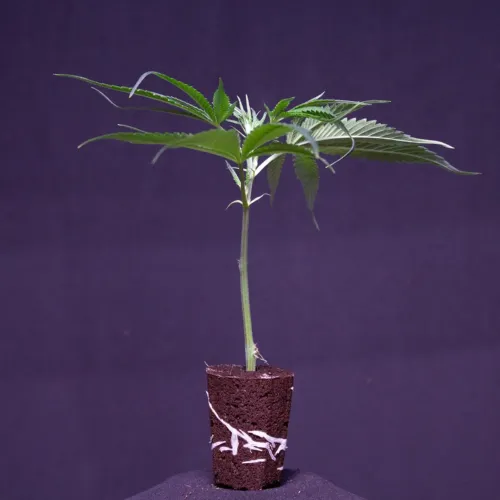
Do you need to cut the leaves off THC cuttings while they are growing?
Do you need to cut the leaves off THC cuttings while they are growing?
Introduction
Anyone working with THC cuttings will sooner or later ask themselves the question:
Do I need to cut the leaves off my cutting while it’s growing?
Many growers are unsure whether removing large fan leaves, i.e. defoliation,
which helps or harms the plants. In this article we explain:
- when to cut leaves
- when it is absolutely necessary to avoid it,
- which techniques are available,
- and how to train cuttings without stress to achieve maximum yields.
1. Basic knowledge: What function do the leaves of a cutting have?
Leaves are not decoration for THC cuttings, but vital organs.
They are responsible for, among other things:
- Photosynthesis – the plant produces energy and sugar,
- Root development – especially in the first days and weeks,
- Moisture regulation – evaporation via the leaf surface,
- Nutrient storage – reserves for stressful situations.
Without healthy, strong leaves, a THC cutting cannot grow stably or reach its full potential.
To develop yield potential, it is therefore crucial to understand when to prune.
when it is beneficial and when it is more likely to harm the plant.
2. Should you cut leaves from THC cuttings?
Recommendation: Only rarely and very selectively.
Situations in which you shouldn’t cut
During the following phases, you should refrain from cutting leaves from THC cuttings:
- immediately after inserting the cutting,
- while the plant forms roots,
- if the cutting appears visibly stressed (drooping leaves, pale colors, dry edges),
- during additional stress such as repotting, strong pH fluctuations or temperature shocks.
Any removal of leaf mass means a loss of energy. A weakened cutting grows more slowly.
It recovers less well from stress and in many cases produces less yield.
3. When is it advisable to cut leaves?
There are some situations where carefully cutting leaves from THC cuttings is advisable.
sensible or at least justifiable:
-
Excessively dense leaf mass and poor air circulation:
When leaves are lying close together, moisture can build up, which promotes mold growth. -
Leaves lie on the soil or touch the edge of the pot:
This increases the risk of leaf rot and fungal infestation. -
Large fan leaves block a lot of light:
If important shoots are completely shaded, growth can suffer. -
Targeted defoliation as part of training methods:
Techniques such as Low Stress Training (LST) or certain high-stress methods
Light defoliation can be beneficial.
As a rule of thumb: Remove only as many leaves as necessary and during the growth phase.
Ideally, no more than about 10–20 percent of the large fan pages. Anything beyond that.
This significantly increases the risk of stress.
4. Step-by-step instructions: How to cut leaves correctly
1. Observe the plant
Before defoliating any cutting, you should check if the THC cutting:
- appears stable and strong
- has already developed a good root system
- shows even growth.
2. Remove only fan leaves
Remove only large fan leaves. Do not remove small leaves in the flower or shoot area.
Sugar leaves should not be cut during the growth phase. They actively contribute to…
Photosynthesis is involved and is particularly valuable during this phase.
3. Use clean tools
Always use clean, sharp scissors or a scalpel and disinfect the tool.
Apply alcohol before defoliation. This reduces the risk of infections and fungal growth.
4. Remove only a few leaves at a time.
Especially with young THC cuttings, you should proceed with caution. Remove only individual leaves:
- which lie on the substrate,
- which completely cover other shoots,
- or causing problems such as friction or heat buildup.
5. Plan for recovery time
After defoliation, the plant should be left to rest for a few days. During this time, avoid:
- Repotting,
- intensive training measures
- major changes in light, temperature or nutrient addition.
This allows the cutting to better process the procedure and develop stably.
5. What happens if you cut too much?
Excessive defoliation can have significant disadvantages for THC cuttings:
- slowed growth,
- smaller root volume,
- reduced yield,
- Increased drooping or discolored leaves,
- Increased stress, which temporarily stops growth.
Cuttings are generally more sensitive than plants grown from seed, as they are without a complete foundation from the start.
The root system starts up and relies on stored energy. Any unnecessary interference with the leaf mass
This increases the risk.
6. Alternative to defoliation: Tie leaves instead of cutting them (LST)
In many cases, it is better to tie leaves rather than cut them. This method falls under
Low Stress Training (LST) .
Instead of removing large fan leaves, you can:
- Carefully tie the leaves downwards or to the side,
- Expose shoots without losing leaf mass,
- Distribute light more evenly throughout the entire canopy.
The advantage: The plant retains its full photosynthetic surface, is less stressed, and the yield potential is increased.
remains intact, while growth becomes more controlled and even.
7. Differences between Indica and Sativa dominant THC cuttings
Not every THC cutting reacts the same way to defoliation. Genetics plays an important role:
Indica-dominant cuttings
- mostly broad, large leaves,
- compact growth,
- They usually tolerate light defoliation somewhat better.
Sativa-dominant cuttings
- long, narrow leaves,
- taller growth and longer internodes,
- They often react more sensitively to stress and major interventions.
For many modern varieties offered as THC cuttings (for example, hybrid varieties)
such as California Indi, Gelato or Amnesia types), the following applies:
Light, targeted defoliation is possible, but in most cases restraint is better.
8. Frequently Asked Questions (FAQ) about defoliating THC cuttings
When is the best time to cut leaves?
The most suitable time is during the middle growth phase, typically around week three to five.
when the cutting is already well rooted and actively growing. Immediately after planting or when visible
Weakened plants should not be cut.
Can you cut leaves to prevent mold?
Yes, in justified cases, removing individual leaves can help improve air circulation and
To reduce the risk of mold. Nevertheless, the first step should always be to optimize the climate, for example.
through better ventilation, air movement or adjusted humidity.
Does defoliation harm the yield?
If applied incorrectly, defoliation can significantly reduce yield, as the plant lacks important energy sources.
However, when used carefully and selectively, it can help distribute light more efficiently in some setups.
and thus positively influence the development of the inflorescences.
Should you trim the leaves when planting cuttings?
Previously, it was often recommended to trim the leaf tips in the shape of a crescent moon to reduce evaporation.
With modern, healthy THC cuttings, this is no longer necessary in most cases and is rarely done today.
Recommended. Good climate control and careful irrigation are more important here.
9. Conclusion: Only cut leaves if there is a clear reason.
In summary, for THC cuttings:
- Leaves are energy sources and should not be removed lightly.
- Defoliation is only useful if there is a clear reason, such as risk of mold or extremely dense leaf mass.
- Low Stress Training (LST) is in many cases the better alternative to cutting leaves.
- Young cuttings are particularly sensitive and react more strongly to stress than established plants.
Those who carefully tend to their THC cuttings, work gently, and only intervene in the leaf structure when necessary,
If it is truly necessary, it creates the basis for healthy plants and stable yields.